Review
. 2014 Jun 26;4(8):a022459.
doi: 10.1101/cshperspect.a022459.

Interaction of Mycobacterium tuberculosis with host cell death pathways

Affiliations
Review

Interaction of Mycobacterium tuberculosis with host cell death pathways

Lalitha Srinivasan et al. Cold Spring Harb Perspect Med. .

Abstract

Mycobacterium tuberculosis (Mtb) has coevolved with humans for tens of thousands of years. It is thus highly adapted to its human host and has evolved multiple mechanisms to manipulate host immune responses to its advantage. One central host pathogen interaction modality is host cell death pathways. Host cell apoptosis is associated with a protective response to Mtb infection, whereas a necrotic response favors the pathogen. Consistently, Mtb inhibits host cell apoptosis signaling but promotes induction of programmed necrosis. The molecular mechanisms involved in Mtb-mediated host cell death manipulation, the consequences for host immunity, and the potential for therapeutic and preventive approaches will be discussed.


Figures

Figure 1.
Figure 1.
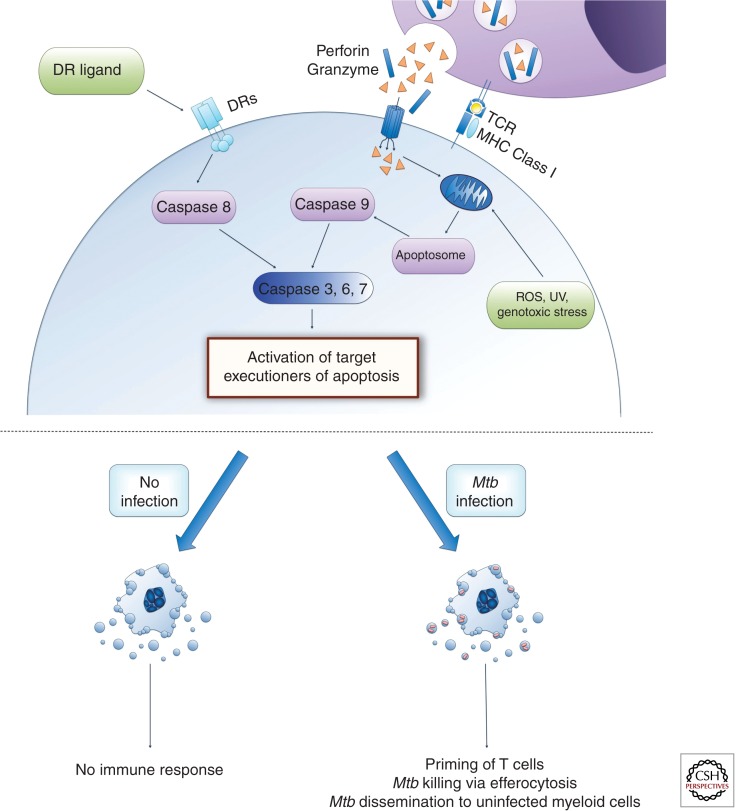
Host cell apoptosis pathways are classified into two main categories—extrinsic and intrinsic pathways. The extrinsic pathway of cell death is triggered by the interaction of death receptors (DRs) with specific death ligands and involves activation of caspase 8. Intrinsic pathways are triggered by stimuli that target mitochondria and result in release of cytochrome c, which participates in apoptosome formation, a platform for caspase 9 activation. In addition, CD8+ T cells engage the extrinsic pathway via the Fas death receptor and the intrinsic pathway via perforin/granzyme secretion. Caspase 8 and 9 activate downstream effector caspases (caspase 3, 6, and 7), which leads to the characteristic features of apoptotic cells via activation of multiple targets. Apoptosis is immunologically silent as cellular material is enclosed within apoptotic bodies. Apoptosis of Mtb-infected cells results in packaging of mycobacterial antigens within apoptotic bodies that, when phagocytosed by dendritic cells, allow for antigen presentation to CD8+ T cells via cross-presentation and the induction of a robust adaptive immune response. Additionally, uptake of dying apoptotic cells by healthy macrophages or neutrophils (efferocytosis) leads to killing of bacteria. However, Mtb-mediated apoptosis induction was also reported to help in dissemination of bacteria during early phase of infection.
Figure 2.
Figure 2.
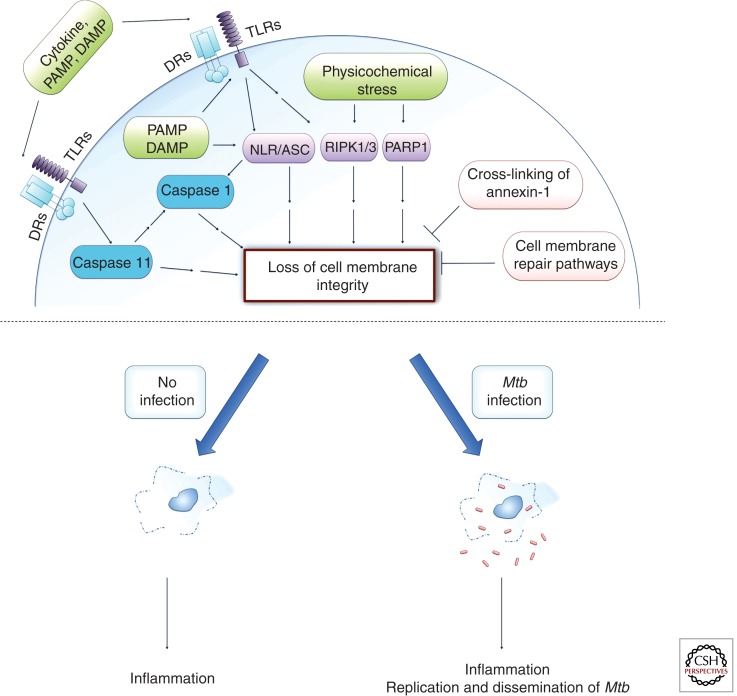
Necroptosis and pyroptosis both lead to the loss of cell membrane integrity. Necroptosis can be initiated by extracellular ligands interacting with their cognate cell surface receptors (DRs, death receptors; TLR, Toll-like receptors) or by varied intracellular stress signals (physicochemical stress). One pathway involves activation of RIPK1 and RIPK3, which leads to mitochondrial malfunction. Intracellular stress can also activate PARP1, which can signal for mitochondrial dysfunction potentially involving RIPK1 (sometimes referred to as the parthanatos death pathway). The inflammasome (NLR/ASC) may signal directly for necroptosis induction or indirectly via caspase 1 leading to pyroptosis, which also results in cell lysis but induces DNA degradation similar to apoptotic cell death. Caspase 11 can signal directly for a pyroptosis-like cell death or indirectly via NLR/ASC to activate caspase 1–dependent pyroptosis signaling. The cell may attempt to inhibit cell membrane lysis either by recruitment of lysosomal membranes to the cell surface to repair the cell membrane or by cross-linking annexin-1 on the cell surface and thus leading to formation of a stable apoptotic envelope. Necrotic cell death is inflammatory as it leads to spilling of the intracellular contents into the extracellular milieu. Mtb has been associated with both the induction of necrosis pathways and the inhibition of the inhibitory mechanisms. Programmed necrosis of Mtb-infected host cells leads to bacterial escape, whereas the associated inflammatory response recruits new host cells for extracellular Mtb to infect and replicate in, thus leading to dissemination of infection.

References

    1. Aachoui Y, Sagulenko V, Miao EA, Stacey KJ 2013. Inflammasome-mediated pyroptotic and apoptotic cell death, and defense against infection. Curr Opin Microbiol 16: 319–326 - PMC - PubMed
    1. Abdallah AM, Verboom T, Hannes F, Safi M, Strong M, Eisenberg D, Musters RJ, Vandenbroucke-Grauls CM, Appelmelk BJ, Luirink J, et al. 2006. A specific secretion system mediates PPE41 transport in pathogenic mycobacteria. Mol Microbiol 62: 667–679 - PubMed
    1. Abdallah AM, Gey van Pittius NC, Champion PA, Cox J, Luirink J, Vandenbroucke-Grauls CM, Appelmelk BJ, Bitter W 2007. Type VII secretion--mycobacteria show the way. Nat Rev Microbiol 5: 883–891 - PubMed
    1. Abdallah AM, Verboom T, Weerdenburg EM, Gey van Pittius NC, Mahasha PW, Jimenez C, Parra M, Cadieux N, Brennan MJ, Appelmelk BJ, et al. 2009. PPE and PE_PGRS proteins of Mycobacterium marinum are transported via the type VII secretion system ESX-5. Mol Microbiol 73: 329–340 - PubMed
    1. Abdallah AM, Bestebroer J, Savage ND, de Punder K, van Zon M, Wilson L, Korbee CJ, van der Sar AM, Ottenhoff TH, van der Wel NN, et al. 2011. Mycobacterial secretion systems ESX-1 and ESX-5 play distinct roles in host cell death and inflammasome activation. J Immunol 187: 4744–4753 - PubMed

Publication types

MeSH terms

LinkOut - more resources