


Postischemic reperfusion causes smooth muscle calcium sensitization and vasoconstriction of parenchymal arterioles
- PMID: 24968928
- PMCID: PMC4144269
- DOI: 10.1161/STROKEAHA.114.005888
Postischemic reperfusion causes smooth muscle calcium sensitization and vasoconstriction of parenchymal arterioles
Abstract
Background and purpose: Parenchymal arterioles (PAs) are high-resistance vessels in the brain that connect pial vessels to the microcirculation. We previously showed that PAs have increased vasoconstriction after ischemia and reperfusion that could increase perfusion deficit. Here, we investigated underlying mechanisms by which early postischemic reperfusion causes increased vasoconstriction of PAs.
Methods: Isolated and pressurized PAs from within the middle cerebral artery territory were studied in male Wistar rats that were either nonischemic control (n=34) or after exposure to transient middle cerebral artery occlusion (MCAO) by filament occlusion for 2 hours with 30 minutes of reperfusion (MCAO; n=38). The relationships among pressure-induced tone, smooth muscle calcium (using Fura 2), and membrane potential were determined. Sensitivity of the contractile apparatus to calcium was measured in permeabilized arterioles using Staphylococcus aureus α-toxin. Reactivity to inhibition of transient receptor potential melastanin receptor type 4 (9-phenanthrol), Rho kinase (Y27632), and protein kinase C (Gö6976) was also measured.
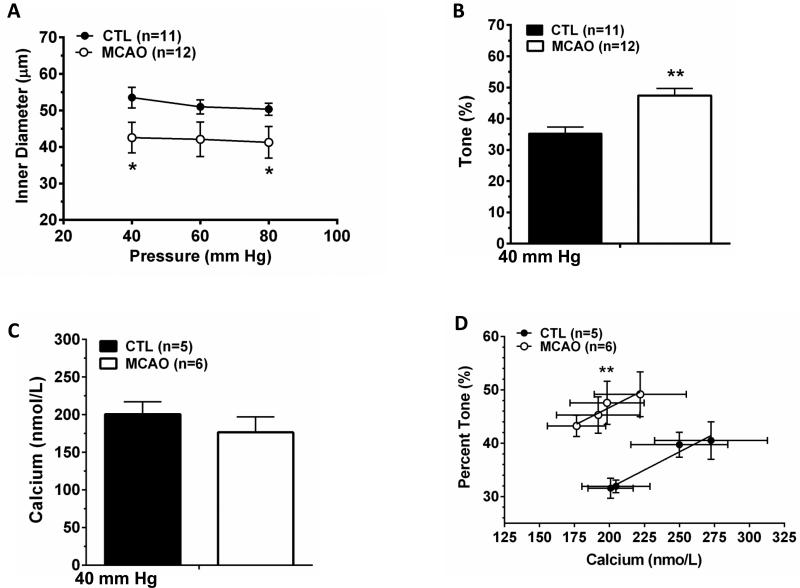
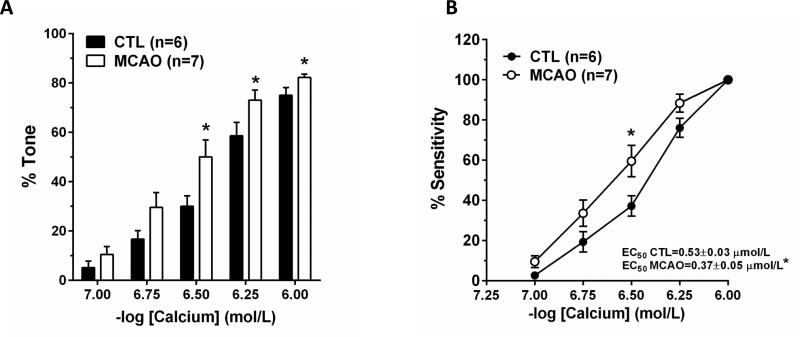
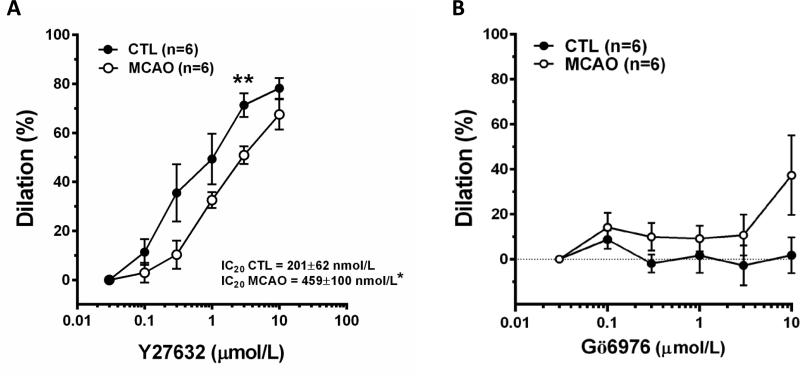
Results: After MCAO, PAs had increased myogenic tone compared with controls (47±2% versus 35±2% at 40 mm Hg; P<0.01), without an increase in smooth muscle calcium (177±21 versus 201±16 nmol/L; P>0.05) or membrane depolarization (-38±4 versus -36±1 mV; P>0.05). In α-toxin-permeabilized vessels, MCAO caused increased sensitivity of the contractile apparatus to calcium. MCAO did not affect dilation to transient receptor potential melastanin receptor type 4 or protein kinase C inhibition but diminished dilation to Rho kinase inhibition.
Conclusions: The increased vasoconstriction of PAs during early postischemic reperfusion seems to be due to calcium sensitization of smooth muscle and could contribute to infarct expansion and limit neuroprotective agents from reaching their target tissue.
Keywords: arterioles; brain infarction; calcium; no-reflow phenomenon; smooth muscle.
© 2014 American Heart Association, Inc.
Figures

References
-
- Ahmed N, Wahlgren N, Grond M, Hennerici M, Lees KR, Mikulik R, et al. SITS investigators. Implementation and outcome of thrombolysis with alteplase 3-4.5 h after an acute stroke: an updated analysis from SITS-ISTR. Lancet Neurol. 2010;9:866–874. - PubMed
-
- The National Institute of Neurological Disorders and Stroke rt-PA Stroke Study Group Tissue plasminogen activator for acute ischemic stroke. N Engl J Med. 1995;333:1581–1587. - PubMed
-
- Donnan GA, Davis SM, Parsons MW, Ma H, Dewey HM, Howells DW. How to make better use of thrombolytic therapy in acute ischemic stroke. Nat Rev Neurol. 2011;7:400–409. - PubMed
-
- Busch E, Kruger K, Allegrini PR, Kerskens CM, Gyngell ML, Hoehn-Berlage M, et al. Reperfusion after thrombolytic therapy of embolic stroke in the rat: magnetic resonance and biochemical imaging. J Cereb Blood Flow Metab. 1998;18:407–418. - PubMed
Publication types
MeSH terms
Substances
Grants and funding
LinkOut - more resources
Full Text Sources
Other Literature Sources
