


CAREX Canada: an enhanced model for assessing occupational carcinogen exposure
- PMID: 24969047
- PMCID: PMC4283677
- DOI: 10.1136/oemed-2014-102286
CAREX Canada: an enhanced model for assessing occupational carcinogen exposure
Abstract
Objectives: To estimate the numbers of workers exposed to known and suspected occupational carcinogens in Canada, building on the methods of CARcinogen EXposure (CAREX) projects in the European Union (EU).
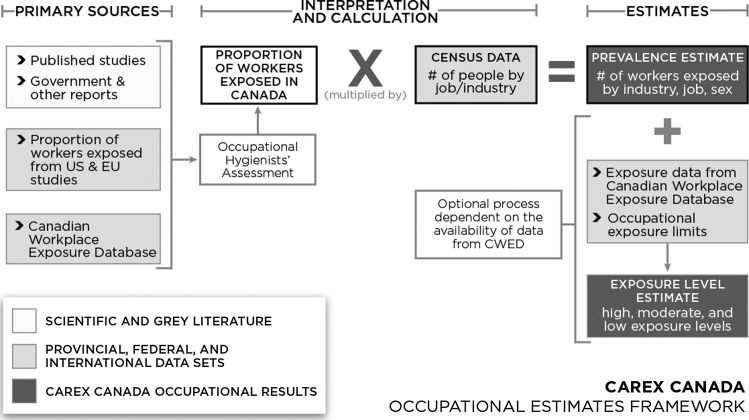
Methods: CAREX Canada consists of estimates of the prevalence and level of exposure to occupational carcinogens. CAREX Canada includes occupational agents evaluated by the International Agency for Research on Cancer as known, probable or possible human carcinogens that were present and feasible to assess in Canadian workplaces. A Canadian Workplace Exposure Database was established to identify the potential for exposure in particular industries and occupations, and to create exposure level estimates among priority agents, where possible. CAREX EU data were reviewed for relevance to the Canadian context and the proportion of workers likely to be exposed by industry and occupation in Canada was assigned using expert assessment and agreement by a minimum of two occupational hygienists. These proportions were used to generate prevalence estimates by linkage with the Census of Population for 2006, and these estimates are available by industry, occupation, sex and province.
Results: CAREX Canada estimated the number of workers exposed to 44 known, probable and suspected carcinogens. Estimates of levels of exposure were further developed for 18 priority agents. Common exposures included night shift work (1.9 million exposed), solar ultraviolet radiation exposure (1.5 million exposed) and diesel engine exhaust (781 000 exposed).
Conclusions: A substantial proportion of Canadian workers are exposed to known and suspected carcinogens at work.
Published by the BMJ Publishing Group Limited. For permission to use (where not already granted under a licence) please go to http://group.bmj.com/group/rights-licensing/permissions.
Figures
Comment in
-
Occupational carcinogen exposure in Canada.Occup Environ Med. 2015 Jan;72(1):4-5. doi: 10.1136/oemed-2014-102388. Epub 2014 Oct 30. Occup Environ Med. 2015. PMID: 25358743 No abstract available.
References
-
- International Agency for Research on Cancer. IARC Monographs on the Evaluation of Carcinogenic Risks to Humans, 2013.
Publication types
MeSH terms
Substances
LinkOut - more resources
Full Text Sources
Other Literature Sources
Medical
