


Corneal confocal microscopy detects neuropathy in subjects with impaired glucose tolerance
- PMID: 24969581
- PMCID: PMC4140158
- DOI: 10.2337/dc14-0279
Corneal confocal microscopy detects neuropathy in subjects with impaired glucose tolerance
Abstract
Objective: Impaired glucose tolerance (IGT) represents one of the earliest stages of glucose dysregulation and is associated with macrovascular disease, retinopathy, and microalbuminuria, but whether IGT causes neuropathy is unclear.
Research design and methods: Thirty-seven subjects with IGT and 20 age-matched control subjects underwent a comprehensive evaluation of neuropathy by assessing symptoms, neurological deficits, nerve conduction studies, quantitative sensory testing, heart rate variability deep breathing (HRVdb), skin biopsy, and corneal confocal microscopy (CCM).
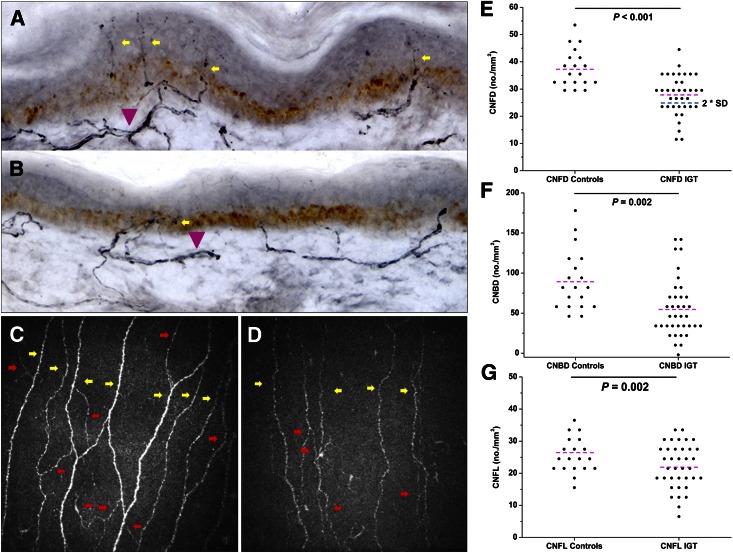
Results: Subjects with IGT had a significantly increased neuropathy symptom profile (P < 0.001), McGill pain index (P < 0.001), neuropathy disability score (P = 0.001), vibration perception threshold (P = 0.002), warm threshold (P = 0.006), and cool threshold (P = 0.03), with a reduction in intraepidermal nerve fiber density (P = 0.03), corneal nerve fiber density (P < 0.001), corneal nerve branch density (P = 0.002), and corneal nerve fiber length (P = 0.05). No significant difference was found in sensory and motor nerve amplitude and conduction velocity or HRVdb.
Conclusions: Subjects with IGT have evidence of neuropathy, particularly small-fiber damage, which can be detected using skin biopsy and CCM.
© 2014 by the American Diabetes Association. Readers may use this article as long as the work is properly cited, the use is educational and not for profit, and the work is not altered.
Figures
References
-
- Singleton JR, Smith AG, Bromberg MB. Increased prevalence of impaired glucose tolerance in patients with painful sensory neuropathy. Diabetes Care 2001;24:1448–1453 - PubMed
-
- Franklin GM, Kahn LB, Baxter J, Marshall JA, Hamman RF. Sensory neuropathy in non-insulin-dependent diabetes mellitus. The San Luis Valley Diabetes Study. Am J Epidemiol 1990;131:633–643 - PubMed
-
- Ziegler D, Rathmann W, Dickhaus T, Meisinger C, Mielck A, KORA Study Group . Neuropathic pain in diabetes, prediabetes and normal glucose tolerance: the MONICA/KORA Augsburg Surveys S2 and S3. Pain Med 2009;10:393–400 - PubMed
-
- Smith AG, Russell J, Feldman EL, et al. Lifestyle intervention for pre-diabetic neuropathy. Diabetes Care 2006;29:1294–1299 - PubMed
Publication types
MeSH terms
Substances
LinkOut - more resources
Full Text Sources
Other Literature Sources
Medical
