


Evaluating the tongue-hold maneuver using high-resolution manometry and electromyography
- PMID: 24969727
- PMCID: PMC4179981
- DOI: 10.1007/s00455-014-9545-6
Evaluating the tongue-hold maneuver using high-resolution manometry and electromyography
Erratum in
- Dysphagia. 2014 Oct;29(5):571. Jones, Corrine A [corrected to Jones, Corinne A]
Abstract
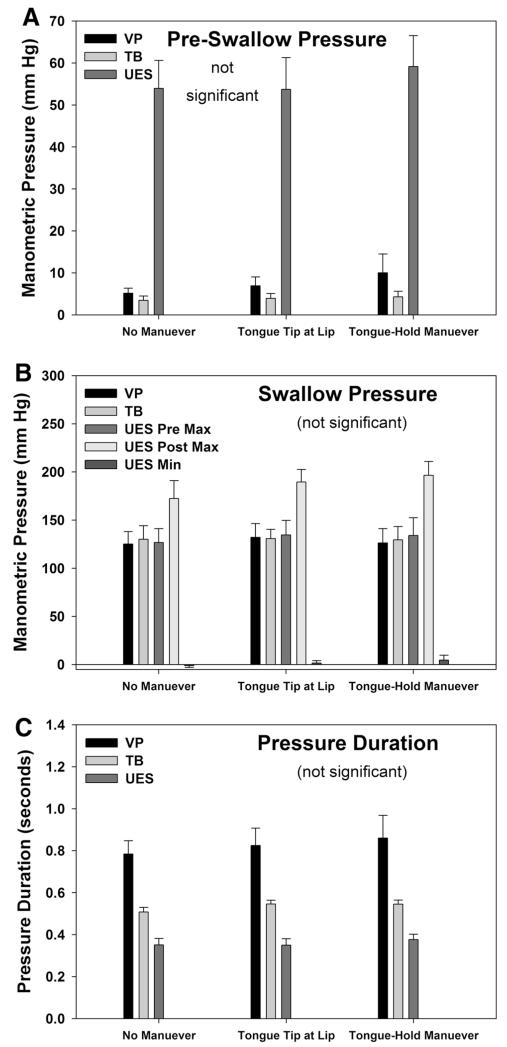
The tongue-hold maneuver is a widely used clinical technique designed to increase posterior pharyngeal wall movement in individuals with dysphagia. It is hypothesized that the tongue-hold maneuver results in increased contraction of the superior pharyngeal constrictor. However, an electromyographic study of the pharynx and tongue during the tongue-hold is still needed to understand whether and how swallow muscle activity and pressure may change with this maneuver. We tested eight healthy young participants using simultaneous intramuscular electromyography with high-resolution manometry during three task conditions including (a) saliva swallow without maneuver, (b) saliva swallow with the tongue tip at the lip, and (c) saliva swallow during the tongue-hold maneuver. We tested the hypothesis that tongue and pharyngeal muscle activity would increase during the experimental tasks, but that pharyngeal pressure would remain relatively unchanged. We found that the pre-swallow magnitude of tongue, pharyngeal constrictor, and cricopharyngeus muscle activity increased. During the swallow, the magnitude and duration of tongue and pharyngeal constrictor muscle activity each increased. However, manometric pressures and durations remained unchanged. These results suggest that increased superior pharyngeal constrictor activity may serve to maintain relatively stable pharyngeal pressures in the absence of posterior tongue movement. Thus, the tongue-hold maneuver may be a relatively simple but robust example of how the medullary swallow center is equipped to dynamically coordinate actions between tongue and pharynx. Our findings emphasize the need for combined modality swallow assessment to include high-resolution manometry and intramuscular electromyography to evaluate the potential benefit of the tongue-hold maneuver for clinical populations.
Figures


References
-
- Fujiu M, Logemann JA. Effect of a tongue-holding maneuver on posterior pharyngeal wall movement during deglutition. Am J Speech Lang Pathol. 1996;5:23–30.
-
- Kokawa T, Saigusa H, Aino I, Matsuoka C, Nakamura T, Tanuma K, Yamashita K, Niimi S. Physiological studies of retrusive movements of the human tongue. J Voice. 2006;20:414–22. doi:10.1016/j. jvoice.2005.08.004. - PubMed
-
- Saigusa H, Yamashita K, Tanuma K, Saigusa M, Niimi S. Morphological studies for retrusive movement of the human adult tongue. Clin Anat. 2004;17:93–8. doi:10.1002/ca.10156. - PubMed
-
- Zemlin WR. Speech and hearing science: anatomy and physiology. 3rd ed. Prentice Hall; Englewood Cliffs: 1988.
-
- Takemoto H. Morphological analyses of the human tongue musculature for three-dimensional modeling. J Speech Lang Hear Res. 2001;44:95–107. - PubMed
Publication types
MeSH terms
Grants and funding
LinkOut - more resources
Full Text Sources
Other Literature Sources
