


Sialyl-tn in cancer: (how) did we miss the target?
- PMID: 24970145
- PMCID: PMC4030860
- DOI: 10.3390/biom2040435
Sialyl-tn in cancer: (how) did we miss the target?
Abstract
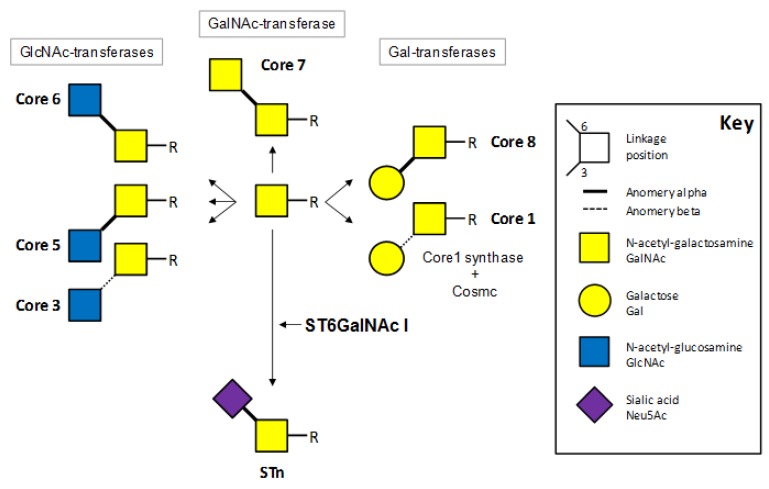
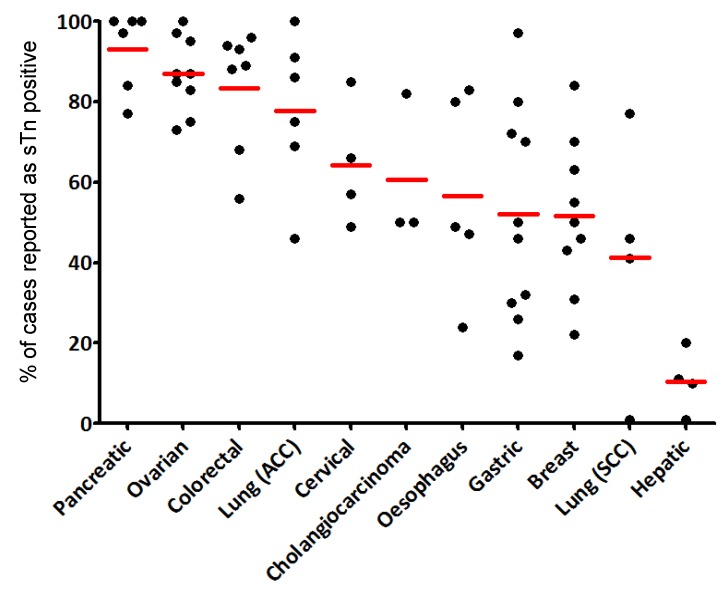
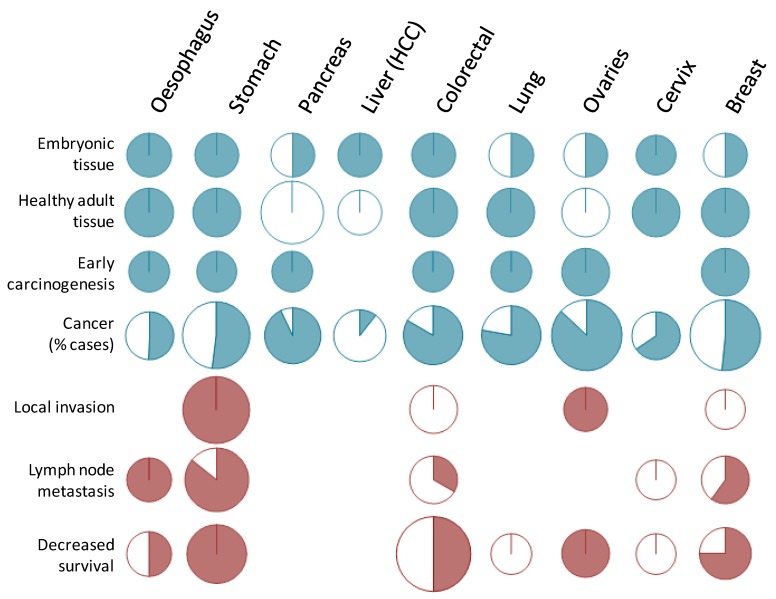
Sialyl-Tn antigen (STn) is a short O-glycan containing a sialic acid residue a2,6-linked to GalNAca-O-Ser/Thr. The biosynthesis of STn is mediated by a specific sialyltransferase termed ST6GalNAc I, which competes with O-glycans elongating glycosyltransferases and prevents cancer cells from exhibiting longer O-glycans. While weakly expressed by fetal and normal adult tissues, STn is expressed by more than 80% of human carcinomas and in all cases, STn detection is associated with adverse outcome and decreased overall survival for the patients. Because of its pan-carcinoma expression associated with an adverse outcome, an anti-cancer vaccine, named Theratope, has been designed towards the STn epitope. In spite of the great enthusiasm around this immunotherapy, Theratope failed on Phase III clinical trial. However, in lieu of missing this target, one should consider to revise the Theratope design and the actual facts. In this review, we highlight the many lessons that can be learned from this failure from the immunological standpoint, as well as from the drug design and formulation and patient selection. Moreover, an irrefutable knowledge is arising from novel immunotherapies targeting other carbohydrate antigens and STn carrier proteins, such as MUC1, that will warrantee the future development of more successful anti-STn immunotherapy strategies.
Figures
References
-
- Rajpert-De Meyts E., Poll S.N., Goukasian I., Jeanneau C., Herlihy A.S., Bennett E.P., Skakkebaek N.E., Clausen H., Giwercman A., Mandel U. Changes in the profile of simple mucin-type O-glycans and polypeptide GalNAc-transferases in human testis and testicular neoplasms are associated with germ cell maturation and tumour differentiation. Virchows Arch. 2007;451:805–814. doi: 10.1007/s00428-007-0478-4. - DOI - PubMed
-
- Marcos N.T., Pinho S., Grandela C., Cruz A., Samyn-Petit B., Harduin-Lepers A., Almeida R., Silva F., Morais V., Costa J., Kihlberg J., Clausen H., Reis C.A. Role of the human ST6GalNAc-I and ST6GalNAc-II in the synthesis of the cancer-associated sialyl-Tn antigen. Cancer Res. 2004;64:7050–7057. - PubMed
-
- Sewell R., Bäckström M., Dalziel M., Gschmeissner S., Karlsson H., Noll T., Gätgens J., Clausen H., Hansson G.C., Burchell J., Taylor-Papadimitriou J. The ST6GalNAc-I sialyltransferase localizes throughout the Golgi and is responsible for the synthesis of the tumor-associated sialyl-Tn O-glycan in human breast cancer. J. Biol. Chem. 2006;281:3586–3594. - PubMed
-
- Marcos N.T., Bennett E.P., Gomes J., Magalhaes A., Gomes C., David L., Dar I., Jeanneau C., DeFrees S., Krustrup D., Vogel L.K., Kure E.H., Burchell J., Taylor-Papadimitriou J., Clausen H., Mandel U., Reis C.A. ST6GalNAc-I controls expression of sialyl-Tn antigen in gastrointestinal tissues. Front Biosci. (Elite Ed.) 2011;3:1443–1455. - PubMed
LinkOut - more resources
Full Text Sources
Other Literature Sources
Research Materials
Miscellaneous
