. 2012 Nov 12;2(4):524-48.
doi: 10.3390/biom2040524.

Functional Aspects of PARP1 in DNA Repair and Transcription

Affiliations

Functional Aspects of PARP1 in DNA Repair and Transcription

Hui Ling Ko et al. Biomolecules. .

Abstract

Poly (ADP-ribose) polymerase 1 (PARP1) is an ADP-ribosylating enzyme essential for initiating various forms of DNA repair. Inhibiting its enzyme activity with small molecules thus achieves synthetic lethality by preventing unwanted DNA repair in the treatment of cancers. Through enzyme-dependent chromatin remodeling and enzyme-independent motif recognition, PARP1 also plays important roles in regulating gene expression. Besides presenting current findings on how each process is individually controlled by PARP1, we shall discuss how transcription and DNA repair are so intricately linked that disturbance by PARP1 enzymatic inhibition, enzyme hyperactivation in diseases, and viral replication can favor one function while suppressing the other.


Figures
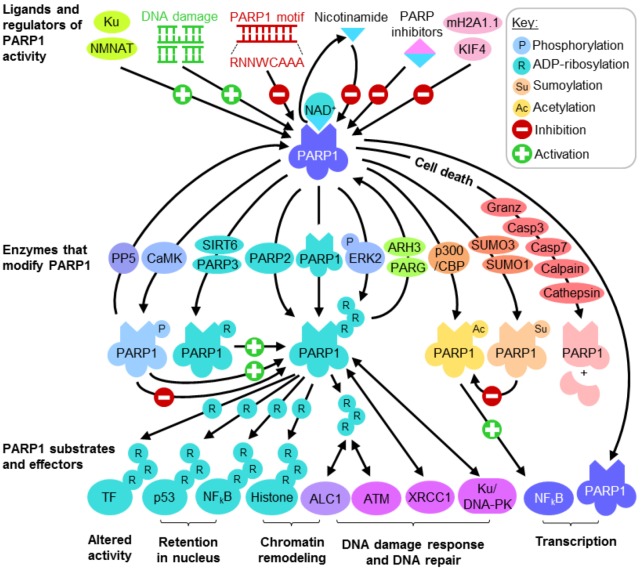
Figure 1
Figure 1
PARP1 function and regulation. Abbreviations: Granz: Granzyme; Casp:Caspase; TF: Transcription factor.
Figure 2
Figure 2
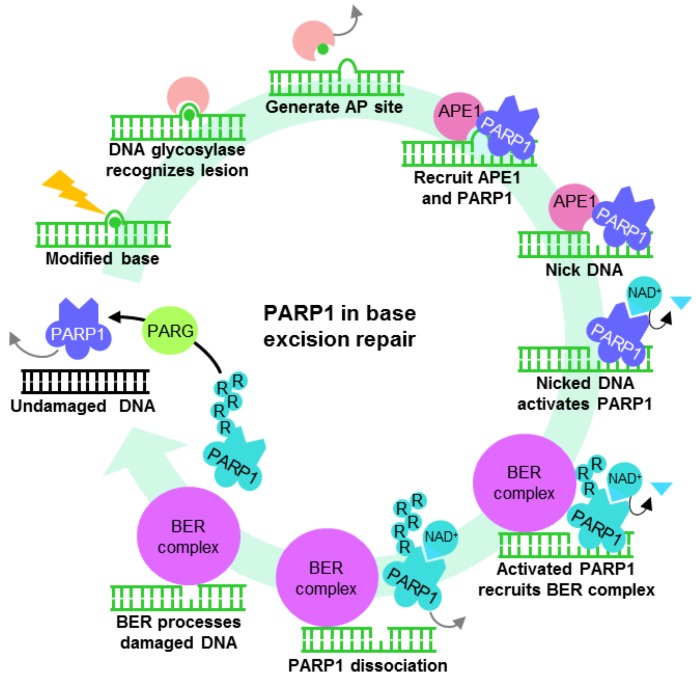
The role of PARP1 in base excision repair (BER). PARP1 may also mediate DNA single-strand break repair by recruiting the BER complex.
Figure 3
Figure 3
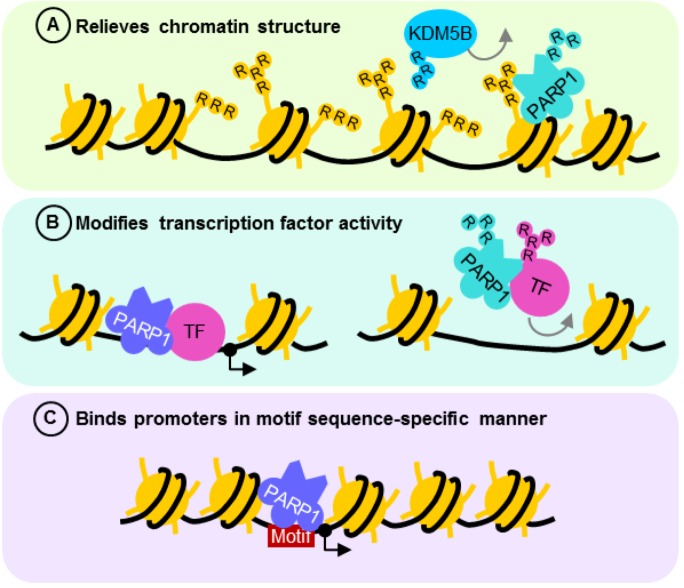
The role of PARP1 in transcriptional regulation. (A) PARP1 relieves and maintains an “open” chromatin structure by ADP-ribosylation of histones or preventing the action of histone demethylase KDM5B. (B) PARP1 forms functional complexes with transcription factors such as NFκB, altering their activity depending on its state of posttranslational modification. This interaction need not activate or require PARP1 enzyme activity, although when stimulated, ADP-ribosylation usually reduces the affinity of the complex for DNA cis elements. The effect of PARP1 on transcription in both cases is dependent on the type of binding partner and nature of promoter element recognized. (C) PARP1 acts as a transcription activator or repressor by binding its recognition motif. Grey arrows are repulsion from DNA or chromatin. R—ADP-ribosylation; TF—transcription factor.
Figure 4
Figure 4
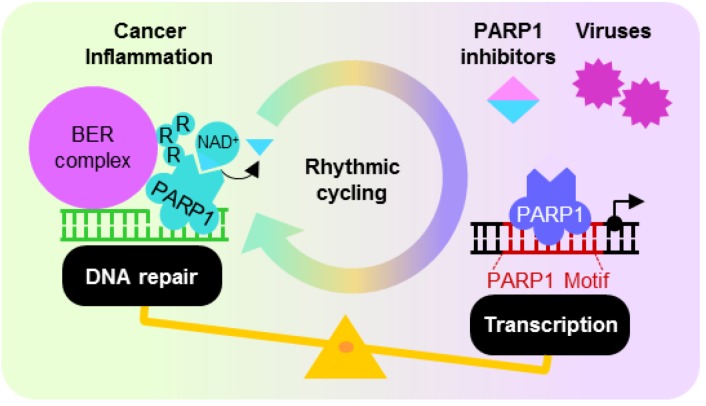
PARP1 DNA repair and motif-dependent transcription is intricately regulated and possibly temporally compartmentalized by the circadian rhythm. Disturbances to this may favor one function over the other, and arise from diseases such as cancer and inflammatory disorders, as well as the addition of small molecule inhibitors and utilization of PARP1 for viral replication.

References

    1. Satoh M.S., Poirier G.G., Lindahl T. Dual function for poly(ADP-ribose) synthesis in response to DNA strand breakage. Biochemistry. 1994;33:7099–7106. - PubMed
    1. Langelier M.F., Planck J.L., Roy S., Pascal J.M. Crystal structures of poly(ADP-ribose) polymerase-1 (PARP-1) zinc fingers bound to DNA: Structural and functional insights into DNA-dependent PARP-1 activity. J. Biol. Chem. 2011;286:10690–10701. - PMC - PubMed
    1. Langelier M.F., Planck J.L., Roy S., Pascal J.M. Structural basis for DNA damage-dependent poly(ADP-ribosyl)ation by human PARP-1. Science. 2012;336:728–732. doi: 10.1126/science.1216338. - DOI - PMC - PubMed
    1. Eustermann S., Videler H., Yang J.C., Cole P.T., Gruszka D., Veprintsev D., Neuhaus D. The DNA-binding domain of human PARP-1 interacts with DNA single-strand breaks as a monomer through its second zinc finger. J. Mol. Biol. 2011;407:149–170. doi: 10.1016/j.jmb.2011.01.034. - DOI - PMC - PubMed
    1. Lindahl T., Satoh M.S., Poirier G.G., Klungland A. Post-translational modification of poly(adp-ribose) polymerase induced by DNA strand breaks. Trends Biochem. Sci. 1995;20:405–411. doi: 10.1016/S0968-0004(00)89089-1. - DOI - PubMed

LinkOut - more resources