. 2014 Jul 15;5(13):5065-75.
doi: 10.18632/oncotarget.2080.

Mutational analysis of primary central nervous system lymphoma

Affiliations

Mutational analysis of primary central nervous system lymphoma

Aurélie Bruno et al. Oncotarget. .

Abstract

Little is known about the genomic basis of primary central nervous system lymphoma (PCNSL) tumorigenesis. To investigate the mutational profile of PCNSL, we analyzed nine paired tumor and germline DNA samples from PCNSL patients by high throughput exome sequencing. Eight genes of interest have been further investigated by focused resequencing in 28 additional PCNSL tumors to better estimate their incidence. Our study identified recurrent somatic mutations in 37 genes, some involved in key signaling pathways such as NFKB, B cell differentiation and cell cycle control. Focused resequencing in the larger cohort revealed high mutation rates for genes already described as mutated in PCNSL such as MYD88 (38%), CD79B (30%), PIM1 (22%) and TBL1XR1 (19%) and for genes not previously reported to be involved in PCNSL tumorigenesis such as ETV6 (16%), IRF4 (14%), IRF2BP2 (11%) and EBF1 (11%). Of note, only 3 somatically acquired SNVs were annotated in the COSMIC database. Our results demonstrate a high genetic heterogeneity of PCNSL and mutational pattern similarities with extracerebral diffuse large B cell lymphomas, particularly of the activated B-cell (ABC) subtype, suggesting shared underlying biological mechanisms. The present study provides new insights into the mutational profile of PCNSL and potential targets for therapeutic strategies.


Conflict of interest statement

The authors declare no conflicts of interest.

Figures
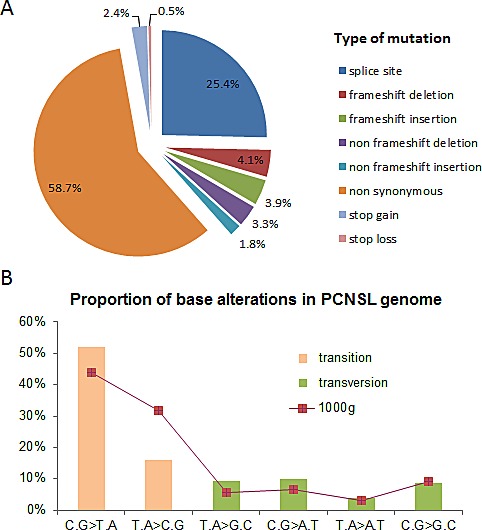
Figure 1
Figure 1. Mutation pattern of PCNSL samples investigated by whole exome sequencing
To address PCNSL mutational profile, whole exome sequencing was conducted in nine paired blood and tumor samples. (A) Pie chart represents relative distribution of somatically acquired mutations classified according to their type. (B) Histogram depicts the proportion of PCNSL somatic mutations in each mutational class of transitions and transversions compared with 1000-genomes project data (red line).
Figure 2
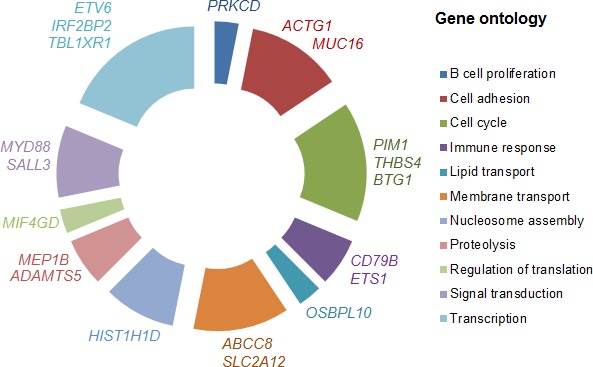
Figure 2. Gene ontology of PCNSL genes
Relative distribution of the 37 genes somatically mutated in PCNSL by gene ontology categories. The spans of the arcs indicate the relative numbers of genes annotated with respect to gene ontology terms. Representative genes in each category are shown next to each arc.
Figure 3
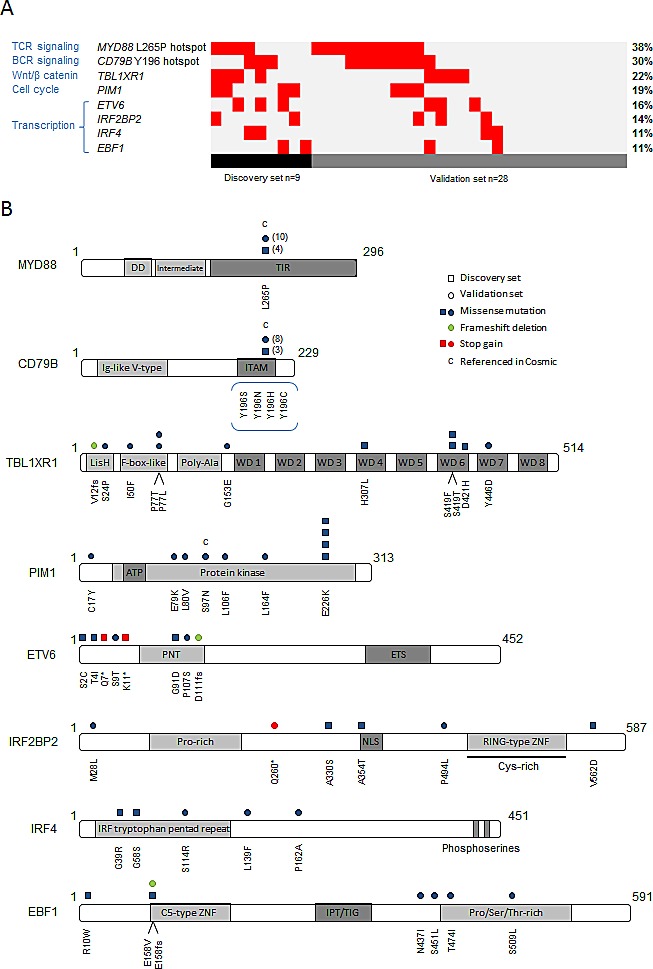
Figure 3. Investigation of 8 relevant genes recurrently affected by point mutations in PCNSL
Based on genes identified by whole exome sequencing, we selected 8 relevant genes to be sequenced in a larger cohort: CD79B, EBF1, ETV6, IRF4, IRF2BP2, MYD88, PIM1 and TBL1XR1. (A) Repartition of validated mutations by gene within the whole population of 37 PCNSL cases. (B) Schematic representation of all validated mutations identified in the discovery (□) and the validation sets (○) with their position according to protein domains. Symbol color indicates mutation type. Number of □ or ○ indicates the number of mutated patients except for L265P MYD88 and Y196 CD79B mutations.
Figure 4
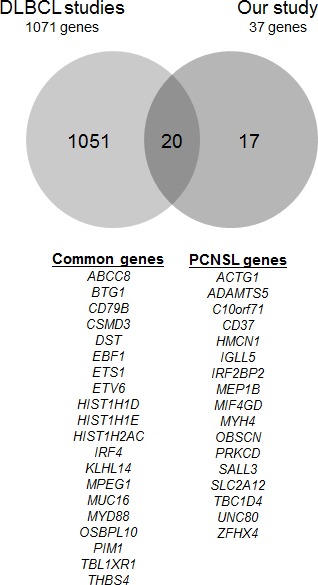
Figure 4. Overlaps in genes discovered in DLBCL studies and our 37 genes of interest
The Venn diagram depicts the comparison between gene mutations from the five DLBCL exomes studies and the present PCNSL study. The gene lists used were as follows: Lohr et al. (Table 1 in Ref. 11, n=72 genes), Pasqualucci et al. (Table S3 and Fig. S4 in Ref. 15, n=108 validated somatic genes), Zhang et al. (Table S3 in Ref. 14, n=322 genes), Morin et al. (in Ref. 9, n=315 known and confirmed somatic genes; Table S3 in Ref. 37, n=588 known and confirmed somatic genes).

References

    1. Ricard D, Idbaih A, Ducray F, Lahutte M, Hoang-Xuan K, Delattre J-Y. Primary brain tumours in adults. Lancet. 2012;379:1984–1996. - PubMed
    1. Montesinos-Rongen M, Brunn A, Bentink S, Basso K, Lim WK, Klapper W, Schaller C, Reifenberger G, Rubenstein J, Wiestler OD, Spang R, Dalla-Favera R, Siebert R, et al. Gene expression profiling suggests primary central nervous system lymphomas to be derived from a late germinal center B cell. Leukemia. 2008;22:400–405. - PMC - PubMed
    1. Tun HW, Personett D, Baskerville KA, Menke DM, Jaeckle KA, Kreinest P, Edenfield B, Zubair AC, O'Neill BP, Lai WR, Park PJ, McKinney M. Pathway analysis of primary central nervous system lymphoma. Blood. 2008;111:3200–3210. - PMC - PubMed
    1. Sung CO, Kim SC, Karnan S, Karube K, Shin HJ, Nam D-H, Suh Y-L, Kim S-H, Kim JY, Kim SJ, Kim WS, Seto M, Ko Y-H. Genomic profiling combined with gene expression profiling in primary central nervous system lymphoma. Blood. 2011;117:1291–1300. - PubMed
    1. Rubenstein JL, Fridlyand J, Shen A, Aldape K, Ginzinger D, Batchelor T, Treseler P, Berger M, McDermott M, Prados M, Karch J, Okada C, Hyun W, et al. Gene expression and angiotropism in primary CNS lymphoma. Blood. 2006;107:3716–3723. - PMC - PubMed

Publication types

MeSH terms