


Empathy and stress related neural responses in maternal decision making
- PMID: 24971049
- PMCID: PMC4053926
- DOI: 10.3389/fnins.2014.00152
Empathy and stress related neural responses in maternal decision making
Abstract
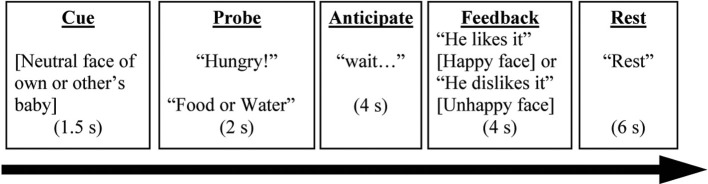
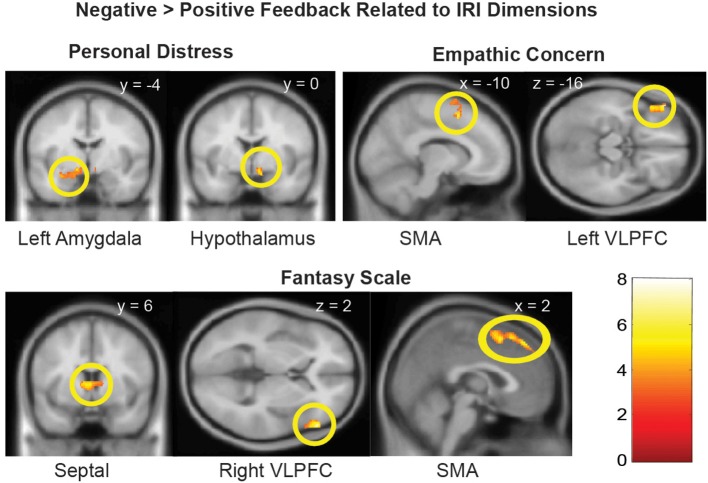
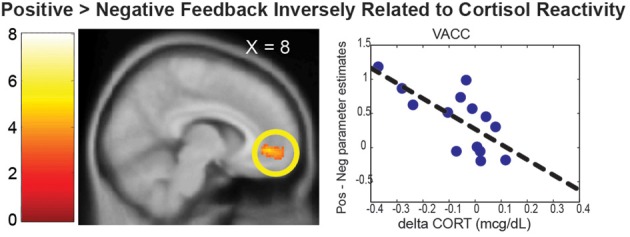
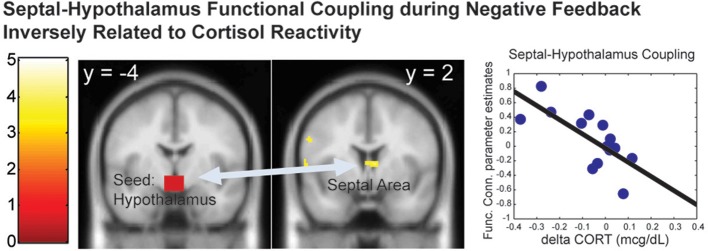
Mothers need to make caregiving decisions to meet the needs of children, which may or may not result in positive child feedback. Variations in caregivers' emotional reactivity to unpleasant child-feedback may be partially explained by their dispositional empathy levels. Furthermore, empathic response to the child's unpleasant feedback likely helps mothers to regulate their own stress. We investigated the relationship between maternal dispositional empathy, stress reactivity, and neural correlates of child feedback to caregiving decisions. In Part 1 of the study, 33 female participants were recruited to undergo a lab-based mild stressor, the Social Evaluation Test (SET), and then in Part 2 of the study, a subset of the participants, 14 mothers, performed a Parenting Decision Making Task (PDMT) in an fMRI setting. Four dimensions of dispositional empathy based on the Interpersonal Reactivity Index were measured in all participants-Personal Distress, Empathic Concern, Perspective Taking, and Fantasy. Overall, we found that the Personal Distress and Perspective Taking were associated with greater and lesser cortisol reactivity, respectively. The four types of empathy were distinctly associated with the negative (vs. positive) child feedback activation in the brain. Personal Distress was associated with amygdala and hypothalamus activation, Empathic Concern with the left ventral striatum, ventrolateral prefrontal cortex (VLPFC), and supplemental motor area (SMA) activation, and Fantasy with the septal area, right SMA and VLPFC activation. Interestingly, hypothalamus-septal coupling during the negative feedback condition was associated with less PDMT-related cortisol reactivity. The roles of distinct forms of dispositional empathy in neural and stress responses are discussed.
Keywords: amygdala; cortisol; decision making; empathy; functional MRI; hypothalamus; mothers; social neuroscience.
Figures
References
-
- Abelson J. L., Erickson T. M., Mayer S. E., Crocker J., Briggs H., Lopez-Duran N. L., et al. (2014). Brief cognitive intervention can modulate neuroendocrine stress responses to the Trier Social Stress Test: buffering effects of a compassionate goal orientation. Psychoneuroendocrinology 44, 60–70 10.1016/j.psyneuen.2014.02.016 - DOI - PMC - PubMed
-
- Brown S., Brown R., Preston S. (2012). The human caregiving system: a neuroscience model of compassionate motivation and behavior, in Moving Beyond Self Interest: Perspectives from Evolutionary Biology, Neuroscience, and the Social Sciences, eds Brown S., Brown R., Penner L.(New York, NY: Oxford University Press; ), 75–88
-
- Cox M. J., Harter K. S. (2003). Parent-child relationships, in Well-being: Positive Development Across the Life Course, ed Bornstein M. (Mahwah, NJ: Lawrence Erlbaum Associates; ), 191–204
Grants and funding
LinkOut - more resources
Full Text Sources
Other Literature Sources
Miscellaneous
