Engraftment kinetics and graft failure after single umbilical cord blood transplantation using a myeloablative conditioning regimen
- PMID: 24972767
- PMCID: PMC4562541
- DOI: 10.3324/haematol.2014.109280
Engraftment kinetics and graft failure after single umbilical cord blood transplantation using a myeloablative conditioning regimen
Abstract
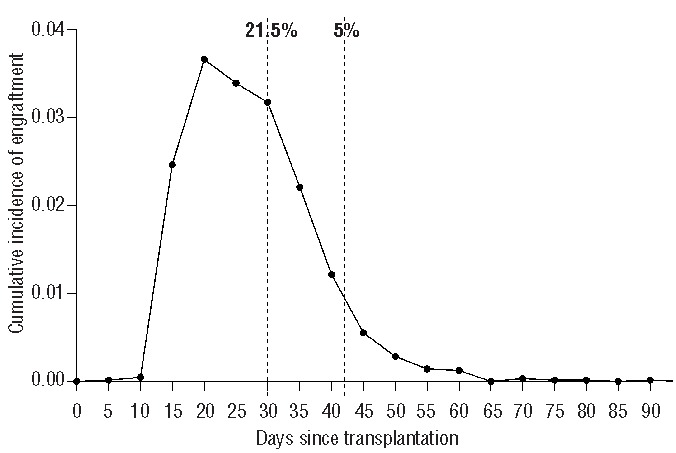
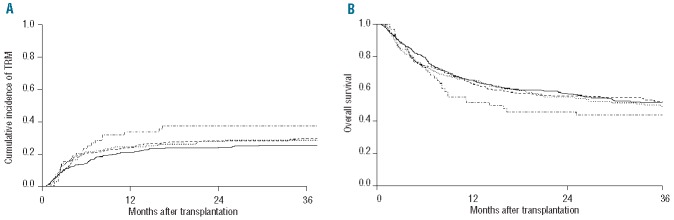
Umbilical cord blood transplant recipients are exposed to an increased risk of graft failure, a complication leading to a higher rate of transplant-related mortality. The decision and timing to offer a second transplant after graft failure is challenging. With the aim of addressing this issue, we analyzed engraftment kinetics and outcomes of 1268 patients (73% children) with acute leukemia (64% acute lymphoblastic leukemia, 36% acute myeloid leukemia) in remission who underwent single-unit umbilical cord blood transplantation after a myeloablative conditioning regimen. The median follow-up was 31 months. The overall survival rate at 3 years was 47%; the 100-day cumulative incidence of transplant-related mortality was 16%. Longer time to engraftment was associated with increased transplant-related mortality and shorter overall survival. The cumulative incidence of neutrophil engraftment at day 60 was 86%, while the median time to achieve engraftment was 24 days. Probability density analysis showed that the likelihood of engraftment after umbilical cord blood transplantation increased after day 10, peaked on day 21 and slowly decreased to 21% by day 31. Beyond day 31, the probability of engraftment dropped rapidly, and the residual probability of engrafting after day 42 was 5%. Graft failure was reported in 166 patients, and 66 of them received a second graft (allogeneic, n=45). Rescue actions, such as the search for another graft, should be considered starting after day 21. A diagnosis of graft failure can be established in patients who have not achieved neutrophil recovery by day 42. Moreover, subsequent transplants should not be postponed after day 42.
Copyright© Ferrata Storti Foundation.
Figures
References
-
- Rocha V, Labopin M, Sanz G, Arcese W, Schwerdtfeger R, Bosi A, et al. Transplants of umbilical-cord blood or bone marrow from unrelated donors in adults with acute leukemia. N Engl J Med. 2004;351(22): 2276–85. - PubMed
-
- Laughlin MJ, Eapen M, Rubinstein P, Wagner JE, Zhang MJ, Champlin RE, et al. Outcomes after transplantation of cord blood or bone marrow from unrelated donors in adults with leukemia. N Engl J Med. 2004;351(22):2265–75. - PubMed
-
- Remberger M, Ringden O, Ljungman P, Hagglund H, Winiarski J, Lonnqvist B, et al. Booster marrow or blood cells for graft failure after allogeneic bone marrow transplantation. Bone Marrow Transplant. 1998;22(1):73–8. - PubMed
Publication types
MeSH terms
Substances
Grants and funding
LinkOut - more resources
Full Text Sources
Other Literature Sources
Medical