. 2014 Sep;13(9):1143-57.
doi: 10.1128/EC.00092-14. Epub 2014 Jun 27.

The strictly aerobic yeast Yarrowia lipolytica tolerates loss of a mitochondrial DNA-packaging protein

Affiliations

The strictly aerobic yeast Yarrowia lipolytica tolerates loss of a mitochondrial DNA-packaging protein

Jana Bakkaiova et al. Eukaryot Cell. 2014 Sep.

Erratum in

Abstract

Mitochondrial DNA (mtDNA) is highly compacted into DNA-protein structures termed mitochondrial nucleoids (mt-nucleoids). The key mt-nucleoid components responsible for mtDNA condensation are HMG box-containing proteins such as mammalian mitochondrial transcription factor A (TFAM) and Abf2p of the yeast Saccharomyces cerevisiae. To gain insight into the function and organization of mt-nucleoids in strictly aerobic organisms, we initiated studies of these DNA-protein structures in Yarrowia lipolytica. We identified a principal component of mt-nucleoids in this yeast and termed it YlMhb1p (Y. lipolytica mitochondrial HMG box-containing protein 1). YlMhb1p contains two putative HMG boxes contributing both to DNA binding and to its ability to compact mtDNA in vitro. Phenotypic analysis of a Δmhb1 strain lacking YlMhb1p resulted in three interesting findings. First, although the mutant exhibits clear differences in mt-nucleoids accompanied by a large decrease in the mtDNA copy number and the number of mtDNA-derived transcripts, its respiratory characteristics and growth under most of the conditions tested are indistinguishable from those of the wild-type strain. Second, our results indicate that a potential imbalance between subunits of the respiratory chain encoded separately by nuclear DNA and mtDNA is prevented at a (post)translational level. Third, we found that mtDNA in the Δmhb1 strain is more prone to mutations, indicating that mtHMG box-containing proteins protect the mitochondrial genome against mutagenic events.


Figures

FIG 1
FIG 1
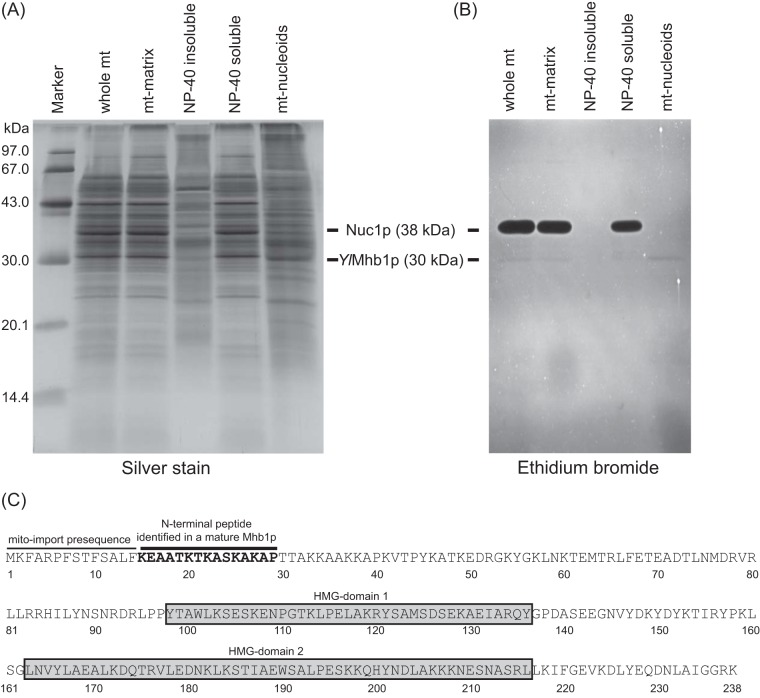
Y. lipolytica nucleoids contain a novel type of HMG box-containing protein, YlMhb1. (A) Y. lipolytica mitochondria were fractionated, and mt-nucleoids were purified as described in Materials and Methods. Proteins (5 μg per lane) were separated by 12% SDS-PAGE and were visualized by silver staining. (B) DNA-binding proteins in mitochondrial fractions were detected using SDS-DNA-polyacrylamide gel electrophoresis as described previously (46). The 38-kDa band exhibiting strong DNA-binding activity most likely corresponds to the Nuc1 nuclease as observed in C. parapsilosis (46). (C) Schematic representation of the amino acid sequence of YlMhb1p highlighting the putative N-terminal mitochondrial targeting sequence, the peptide identified by N-terminal sequencing, and the positions of two putative HMG boxes predicted by the Phyre server (66).
FIG 2
FIG 2
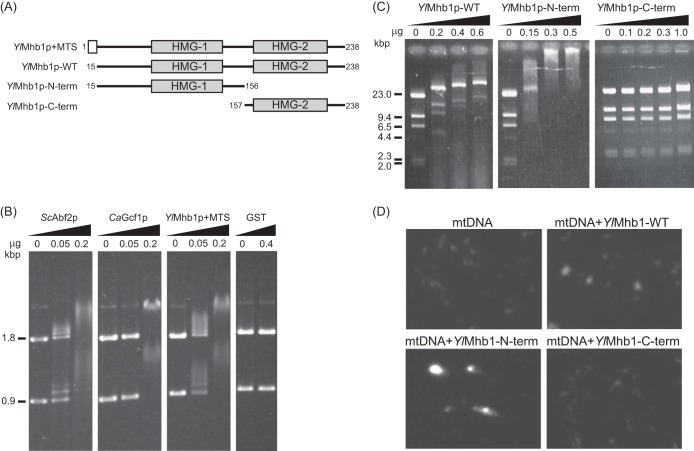
Recombinant YlMhb1p binds DNA in vitro. (A) Schematic representation of four versions of YlMhb1p produced in E. coli and used for in vitro experiments. YlMhb1p+MTS, full-length protein containing a mitochondrial targeting sequence (MTS); YlMhb1p-WT, wild-type protein lacking MTS; YlMhb1p-N-term and YlMhb1p-C-term, truncation mutants containing amino acids 15 to 156 and amino acids 157 to 238, respectively. (B) Analysis by EMSA indicates that increasing concentrations of YlMhb1p bind to DNA fragments in vitro. For comparison, purified mitochondrial HMG box-containing proteins from S. cerevisiae (ScAbf2p) and C. albicans (CaGcf1p) were subjected to the same assay. Purified glutathione S-transferase (GST) was used as a negative control. (C) EMSAs of various forms of YlMhb1p bound to HindIII fragments of bacteriophage λ DNA. Purified proteins were added at the same molar concentrations to compensate for the differences in molecular weight. (D) mtDNA was compacted in vitro as described in Materials and Methods. The reaction mixtures contained 50 ng of purified mtDNA and either 0.2 μg of YlMhb1p-WT, 0.16 μg of YlMhb1p-N-term, or 0.1 μg of YlMhb1p-C-term.
FIG 3
FIG 3
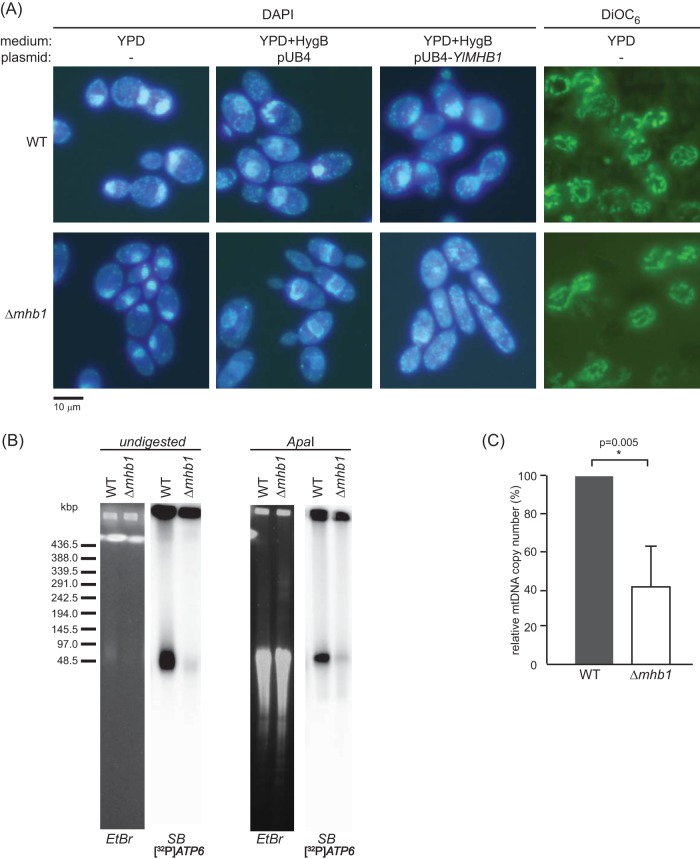
The absence of YlMhb1p leads to a decreased number of mt-nucleoids as well as a lower mtDNA copy number per cell. (A) Wild-type Po1h (WT) (top) and the Δmhb1 mutant (bottom) were stained with DAPI or DiOC6 and were visualized by fluorescence microscopy. Cells transformed with an empty pUB4 vector or with pUB4 carrying the wild-type YlMHB1 gene were grown in YPD medium supplemented with hygromycin B (HygB). (B) PFGE analysis of mtDNA from the wild-type Po1h strain and the Δmhb1 strain. Whole-cell DNA was released from the cells in agarose blocks and was subjected to electrophoresis either without (undigested) or with prior treatment with the restriction endonuclease ApaI. Mitochondrial DNA was visualized by Southern blotting using a radioactively labeled probe derived from the ATP6 gene. EtBr, ethidium bromide-stained gel; SB, Southern blot. (C) The amount of mtDNA in the Δmhb1 mutant relative to that in the WT strain Po1h was measured by qPCR. The data presented are means of results from five independent experiments.
FIG 4
FIG 4
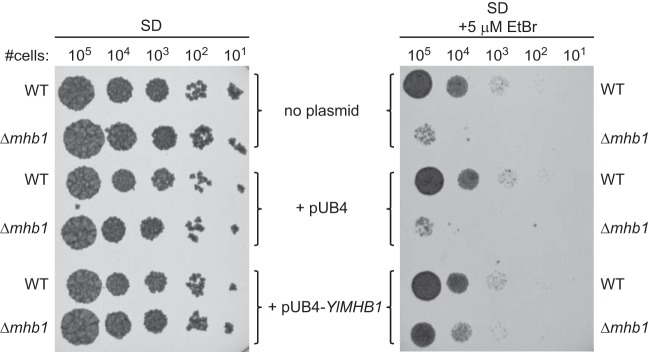
The absence of YlMhb1p results in sensitivity to ethidium bromide. Cells of the wild-type strain Po1h (WT) and the Δmhb1 strain either carrying no plasmid or transformed with the pUB4 vector without or with the YlMHB1 gene were first grown overnight in YPD medium alone or supplemented with HygB and were then spotted onto solid SD medium without (left) or with (right) EtBr (5 μM). Plates were photographed after 1 day (left) or 3 days (right) of growth at 28°C.
FIG 5
FIG 5
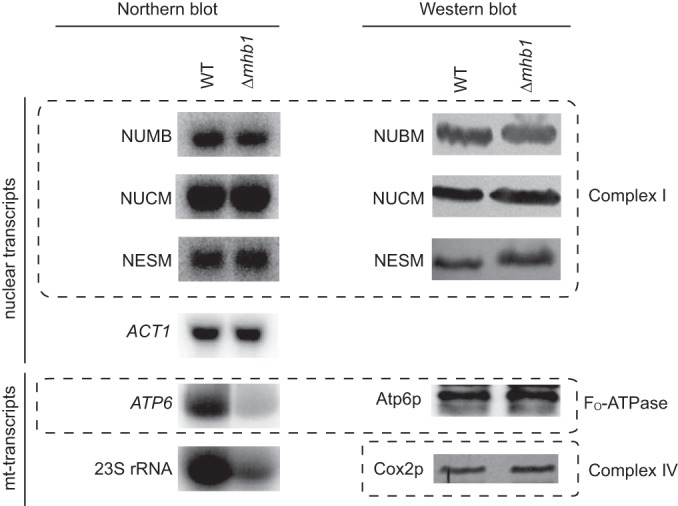
Comparison of the levels of RNA and proteins encoded by nuclear DNA and mtDNA. (Left) Northern blot analysis of RNA resulting from transcription of nuclear DNA (ACT1, NUBM, NUCM, NESM) and mtDNA (23S rRNA, ATP6). (Right) Western blot analysis of the levels of mitochondrial proteins encoded by nuclear DNA (NUCM [49-kDa], NUBM [51-kDa], and NESM subunits of complex I) and mtDNA (Atp6p and Cox2p). The WT (strain Po1h) and Δmhb1 protein extracts were prepared from the same numbers of cells. Note that whereas anti-NUCM, anti-NUMB, and anti-NESM antibodies were raised against Y. lipolytica proteins, anti-Atp6p and anti-Cox2p antibodies were raised against S. cerevisiae Atp6p and Cox2p, respectively.
FIG 6
FIG 6
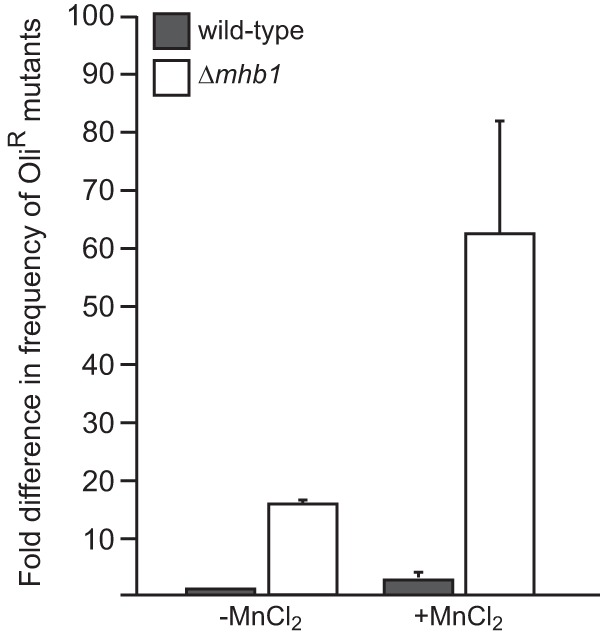
Measurement of frequencies of spontaneous and MnCl2-induced OliR mutations. MnCl2-induced mutagenesis of mtDNA was performed as described previously (71), and the frequency of OliR mutants was calculated based on the number of colonies appearing after 8 days of cultivation on plates containing 10 μg/ml oligomycin A. Wild-type, strain Po1h.

References

    1. Kaufman BA, Kolesar JE, Perlman PS, Butow RA. 2003. A function for the mitochondrial chaperonin Hsp60 in the structure and transmission of mitochondrial DNA nucleoids in Saccharomyces cerevisiae. J. Cell Biol. 163:457–461. 10.1083/jcb.200306132 - DOI - PMC - PubMed
    1. Miyakawa I, Aoi H, Sando N, Kuroiwa T. 1984. Fluorescence microscopic studies of mitochondrial nucleoids during meiosis and sporulation in the yeast, Saccharomyces cerevisiae. J. Cell Sci. 66:21–38 - PubMed
    1. Miyakawa I, Sando N, Kawano S, Nakamura S, Kuroiwa T. 1987. Isolation of morphologically intact mitochondrial nucleoids from the yeast, Saccharomyces cerevisiae. J. Cell Sci. 88:431–439 - PubMed
    1. Miyakawa I, Miyamoto M, Kuroiwa T, Sando N. 2004. DNA content of individual mitochondrial nucleoids varies depending on the culture conditions of the yeast Saccharomyces cerevisiae. Cytologia 69:101–107. 10.1508/cytologia.69.101 - DOI
    1. Williamson DH, Fennell DJ. 1975. The use of fluorescent DNA-binding agent for detecting and separating yeast mitochondrial DNA. Methods Cell Biol. 12:335–351. 10.1016/S0091-679X(08)60963-2 - DOI - PubMed

Publication types

MeSH terms

LinkOut - more resources