


Reperfusion-induced sustained ventricular tachycardia, leading to ventricular fibrillation, in chronically instrumented, intact, conscious mice
- PMID: 24973331
- PMCID: PMC4208649
- DOI: 10.14814/phy2.12057
Reperfusion-induced sustained ventricular tachycardia, leading to ventricular fibrillation, in chronically instrumented, intact, conscious mice
Abstract
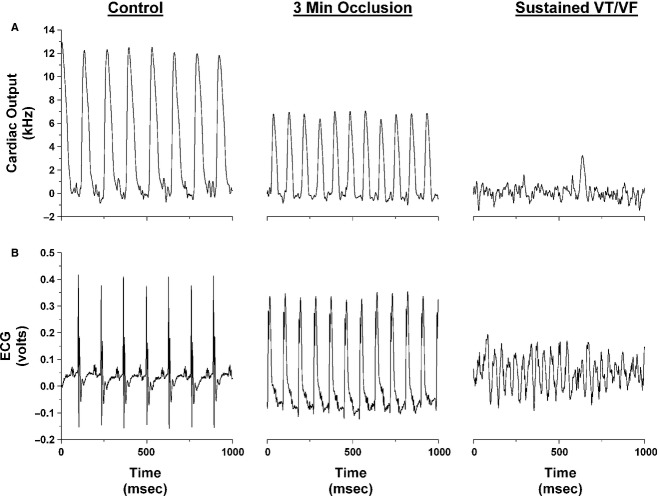
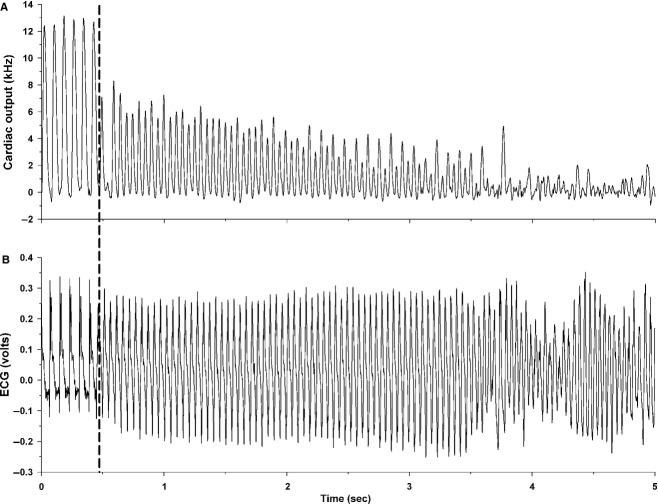
Reperfusion-induced lethal ventricular arrhythmias are observed during relief of coronary artery spasm, with unstable angina, exercise-induced ischemia, and silent ischemia. Accordingly, significant efforts are underway to understand the mechanisms responsible for reperfusion-induced lethal arrhythmias and mice have become increasingly important in these efforts. However, although reperfusion-induced sustained ventricular tachycardia leading to ventricular fibrillation (VF) has been recorded in many models, reports in mice are sparse and of limited success. Importantly, none of these studies were conducted in intact, conscious mice. Accordingly, a chronically instrumented, intact, conscious murine model of reperfusion-induced lethal arrhythmias has the potential to be of major importance for advancing the concepts and methods that drive cardiovascular therapies. Therefore, we describe, for the first time, the use of an intact, conscious, murine model of reperfusion-induced lethal arrhythmias. Male mice (n = 9) were instrumented to record cardiac output and the electrocardiogram. In addition, a snare was placed around the left main coronary artery. Following recovery, the susceptibility to sustained ventricular tachycardia produced by 3 min of occlusion and reperfusion of the left main coronary artery was determined in conscious mice by pulling on the snare. Reperfusion culminated in sustained ventricular tachycardia, leading to VF, in all nine conscious mice. The procedures conducted in conscious C57BL/6J mice, a strain commonly used in transgenic studies, can be utilized in genetically modified models to enhance our understanding of single gene defects on reperfusion-induced lethal ventricular arrhythmias in intact, conscious, and complex animals.
Keywords: arrhythmia; murine model; reperfusion injury.
© 2014 The Authors. Physiological Reports published by Wiley Periodicals, Inc. on behalf of the American Physiological Society and The Physiological Society.
Figures
References
-
- Akhtar M., Breithardt G., Camm A. J., Coumel P., Janse M. J., Lazzara R. 1990. CAST and beyond. Implications of the Cardiac Arrhythmia Suppression Trial. Task Force of the Working Group on Arrhythmias of the European Society of Cardiology. Circulation; 81:1123-1127. - PubMed
-
- Balke C. W., Kaplinsky E., Michelson E. L., Naito M., Dreifus L. S. 1981. Reperfusion ventricular tachyarrhythmias: correlation with antecedent coronary artery occlusion tachyarrhythmias and duration of myocardial ischemia. Am. Heart J.; 101:449-456. - PubMed
-
- Bernier M., Curtis M. J., Hearse D. J. 1989. Ischemia‐induced and reperfusion‐induced arrhythmias: importance of heart rate. Am. J. Physiol.; 256:21-31. - PubMed
-
- Bourke J. P., Richards D. A., Ross D. L., McGuire M. A., Uther J. B. 1995. Does the induction of ventricular flutter or fibrillation at electrophysiologic testing after myocardial infarction have any prognostic significance? Am. J. Cardiol.; 75:431-435. - PubMed
-
- Buxton A. E., Lee K. L., Hafley G. E., Wyse D. G., Fisher J. D., Lehmann M. H. 2002. Relation of ejection fraction and inducible ventricular tachycardia to mode of death in patients with coronary artery disease: an analysis of patients enrolled in the multicenter unsustained tachycardia trial. Circulation; 106:2466-2472. - PubMed
LinkOut - more resources
Full Text Sources
Other Literature Sources
