


Modulation of human vestibular reflexes with increased postural threat
- PMID: 24973412
- PMCID: PMC4229354
- DOI: 10.1113/jphysiol.2014.270744
Modulation of human vestibular reflexes with increased postural threat
Abstract
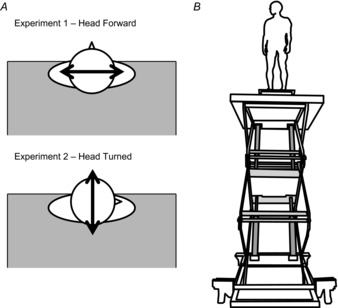
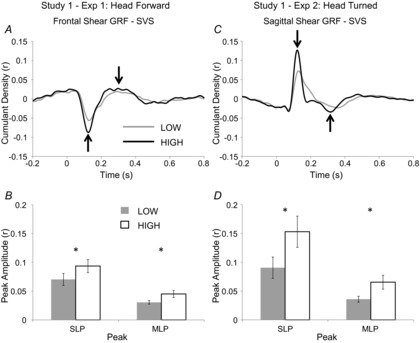
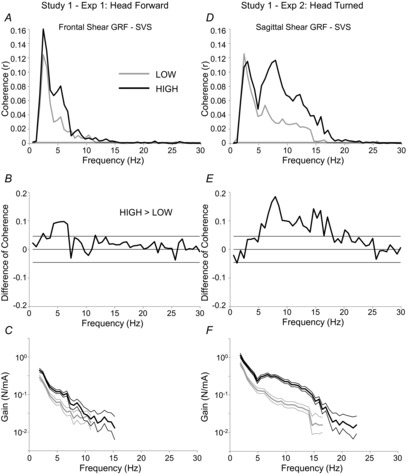
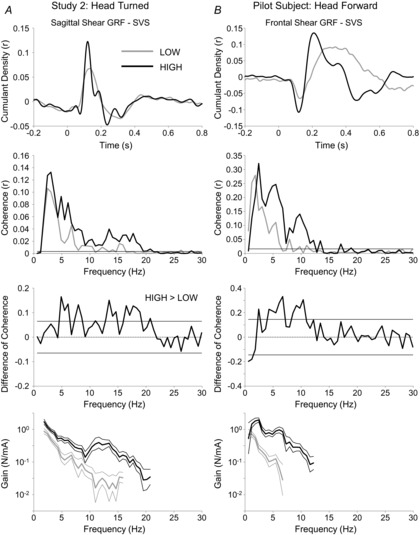
Anxiety and arousal have been shown to facilitate human vestibulo-ocular reflexes, presumably through direct neural connections between the vestibular nuclei and emotional processing areas of the brain. However, the effects of anxiety, fear and arousal on balance-relevant vestibular reflexes are currently unknown. The purpose of this study was to manipulate standing height to determine whether anxiety and fear can modulate the direct relationship between vestibular signals and balance reflexes during stance. Stochastic vestibular stimulation (SVS; 2-25 Hz) was used to evoke ground reaction forces (GRF) while subjects stood in both LOW and HIGH surface height conditions. Two separate experiments were conducted to investigate the SVS-GRF relationship, in terms of coupling (coherence and cumulant density) and gain, in the medio-lateral (ML) and antero-posterior (AP) directions. The short- and medium-latency cumulant density peaks were both significantly increased in the ML and AP directions when standing in HIGH, compared to LOW, conditions. Likewise, coherence was statistically greater between 4.3 Hz and 6.7 Hz in the ML, and between 5.5 and 17.7 Hz in the AP direction. When standing in the HIGH condition, the gain of the SVS-GRF relationship was increased 81% in the ML direction, and 231% in the AP direction. The significant increases in coupling and gain observed in both experiments demonstrate that vestibular-evoked balance responses are augmented in states of height-induced postural threat. These data support the possibility that fear or anxiety-mediated changes to balance control are affected by altered central processing of vestibular information.
© 2014 The Authors. The Journal of Physiology © 2014 The Physiological Society.
Figures
References
-
- Adkin AL, Frank JS, Carpenter MG, Peysar GW. Postural control is scaled to level of postural threat. Gait Posture. 2000;12:87–93. - PubMed
-
- Allum JH, Pfaltz CR. Visual and vestibular contributions to pitch sway stabilization in the ankle muscles of normals and patients with bilateral peripheral vestibular deficits. Exp Brain Res. 1985;58:82–94. - PubMed
-
- Amjad AM, Halliday DM, Rosenberg JR, Conway BA. An extended difference of coherence test for comparing and combining several independent coherence estimates: theory and application to the study of motor units and physiological tremor. J Neurosci Methods. 1997;73:69–79. - PubMed
Publication types
MeSH terms
LinkOut - more resources
Full Text Sources
Other Literature Sources
