


Impact of catheter fragmentation followed by local intrapulmonary thrombolysis in acute high risk pulmonary embolism as primary therapy
- PMID: 24973834
- PMCID: PMC4121751
- DOI: 10.1016/j.ihj.2014.03.024
Impact of catheter fragmentation followed by local intrapulmonary thrombolysis in acute high risk pulmonary embolism as primary therapy
Abstract
Background: Pulmonary embolism (PE) with more than 50% compromise of pulmonary circulation results significant right ventricular (RV) afterload leading to progressive RV failure, systemic hypotension and shock. Prompt restoration of thrombolysis, surgical embolectomy, or percutaneous mechanical thrombectomy (PMT) prevents progressive hemodynamic decline. We report our single center experience in high risk PE patients treated with standard pigtail catheter mechanical fragmentation followed by intrapulmonary thrombolysis as a primary therapy.
Methods: 50 consecutive patients with diagnosis of high risk PE defined as having shock index >1 with angiographic evidence of >50% pulmonary arterial occlusion are included in the present study. All patients underwent emergent cardiac catheterization. After ensuring flow across pulmonary artery with mechanical breakdown of embolus by rotating 5F pigtail catheter; bolus dose of urokinase (4400 IU/kg) followed by infusion for 24 h was given in the thrombus. Hemodynamic parameters were recorded and follow up pulmonary angiogram was done. Clinical and echo follow up was done for one year.
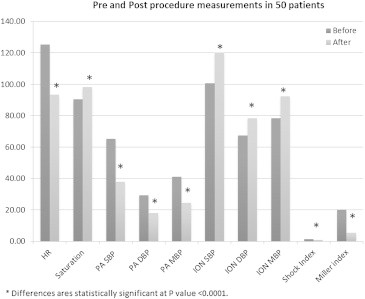
Results: Pigtail rotational mechanical thrombectomy restored antegrade flow in all patients. The mean pulmonary artery pressure, Miller score, Shock index decreased significantly from 41 ± 8 mmHg, 20 ± 5, 1.32 ± 0.3 to 24.52 ± 6.89, 5.35 ± 2.16, 0.79 ± 0.21 respectively (p < 0.0001). In-hospital major complications were seen in 4 patients. There was a statistically significant reduction of PA pressures from 62 ± 11 mmHg to 23±6 mmHg on follow up.
Conclusions: Rapid reperfusion of pulmonary arteries with mechanical fragmentation by pigtail catheter followed by intrapulmonary thrombolysis results in excellent immediate and intermediate term outcomes in patients presenting with high risk pulmonary embolism.
Keywords: Catheter fragmentation; Intrapulmonary; Pulmonary embolism; Thrombolysis.
Copyright © 2014. Published by Elsevier B.V.
Figures



References
-
- Heit J.A., Silverstein M.D., Mohr D.N. Predictors of survival after deep vein thrombosis and pulmonary embolism: a population-based cohort study. Arch Intern Med. 1999;159:445–453. - PubMed
-
- Wood K.E. Major pulmonary embolism: review of a pathophysiologic approach to the golden hour of hemodynamically significant pulmonary embolism. Chest. 2002;121:877–905. - PubMed
-
- Goldhaber S.Z., Visani L., De Rosa M., for ICOPER Acute pulmonary embolism: clinical outcomes in the International Cooperative Pulmonary Registry (ICOPER) Lancet. 1999;353:1386–1389. - PubMed
-
- Kucher N., Goldhaber S.Z. Management of massive pulmonary embolism. Circulation. 2005;112:e28–e32. - PubMed
-
- Uflacker R. Interventional therapy for pulmonary embolism. J Vasc Interv Radiol. 2001;12:147–164. - PubMed
MeSH terms
Substances
LinkOut - more resources
Full Text Sources
Other Literature Sources
Medical
