Review
. 2014 Aug;30(8):348-55.
doi: 10.1016/j.tig.2014.06.001. Epub 2014 Jun 25.

Transcriptional regulatory functions of nuclear long noncoding RNAs

Affiliations
Review

Transcriptional regulatory functions of nuclear long noncoding RNAs

Keith W Vance et al. Trends Genet. 2014 Aug.

Abstract

Several nuclear localised intergenic long noncoding RNAs (lncRNAs) have been ascribed regulatory roles in transcriptional control and their number is growing rapidly. Initially, these transcripts were shown to function locally, near their sites of synthesis, by regulating the expression of neighbouring genes. More recently, lncRNAs have been demonstrated to interact with chromatin at several thousand different locations across multiple chromosomes and to modulate large-scale gene expression programs. Although the molecular mechanisms involved in targeting lncRNAs to distal binding sites remain poorly understood, the spatial organisation of the genome may have a role in specifying lncRNA function. Recent advances indicate that intergenic lncRNAs may exert more widespread effects on gene regulation than previously anticipated.

Keywords: RNA–protein interactions; chromatin conformation; long noncoding RNA; transcription.


Figures

Figure 1
Figure 1
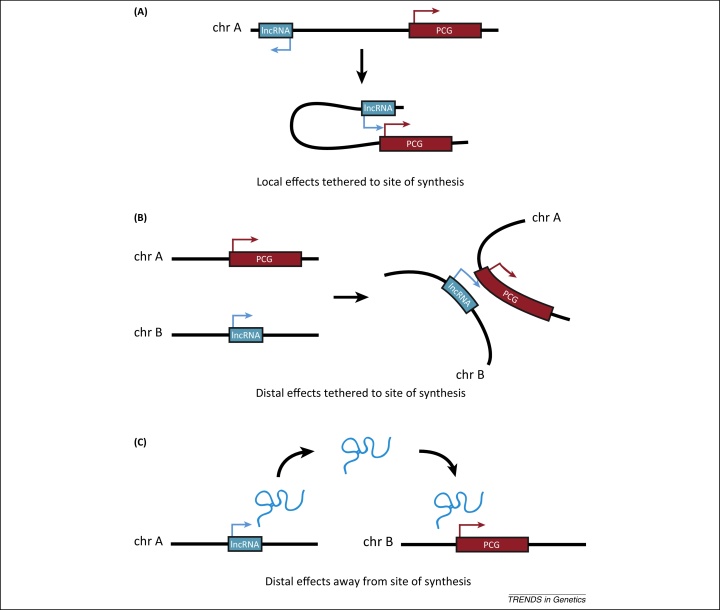
Local and distal modes of long noncoding RNA (lncRNA)-mediated transcriptional regulation. (A) DNA looping interactions bring a lncRNA locus into close physical proximity with a genomically adjacent protein coding gene (PCG). Such lncRNAs function close to their sites of synthesis to regulate the expression of nearby genes on the same chromosome. (B) Chromatin conformation changes bring two distantly located loci into close spatial proximity. lncRNAs in this category function close to their site of synthesis, but their genomic PCG targets are located on different or homologous chromosomes (chr). (C) lncRNAs translocate from their sites of synthesis to regulate transcription of distantly located target genes on the same or different chromosomes.
Figure 2
Figure 2
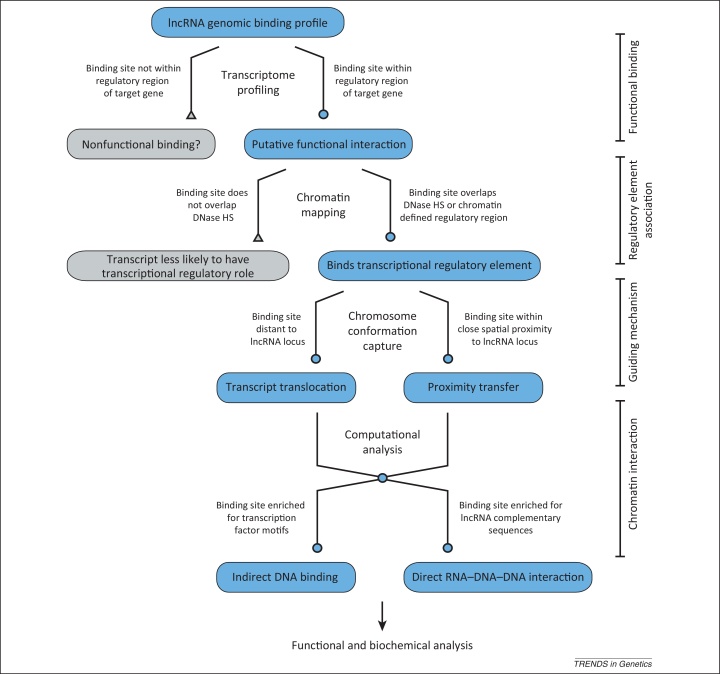
Workflow diagram detailing a combined experimental and computational pipeline for investigating trans-acting long noncoding RNA (lncRNA) transcriptional regulatory functions. Likely functional lncRNA genomic binding sites are identified within the regulatory regions of target genes that are differentially expressed upon lncRNA depletion or overexpression. Gene Ontology analyses of lncRNA bound and regulated genes provide clues regarding lncRNA function. Binding sites that associate with transcriptional regulatory regions are further selected for based on DNase I hypersensitive site mapping and chromatin status. Putative functional binding locations are integrated with chromosome conformation capture-based experiments to provide insights into the mechanism of genomic targeting. Computational sequence analyses generate predictions regarding how lncRNAs interact with DNA. These criteria are used to inform the design of reporter assays and biochemical experiments aimed at understanding trans-acting lncRNA function and mode of action at candidate loci.
Figure 3
Figure 3
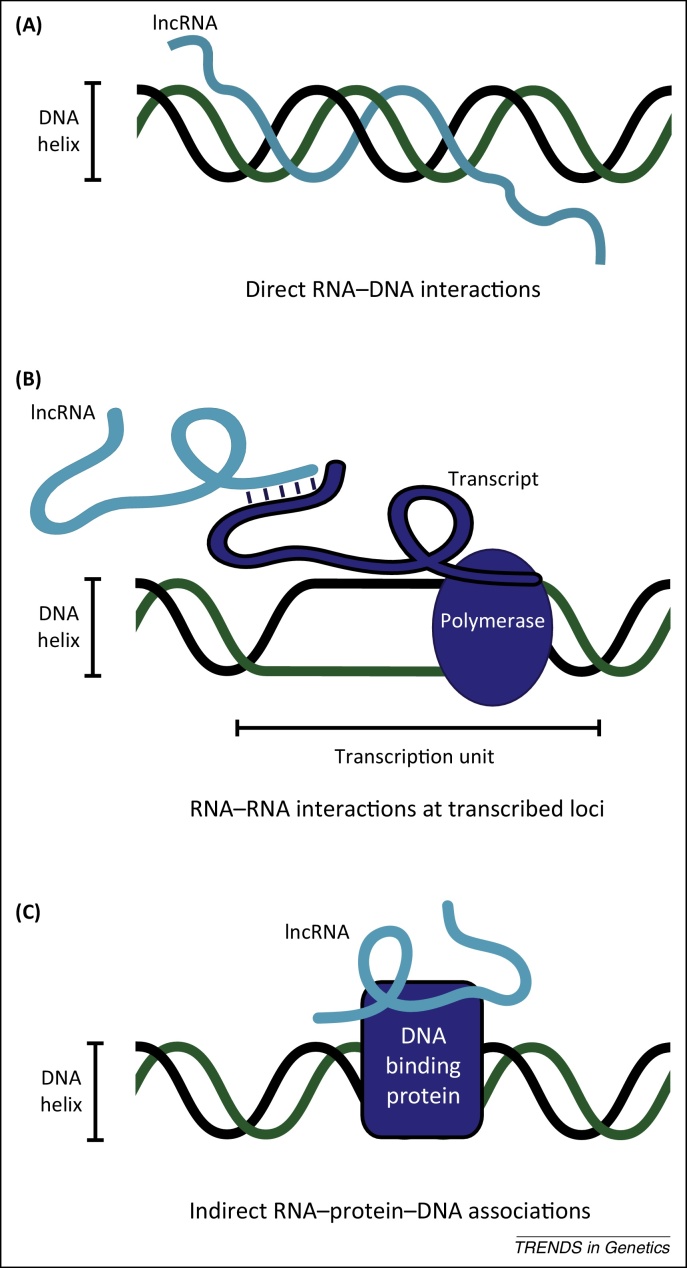
Different modes of long noncoding RNA (lncRNA)–chromatin association. (A) Single-stranded lncRNAs directly interact with complementary double-stranded DNA target sequences through hydrogen bonding to form a RNA-DNA-DNA triplex structure. lncRNAs are predicted to bind in the major groove of the DNA through either Hoogsteen or reverse Hoogsteen base pairing. (B) lncRNAs base pair with RNA sequences at transcribed loci. This may involve Watson–Crick base pairing (G–C, A–U) between complementary nucleotides as well as non-Watson–Crick base pairing (G–U, A–A) which does not require exact sequence complementarity. (C) Indirect recruitment of lncRNAs to the genome through RNA–protein–DNA interactions. This includes lncRNA associations with sequence specific DNA binding transcription factors, non-DNA binding transcriptional cofactors and histone proteins. Post-translational histone modifications, such as acetylation, methylation, and ubiquitination, may influence lncRNA–histone binding.

References

    1. Cabili M.N. Integrative annotation of human large intergenic noncoding RNAs reveals global properties and specific subclasses. Genes Dev. 2011;25:1915–1927. - PMC - PubMed
    1. Derrien T. The GENCODE v7 catalog of human long noncoding RNAs: analysis of their gene structure, evolution, and expression. Genome Res. 2012;22:1775–1789. - PMC - PubMed
    1. Marques A.C., Ponting C.P. Catalogues of mammalian long noncoding RNAs: modest conservation and incompleteness. Genome Biol. 2009;10:R124. - PMC - PubMed
    1. Ulitsky I., Bartel D.P. lincRNAs: genomics, evolution, and mechanisms. Cell. 2013;154:26–46. - PMC - PubMed
    1. Ponjavic J. Genomic and transcriptional co-localization of protein-coding and long non–coding RNA pairs in the developing brain. PLoS Genet. 2009;5:e1000617. - PMC - PubMed

Publication types

Substances

LinkOut - more resources