


Associations among emergency room visits, parenting styles, and psychopathology among pediatric patients with sickle cell
- PMID: 24975124
- PMCID: PMC5839133
- DOI: 10.1002/pbc.25141
Associations among emergency room visits, parenting styles, and psychopathology among pediatric patients with sickle cell
Abstract
Background: To examine associations between frequency of emergency room (ER) visits and various parenting styles, both conjointly and interactively, and psychopathological outcomes among pediatric patients with sickle cell disease (SCD).
Procedures: Ninety-eight parents/caregivers of 6- to 18-year-old patients with SCD completed instruments assessing parenting style, child psychopathology, and reported on the frequency of ER visits during the previous year.
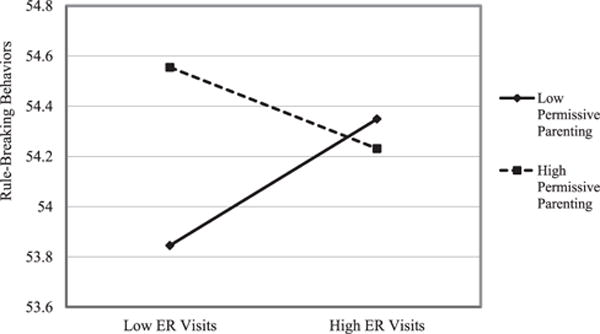
Results: ER visits were found to significantly explain Withdrawn/Depressed problems and parenting styles were found to incrementally contribute to the explanation of all forms of psychopathology. Further, Permissive parenting was found to explain Rule Breaking Behavior for those patients with low ER visit frequency but not for those with high ER visit frequency.
Conclusions: Results of the current study confirm the importance of considering both the frequency of ER visits and parenting style in the explanation of psychopathology among pediatric patients with SCD. Results have important implications for both research and treatment.
Keywords: healthcare utilization; parenting; psychopathology; sickle cell disease.
© 2014 Wiley Periodicals, Inc.
Conflict of interest statement
Conflict of interest: Nothing to declare.
Figures
References
-
- National Heart Lung and Blood Institute. Disease and conditions index Sickle cell anemia: Who is at risk? Bethesda, MD: US Department of Health and Human Services, National Institute of Health, National, Heart, Lung, and Blood Institute; 2009. Available from: http://www.nhlbi.nih.gov/health/dci/Diseases/Sca/SCA_WhoIsAtRisk.html.
-
- National Heart Lung and Blood Institute. What are the signs and symptoms of sickle cell anemia? Bethesda, MD: US Department of Health and Human Services, National Institutes of Health, National Heart, Lung, and Blood Institute; 2012. Available from: http://www.nhlbi.nih.gov/health/health-topics/topics/sca/signs.html.
-
- Platt OS, Thorington BD, Brambilla DJ, et al. Pain in sickle cell disease—Rates and risk factors. N Engl J Med. 1991;325:11–16. - PubMed
-
- Barbarin OA, Christian M. The social and cultural context of coping with sickle cell disease: I. A review of biomedical and psychosocial issues. J Black Psychol. 1999;25:277–293.
-
- Barakat LP, Lash LA, Lutz MJ, et al. Psychosocial adaptation of children and adolescents with sickle cell disease. In: Brown RT, editor. Comprehensive handbook of childhood cancer and sickle cell disease: A biopsychosocial approach. New York: Oxford; 2006. pp. 471–495.
MeSH terms
Grants and funding
LinkOut - more resources
Full Text Sources
Other Literature Sources
Medical
