Amylase activity is associated with AMY2B copy numbers in dog: implications for dog domestication, diet and diabetes
- PMID: 24975239
- PMCID: PMC4329415
- DOI: 10.1111/age.12179
Amylase activity is associated with AMY2B copy numbers in dog: implications for dog domestication, diet and diabetes
Abstract
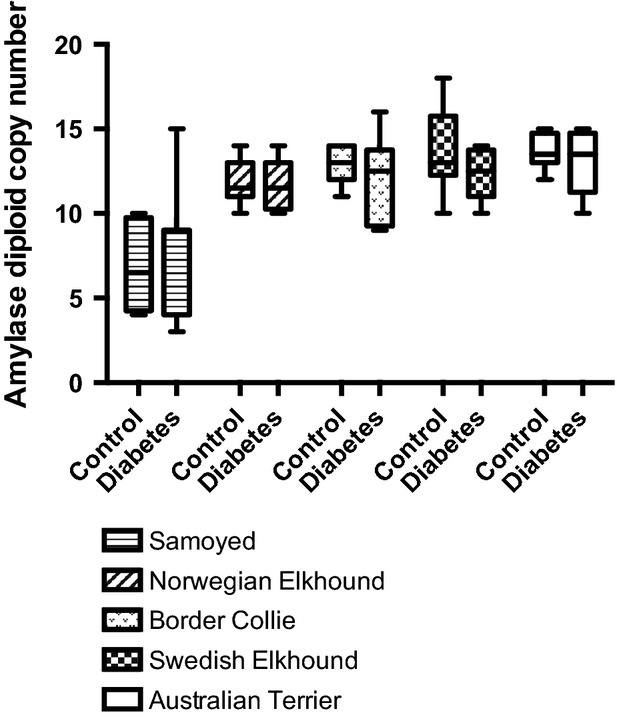
High amylase activity in dogs is associated with a drastic increase in copy numbers of the gene coding for pancreatic amylase, AMY2B, that likely allowed dogs to thrive on a relatively starch-rich diet during early dog domestication. Although most dogs thus probably digest starch more efficiently than do wolves, AMY2B copy numbers vary widely within the dog population, and it is not clear how this variation affects the individual ability to handle starch nor how it affects dog health. In humans, copy numbers of the gene coding for salivary amylase, AMY1, correlate with both salivary amylase levels and enzyme activity, and high amylase activity is related to improved glycemic homeostasis and lower frequencies of metabolic syndrome. Here, we investigate the relationship between AMY2B copy numbers and serum amylase activity in dogs and show that amylase activity correlates with AMY2B copy numbers. We then describe how AMY2B copy numbers vary in individuals from 20 dog breeds and find strong breed-dependent patterns, indicating that the ability to digest starch varies both at the breed and individual level. Finally, to test whether AMY2B copy number is strongly associated with the risk of developing diabetes mellitus, we compare copy numbers in cases and controls as well as in breeds with varying diabetes susceptibility. Although we see no such association here, future studies using larger cohorts are needed before excluding a possible link between AMY2B and diabetes mellitus.
Keywords: canine genetics; comparative genetics; starch digestion.
© 2014 The Authors. Animal Genetics published by John Wiley & Sons Ltd on behalf of Stichting International Foundation for Animal Genetics.
Figures

References
-
- Augustowska E. Polish Lowland Sheepdog. Allenhurst, NJ: Kennel Club Books; 2007.
-
- Axelsson E, Ratnakumar A, Arendt ML, Maqbool K, Webster MT, Perloski M, Liberg O, Arnemo JM, Hedhammar A. Lindblad-Toh K. The genomic signature of dog domestication reveals adaptation to a starch-rich diet. Nature. 2013;495:360–4. - PubMed
-
- Bank RA, Hettema EH, Muijs MA, Pals G, Arwert F, Boomsma DI. Pronk JC. Variation in gene copy number and polymorphism of the human salivary amylase isoenzyme system in Caucasians. Human Genetics. 1992;89:213–22. - PubMed
-
- Catchpole B, Adams JP, Holder AL, Short AD, Ollier WE. Kennedy LJ. Genetics of canine diabetes mellitus: are the diabetes susceptibility genes identified in humans involved in breed susceptibility to diabetes mellitus in dogs? The Veterinary Journal. 2013;195:139–47. - PubMed
-
- Fall T, Hemlin HH, Hedhammer Å, Kämpe O. Egenvall A. Diabetes mellitus in a population of 180,000 insured dogs: incidence, survival, and breed distribution. Journal of Veterinary Internal Medicine. 2007;21:1209–16. - PubMed
Publication types
MeSH terms
Substances
LinkOut - more resources
Full Text Sources
Other Literature Sources
Medical
Miscellaneous