


Internal validation of the renal pelvic score: a novel marker of renal pelvic anatomy that predicts urine leak after partial nephrectomy
- PMID: 24975712
- PMCID: PMC4115009
- DOI: 10.1016/j.urology.2014.05.001
Internal validation of the renal pelvic score: a novel marker of renal pelvic anatomy that predicts urine leak after partial nephrectomy
Abstract
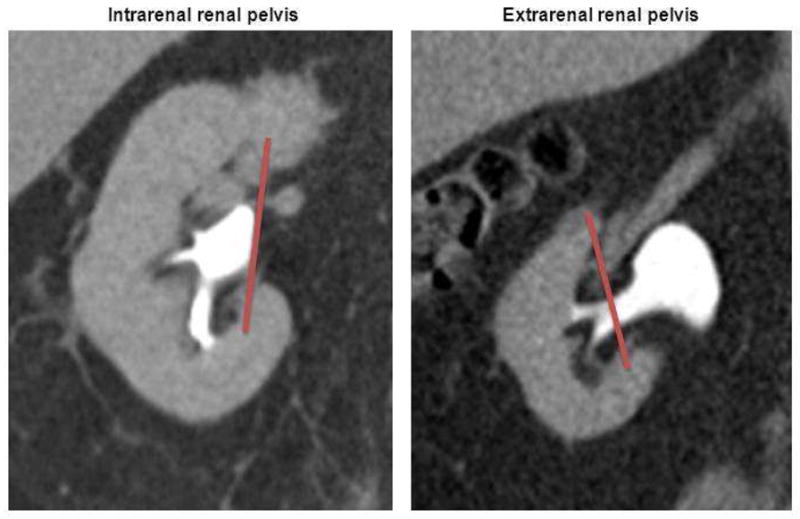
Objective: To internally validate the renal pelvic score (RPS) in an expanded cohort of patients undergoing partial nephrectomy (PN).
Materials and methods: Our prospective institutional renal cell carcinoma database was used to identify all patients undergoing PN for localized renal cell carcinoma from 2007 to 2013. Patients were classified by RPS as having an intraparenchymal or extraparenchymal renal pelvis. Multivariate logistic regression models were used to examine the relationship between RPS and urine leak.
Results: Eight hundred thirty-one patients (median age, 60 ± 11.6 years; 65.1% male) undergoing PN (57.3% robotic) for low (28.9%), intermediate (56.5%), and high complexity (14.5%) localized renal tumors (median size, 3.0 ± 2.3 cm; median nephrometry score, 7.0 ± 2.6) were included. Fifty-four patients (6.5%) developed a clinically significant or radiographically identified urine leak. Seventy-two of 831 renal pelvises (8.7%) were classified as intraparenchymal. Intrarenal pelvic anatomy was associated with a markedly increased risk of urine leak (43.1% vs 3.0%; P <.001), major urine leak requiring intervention (23.6% vs 1.7%; P <.001), and minor urine leak (19.4% vs 1.2%; P <.001) compared with that in patients with an extrarenal pelvis. After multivariate adjustment, RPS (intraparenchymal renal pelvis; odds ratio [OR], 24.8; confidence interval [CI], 11.5-53.4; P <.001) was the most predictive of urine leak as was tumor endophyticity ("E" score of 3 [OR, 4.5; CI, 1.3-15.5; P = .018]), and intraoperative collecting system entry (OR, 6.1; CI, 2.5-14.9; P <.001).
Conclusion: Renal pelvic anatomy as measured by the RPS best predicts urine leak after open and robotic partial nephrectomy. Although external validation of the RPS is required, preoperative identification of patients at increased risk for urine leak should be considered in perioperative management and counseling algorithms.
Copyright © 2014 Elsevier Inc. All rights reserved.
Figures
Comment in
-
Re: Internal validation of the renal pelvic score: a novel marker of renal pelvic anatomy that predicts urine leak after partial nephrectomy.J Urol. 2015 Apr;193(4):1151-2. doi: 10.1016/j.juro.2015.01.030. Epub 2015 Jan 19. J Urol. 2015. PMID: 25890510 No abstract available.
References
-
- Campbell SC, Novick AC, Belldegrun A, et al. Guideline for management of the clinical T1 renal mass. The Journal of urology. 2009;182:1271–1279. - PubMed
-
- Long CJ, Canter DJ, Kutikov A, et al. Partial nephrectomy for renal masses >/= 7 cm: technical, oncological and functional outcomes. BJU international. 2012;109:1450–1456. - PubMed
-
- Weight CJ, Larson BT, Gao T, et al. Elective partial nephrectomy in patients with clinical T1b renal tumors is associated with improved overall survival. Urology. 2010;76:631–637. - PubMed
-
- Van Poppel H, Da Pozzo L, Albrecht W, et al. A prospective randomized EORTC intergroup phase 3 study comparing the complications of elective nephron-sparing surgery and radical nephrectomy for low-stage renal cell carcinoma. European urology. 2007;51:1606–1615. - PubMed
-
- Stephenson AJ, Hakimi AA, Snyder ME, et al. Complications of radical and partial nephrectomy in a large contemporary cohort. The Journal of urology. 2004;171:130–134. - PubMed
Publication types
MeSH terms
Grants and funding
LinkOut - more resources
Full Text Sources
Other Literature Sources
Medical
