. 2014 Sep;23(9):1275-90.
doi: 10.1002/pro.2511. Epub 2014 Jul 22.

A maximum entropy approach to the study of residue-specific backbone angle distributions in α-synuclein, an intrinsically disordered protein

Affiliations

A maximum entropy approach to the study of residue-specific backbone angle distributions in α-synuclein, an intrinsically disordered protein

Alexey B Mantsyzov et al. Protein Sci. 2014 Sep.

Abstract

α-Synuclein is an intrinsically disordered protein of 140 residues that switches to an α-helical conformation upon binding phospholipid membranes. We characterize its residue-specific backbone structure in free solution with a novel maximum entropy procedure that integrates an extensive set of NMR data. These data include intraresidue and sequential H(N) − H(α) and H(N) − H(N) NOEs, values for (3) JHNHα, (1) JHαCα, (2) JCαN, and (1) JCαN, as well as chemical shifts of (15)N, (13)C(α), and (13)C' nuclei, which are sensitive to backbone torsion angles. Distributions of these torsion angles were identified that yield best agreement to the experimental data, while using an entropy term to minimize the deviation from statistical distributions seen in a large protein coil library. Results indicate that although at the individual residue level considerable deviations from the coil library distribution are seen, on average the fitted distributions agree fairly well with this library, yielding a moderate population (20-30%) of the PPII region and a somewhat higher population of the potentially aggregation-prone β region (20-40%) than seen in the database. A generally lower population of the αR region (10-20%) is found. Analysis of (1)H − (1)H NOE data required consideration of the considerable backbone diffusion anisotropy of a disordered protein.

Keywords: Karplus curve; diffusion anisotropy; intrinsically disordered proteins; random coil; short-range NOE.


Figures

Figure 1
Figure 1
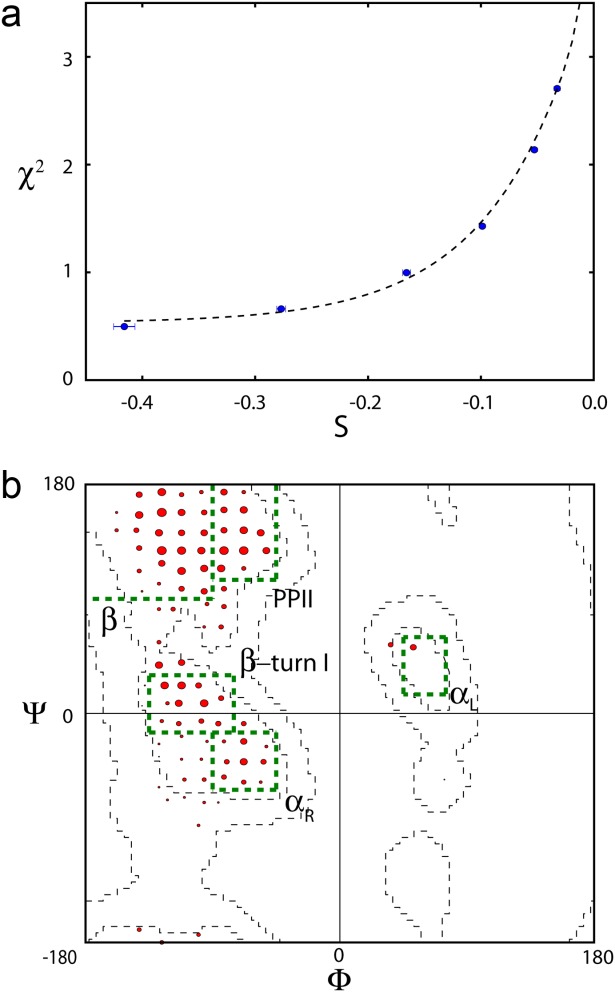
Example of distribution fitting of a residue's backbone angles to 10 independent experimental NMR parameters, shown for V40. (a) Plot of χ2 versus S, for calculations carried out at θ values of 0.4, 0.8, 1.6, 3, 6, and 10 (left to right). S = 0 corresponds to a ϕ/ψ distribution that matches that of the coil database. (b) Backbone conformational distribution at θ = 0.8. The population of each conformer is proportional to the area of the corresponding red circle. Green boxes mark secondary structure regions, β, PPII, type I β-turn, αR, and αL. Results shown in both panels represent averages over eight simulated annealing runs. Conformer populations for all nonGly/Pro residues with complete sets of 10 NMR parameters are shown in Supporting Information Figure 2.
Figure 2
Figure 2
Plot of 2JNCα values, previously reported by Schmidt et al. for a set of six proteins of known structure, supplemented by values measured by us for protein GB3 (unpublished data), against the intervening torsion angle ψ, taken from the corresponding high resolution X-ray structure. Values are shown only for residues with backbone chemical shift values that are consistent with the X-ray structure, as judged by the program TALOS-N. Red symbols correspond to Val, Ile, Thr, and Ser residues. Blue symbols are shown for all other residues. The solid line corresponds to 2JNCa = 8.15 − 1.51 cos(ψ) − 0.66 cos2(ψ) Hz, where ψ is the torsion angle of the residue on which 13Cα resides.
Figure 3
Figure 3
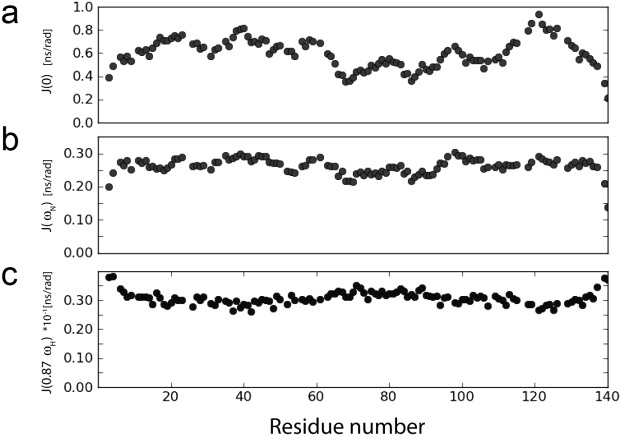
Spectral densities for backbone amide 15N–1H pairs in aS at 500 MHz, 15°C, obtained from reduced spectral density mapping of the relaxation rates listed in Supporting Information Table II. (a) J(0), (b) J(ωN), and (c) J(0.87ωH), for ωN = 50.6 × 2π rad/s and ωH = 499.5 × 2π rad/s. The spectral density values are also listed in Supporting Information Table III.
Figure 4
Figure 4
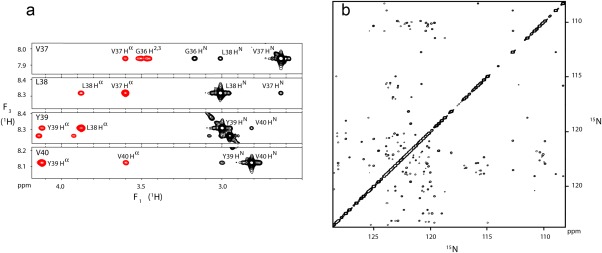
Examples of NOESY spectral data (100 ms NOE mixing; 15°C) recorded for aS. (a) Small regions of strips taken from the 900 MHz 3D 1H–15N–1H NOESY-HSQC spectrum. To achieve improved digital resolution, a narrow F1 spectral window (5.3 ppm) was used, resulting in aliasing and opposite signs of the amide signals (black contours) relative to the aliphatic signals (red). (b) Partial projection of the 15N–15N–1H 3D NOESY spectrum of aS (800 MHz) on the 15N–15N (F1, F2) plane, displaying HN–HN NOEs. The projection extends from 8.15 to 8.61 ppm in the 1H dimension.
Figure 5
Figure 5
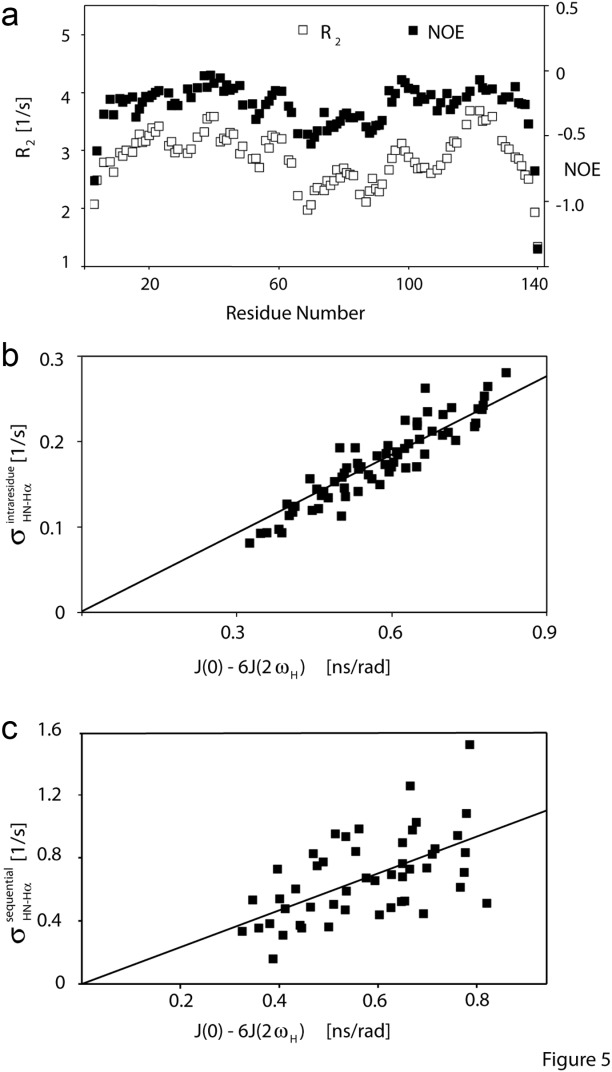
Variation in backbone dynamics of aS, reflected in substantial variations in (a) 15N transverse relaxation rates, R2 (open symbols), and 15N–{1H} NOE values (both at 500 MHz), and in the wide range of (b) intraresidue HN–Hα cross relaxation rates, σHN– (at 900 MHz), which closely correlate with the spectral densities derived from 15N-relaxation and (c) sequential Hα–HN cross relaxation rates, which also scale with 15N-relaxation derived spectral densities. Considerable scatter in (c) is indicative of residue-by-residue variation in the interproton distance distribution. Sample conditions: 0.2 mM 15N-enriched aS; pH 6, 20 mM sodium phosphate, 288 K.
Figure 6
Figure 6
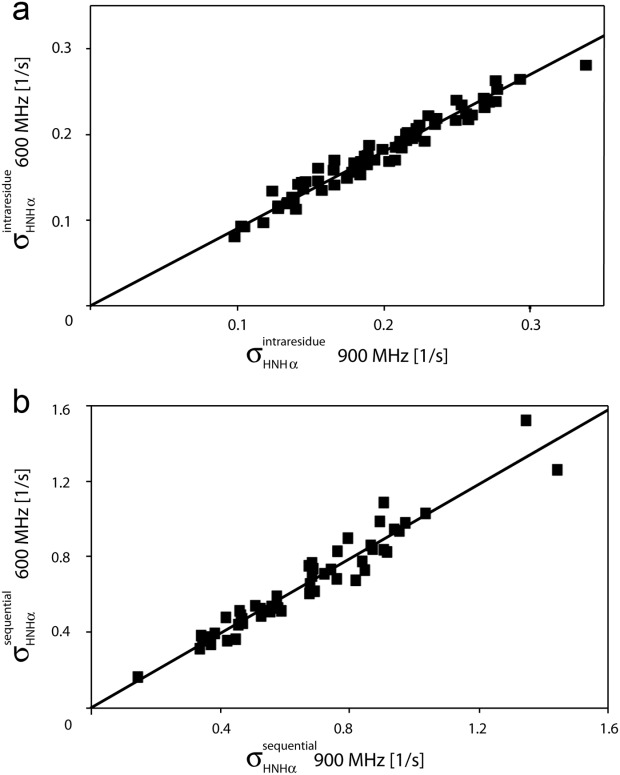
Correlation plot for the (a) intraresidueformula imageformula image and (b) sequentialformula imageformula image crossrelaxation rates measured at 600 and 900 MHz 1H frequency. For (b), which involves short interproton distances when the vector is approximately parallel to theformula imageformula image vector, the slope equals 0.99, indicating that the impact of the 6J(2ωH) term is negligible, considering that J(2ωH) is estimated to be about two-fold smaller at 900 MHz compared to 600 MHz 1H frequency. For the intraresidueformula imageformula image interaction, which makes a large angle with theformula imageformula image vector, the slope is ∼0.9, indicating that the 6J(2ωH) term is small (∼10% of J(0)).
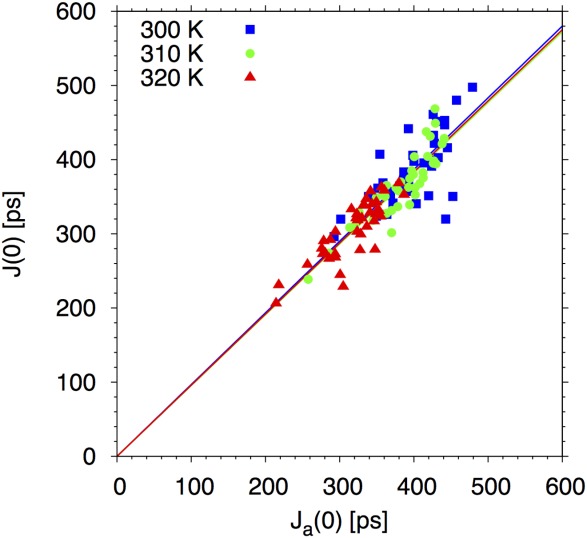
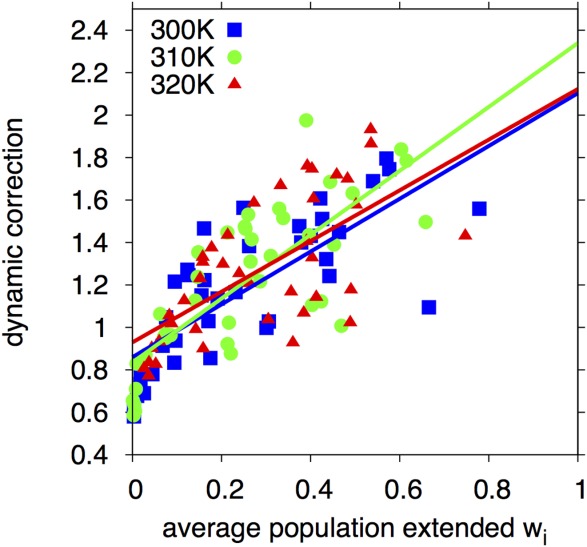
Figure 7
Figure 7
Scatter plot of the MD-derived total spectral density J(0) (y-axis) and of the spectral density Ja(0) for angular motion alone (x-axis) for sequential Hα–HN couplings. The symbols show results for the individual residues at each of the three simulation temperatures (blue squares: 300 K; green circles: 310 K; red triangles: 320 K). The lines show least-squares straight-line fits of the form J(0) = cJa(0) for each of the temperatures. The average slope of c = 0.96 ± 0.01 (with the error determined by the bootstrap method) indicates that rotational dynamics dominates the relaxation.
Figure 8
Figure 8
Dynamic correction [Eq. (7)] to J(0) for sequential Hα–HN couplings as a function of the weighted population [Eq. (8)] in the extended configuration. Results are shown for each residue at three temperatures (blue squares: 300 K; green circles: 310 K; red triangles: 320 K). The lines show least-squares straight-line fits for each of the temperatures. The ratio of the factors extrapolated to weights of 1 and 0 are 2.45, 2.80, and 2.28 at T = 300, 310, and 320 K, respectively. A global fit of all data gives a ratio of 2.51 ± 0.20, with the error determined by the bootstrap method. The simulation estimates for the correction are therefore fully consistent with the functional form of Eq. (6) and the maximum magnitude of 2.5 for the correction factor used in the analysis of the experimental NOE data.
Figure 9
Figure 9
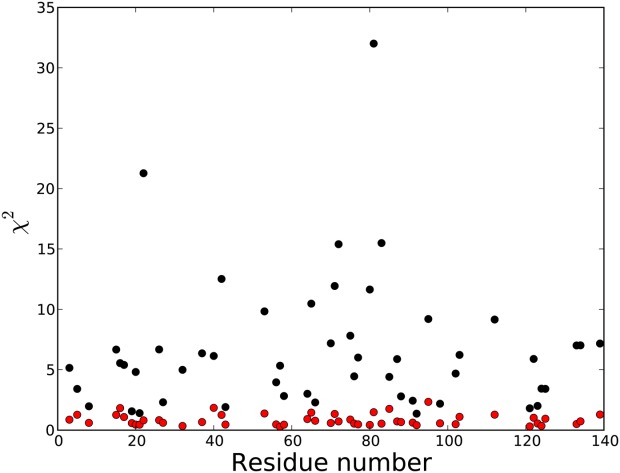
χ2 as a function of residue number, obtained when using the coil database populations of conformers to predict the experimentally observed parameters (black symbols) and when using the optimized populations of Supporting Information Figure 2 (red).
Figure 10
Figure 10
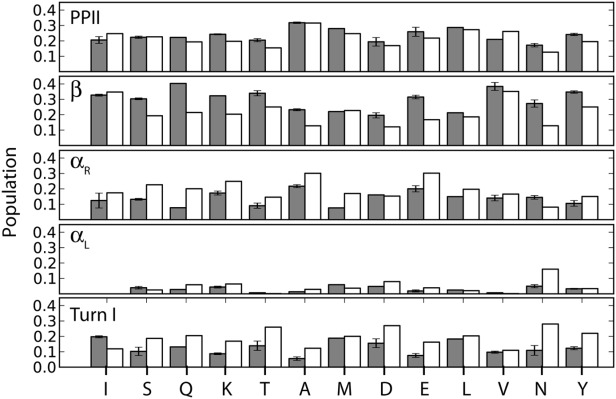
Average populations of the five regions marked in Figure 3(b): β, PPII, type I β-turn, αR, and αL, by residue type as observed in aS (gray bars), with the corresponding population in the coil library of Fitzkee et al. shown in white. Residue-specific values are presented in Supporting Information Fig. S3.

References

    1. Sickmeier M, Hamilton JA, LeGall T, Vacic V, Cortese MS, Tantos A, Szabo B, Tompa P, Chen J, Uversky VN, Obradovic Z, Dunker AK. DisProt: the database of disordered proteins. Nucleic Acid Res. 2007;35:D786–D793. - PMC - PubMed
    1. Dunker AK, Brown CJ, Lawson JD, Iakoucheva LM, Obradovic Z. Intrinsic disorder and protein function. Biochemistry. 2002;41:6573–6582. - PubMed
    1. Csizmok V, Felli IC, Tompa P, Banci L, Bertini I. Structural and dynamic characterization of intrinsically disordered human securin by NMR spectroscopy. J Am Chem Soc. 2008;130:16873–16879. - PubMed
    1. Dyson HJ, Wright PE. Intrinsically unstructured proteins and their functions. Nat Rev Mol Cell Biol. 2005;6:197–208. - PubMed
    1. Shi ZS, Chen K, Liu ZG, Kallenbach NR. Conformation of the backbone in unfolded proteins. Chem Rev. 2006;106:1877–1897. - PubMed

Publication types

MeSH terms

Substances

LinkOut - more resources