


A systematic review for anti-inflammatory property of clusiaceae family: a preclinical approach
- PMID: 24976853
- PMCID: PMC4058220
- DOI: 10.1155/2014/960258
A systematic review for anti-inflammatory property of clusiaceae family: a preclinical approach
Abstract
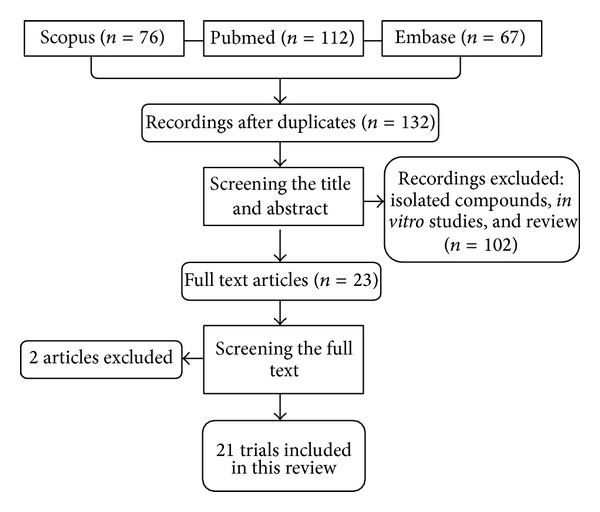
Background. Clusiaceae family (sensu lato) is extensively used in ethnomedicine for treating a number of disease conditions which include cancer, inflammation, and infection. The aim of this review is to report the pharmacological potential of plants of Clusiaceae family with the anti-inflammatory activity in animal experiments. Methods. A systematic review about experiments investigating anti-inflammatory activity of Clusiaceae family was carried out by searching bibliographic databases such as Medline, Scopus and Embase. In this update, the search terms were "anti-inflammatory agents," "Clusiaceae," and "animals, laboratory." Results. A total of 255 publications with plants this family were identified. From the initial 255 studies, a total of 21 studies were selected for the final analysis. Studies with genera Allanblackia, Clusia, Garcinia or Rheedia, and Hypericum showed significant anti-inflammatory activity. The findings include a decrease of total leukocytes, a number of neutrophils, total protein concentration, granuloma formation, and paw or ear edema formation. Other interesting findings included decreased of the MPO activity, and inflammatory mediators such as NF- κ B and iNOS expression, PGE2 and Il-1 β levels and a decrease in chronic inflammation. Conclusion. The data reported suggests the anti-inflammatory effect potential of Clusiaceae family in animal experiments.
Figures
References
-
- Medzhitov R. Origin and physiological roles of inflammation. Nature. 2008;454(7203):428–435. - PubMed
-
- Buckley CD, Pilling D, Lord JM, Akbar AN, Scheel-Toellner D, Salmon M. Fibroblasts regulate the switch from acute resolving to chronic persistent inflammation. Trends in Immunology. 2001;22(4):199–204. - PubMed
-
- Scarpignato C, Hunt RH. Nonsteroidal antiinflammatory drug-related injury to the gastrointestinal tract: clinical picture, pathogenesis, and prevention. Gastroenterology Clinics of North America. 2010;39(3):433–464. - PubMed
-
- Srinivasan K, Muruganandan S, Lal J, Chandra S, Tandan SK, Ravi Prakash V. Evaluation of anti-inflammatory activity of Pongamia pinnata leaves in rats. Journal of Ethnopharmacology. 2001;78(2-3):151–157. - PubMed
-
- da Silva Lima M, Quintans-Junior LJ, de Santana WA, Kaneto CM, Soares MBP, Villarreal CF. Anti-inflammatory effects of carvacrol: evidence for a key role of interleukin-10. European Journal of Pharmacology. 699(1–3):112–117. - PubMed
Publication types
LinkOut - more resources
Full Text Sources
Other Literature Sources
Research Materials
Miscellaneous
