Offline eLearning for undergraduates in health professions: A systematic review of the impact on knowledge, skills, attitudes and satisfaction
- PMID: 24976964
- PMCID: PMC4073241
- DOI: 10.7189/jogh.04.010405
Offline eLearning for undergraduates in health professions: A systematic review of the impact on knowledge, skills, attitudes and satisfaction
Abstract
Background: The world is short of 7.2 million health-care workers and this figure is growing. The shortage of teachers is even greater, which limits traditional education modes. eLearning may help overcome this training need. Offline eLearning is useful in remote and resource-limited settings with poor internet access. To inform investments in offline eLearning, we need to establish its effectiveness in terms of gaining knowledge and skills, students' satisfaction and attitudes towards eLearning.
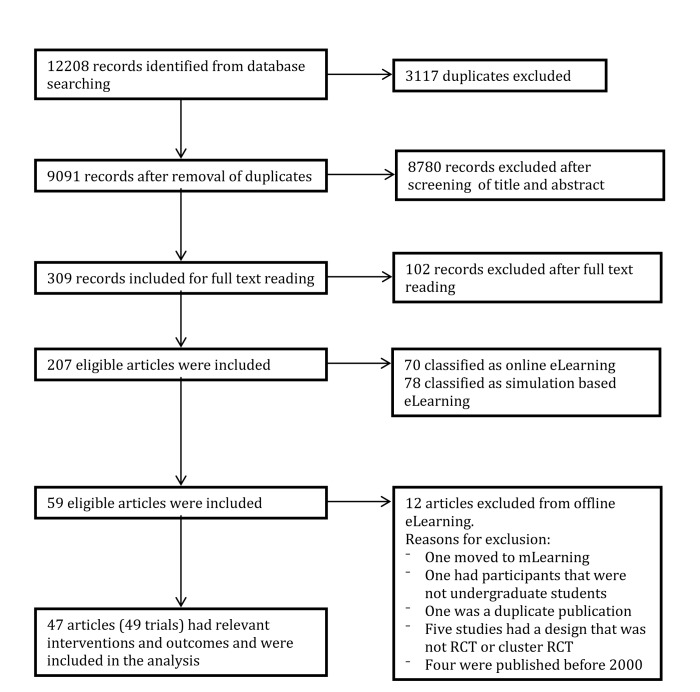
Methods: We conducted a systematic review of offline eLearning for students enrolled in undergraduate, health-related university degrees. We included randomised controlled trials that compared offline eLearning to traditional learning or an alternative eLearning method. We searched the major bibliographic databases in August 2013 to identify articles that focused primarily on students' knowledge, skills, satisfaction and attitudes toward eLearning, and health economic information and adverse effects as secondary outcomes. We also searched reference lists of relevant studies. Two reviewers independently extracted data from the included studies. We synthesized the findings using a thematic summary approach.
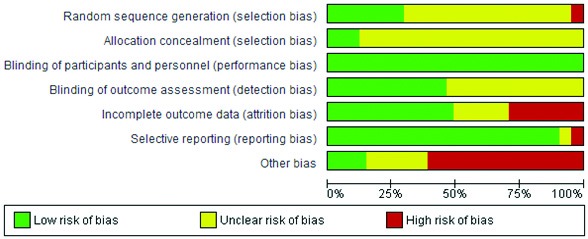
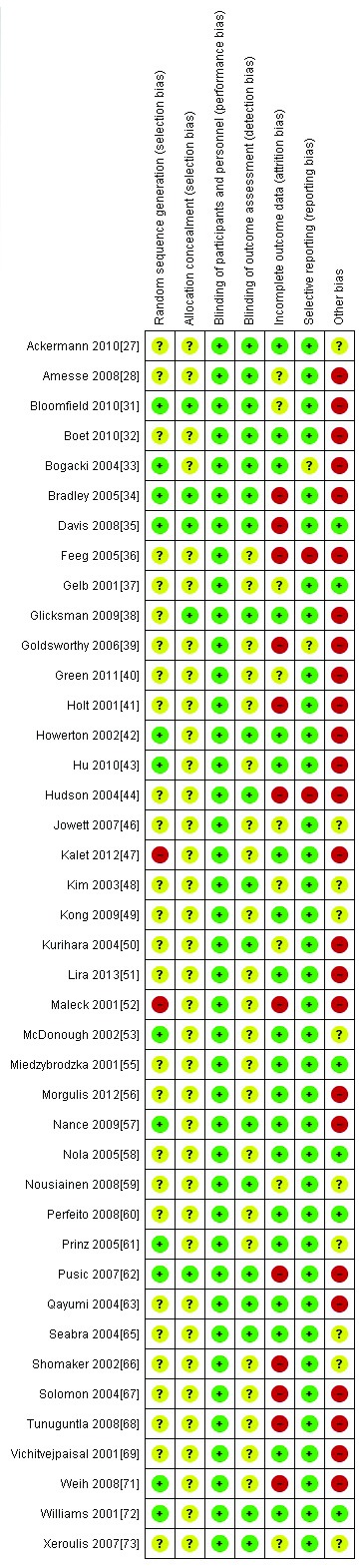
Findings: Forty-nine studies, including 4955 students enrolled in undergraduate medical, dentistry, nursing, psychology, or physical therapy studies, met the inclusion criteria. Eleven of the 33 studies testing knowledge gains found significantly higher gains in the eLearning intervention groups compared to traditional learning, whereas 21 did not detect significant differences or found mixed results. One study did not test for differences. Eight studies detected significantly higher skill gains in the eLearning intervention groups, whilst the other 5 testing skill gains did not detect differences between groups. No study found offline eLearning as inferior. Generally no differences in attitudes or preference of eLearning over traditional learning were observed. No clear trends were found in the comparison of different modes of eLearning. Most of the studies were small and subject to several biases.
Conclusions: Our results suggest that offline eLearning is equivalent and possibly superior to traditional learning regarding knowledge, skills, attitudes and satisfaction. Although a robust conclusion cannot be drawn due to variable quality of the evidence, these results justify further investment into offline eLearning to address the global health care workforce shortage.
Figures
References
-
- World Health Organization. Global health workforce shortage to reach 12.9 million in coming decades. 2013. Available from: http://www.who.int/mediacentre/news/releases/2013/health–workforce–short... Accessed: 29 May 2014.
-
- World Health Organization. Working together for health: the World Health Report 2006. WHO Press. Geneva, 2006. Available from: http://whqlibdoc.who.int/publications/2006/9241563176_eng.pdf Accessed: 30 May 2014.
-
- The Global Workforce Alliance. Making Health Workers Count The Global Workforce Alliance 2012 Annual Health Report. Geneva: WHO, 2012.
-
- World Health Organization. Millennium Development Goals (MDGs). 2000. Available from: http://www.who.int/topics/millennium_development_goals/about/en/ Accessed: 28 May 2014.
-
- Ellis RA, Goodyear P. Students’ experiences of e–learning in higher education: the ecology of sustainable innovation. London: Taylor Francis, Routledge, 2010.
Grants and funding
LinkOut - more resources
Full Text Sources
Other Literature Sources
Miscellaneous