


Mating behavior, male sensory cilia, and polycystins in Caenorhabditis elegans
- PMID: 24977333
- PMCID: PMC4680976
- DOI: 10.1016/j.semcdb.2014.06.001
Mating behavior, male sensory cilia, and polycystins in Caenorhabditis elegans
Abstract
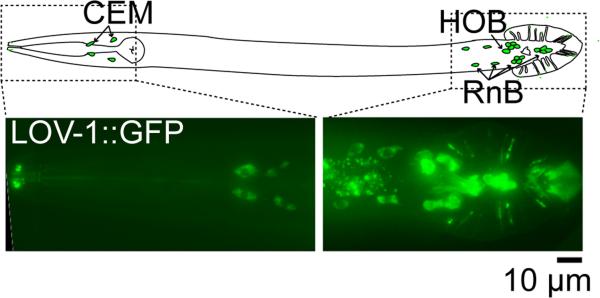
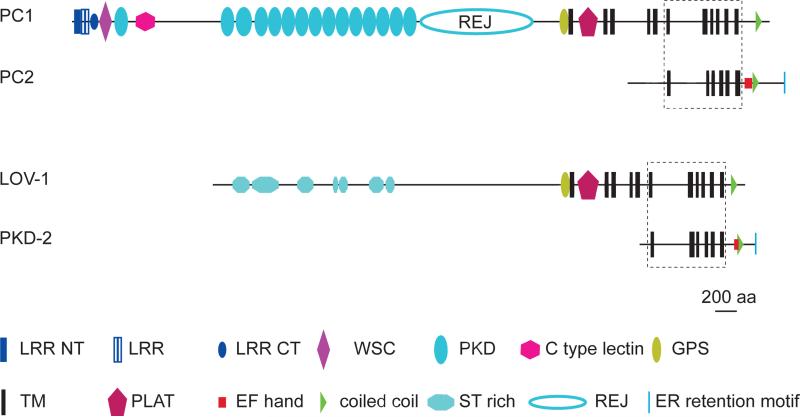
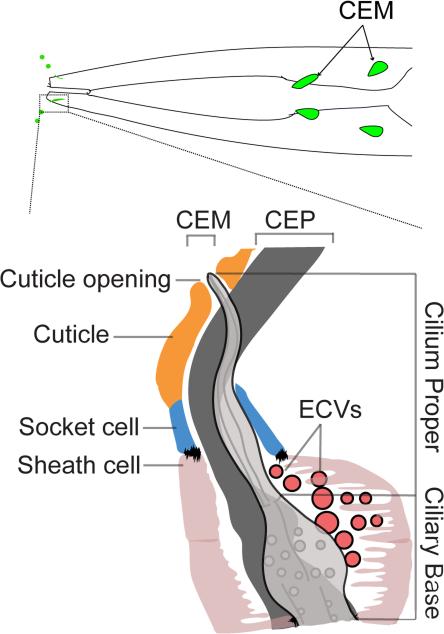
The investigation of Caenorhabditis elegans males and the male-specific sensory neurons required for mating behaviors has provided insight into the molecular function of polycystins and mechanisms that are needed for polycystin ciliary localization. In humans, polycystin 1 and polycystin 2 are needed for kidney function; loss of polycystin function leads to autosomal dominant polycystic kidney disease (ADPKD). Polycystins localize to cilia in C. elegans and mammals, a finding that has guided research into ADPKD. The discovery that the polycystins form ciliary receptors in male-specific neurons needed for mating behaviors has also helped to unlock insights into two additional exciting new areas: the secretion of extracellular vesicles; and mechanisms of ciliary specialization. First, we will summarize the studies done in C. elegans regarding the expression, localization, and function of the polycystin 1 and 2 homologs, LOV-1 and PKD-2, and discuss insights gained from this basic research. Molecules that are co-expressed with the polycystins in the male-specific neurons may identify evolutionarily conserved molecular mechanisms for polycystin function and localization. We will discuss the finding that polycystins are secreted in extracellular vesicles that evoke behavioral change in males, suggesting that such vesicles provide a novel form of communication to conspecifics in the environment. In humans, polycystin-containing extracellular vesicles are secreted in urine and can be taken up by cilia, and quickly internalized. Therefore, communication by polycystin-containing extracellular vesicles may also use mechanisms that are evolutionarily conserved from nematode to human. Lastly, different cilia display structural and functional differences that specialize them for particular tasks, despite the fact that virtually all cilia are built by a conserved intraflagellar transport (IFT) mechanism and share some basic structural features. Comparative analysis of the male-specific cilia with the well-studied cilia of the amphid and phasmid neurons has allowed identification of molecules that specialize the male cilia. We will discuss the molecules that shape the male-specific cilia. The cell biology of cilia in male-specific neurons demonstrates that C. elegans can provide an excellent model of ciliary specialization.
Keywords: Cilia; Ciliopathies; Mating behavior; Polycystins; Sensory biology; TRP channel.
Copyright © 2014 Elsevier Ltd. All rights reserved.
Figures
References
-
- Silverman MA, Leroux MR. Intraflagellar transport and the generation of dynamic, structurally and functionally diverse cilia. Trends Cell Biol. 2009;19:306–316. - PubMed
-
- Bisgrove BW, Yost HJ. The roles of cilia in developmental disorders and disease. Development. 2006;133:4131–4143. - PubMed
-
- Menco BP, Morrison EE. Morphology of the mammalian olfactory epithelium: Form, fine structure, function, and pathology. In: Doty R, editor. Handbook of Olfaction and Gustation. Marcel Dekker; New York: 2003. pp. 17–49.
Publication types
MeSH terms
Substances
Grants and funding
LinkOut - more resources
Full Text Sources
Other Literature Sources
Miscellaneous