


Effect of heat and heat acclimatization on cycling time trial performance and pacing
- PMID: 24977692
- PMCID: PMC4342312
- DOI: 10.1249/MSS.0000000000000428
Effect of heat and heat acclimatization on cycling time trial performance and pacing
Abstract
Purpose: This study aimed to determine the effects of heat acclimatization on performance and pacing during outdoor cycling time trials (TT, 43.4 km) in the heat.
Methods: Nine cyclists performed three TT in hot ambient conditions (TTH, approximately 37°C) on the first (TTH-1), sixth (TTH-2), and 14th (TTH-3) days of training in the heat. Data were compared with the average of two TT in cool condition (approximately 8°C) performed before and after heat acclimatization (TTC).
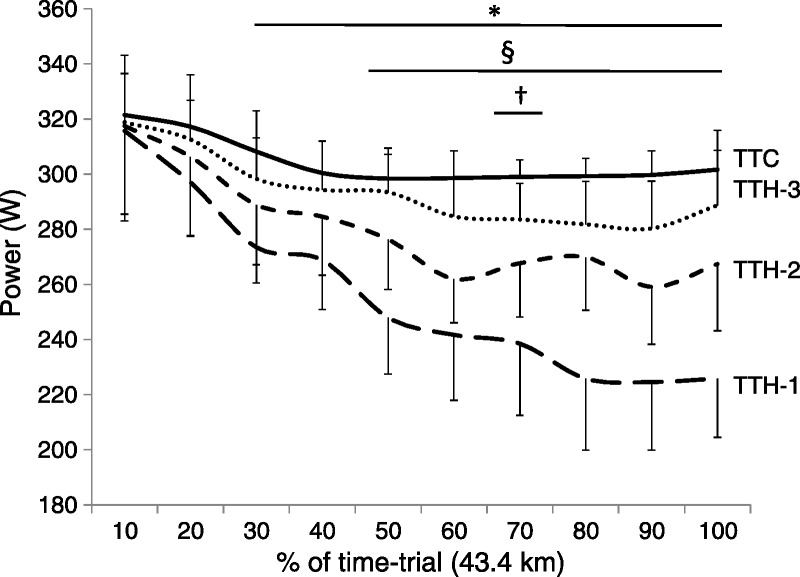
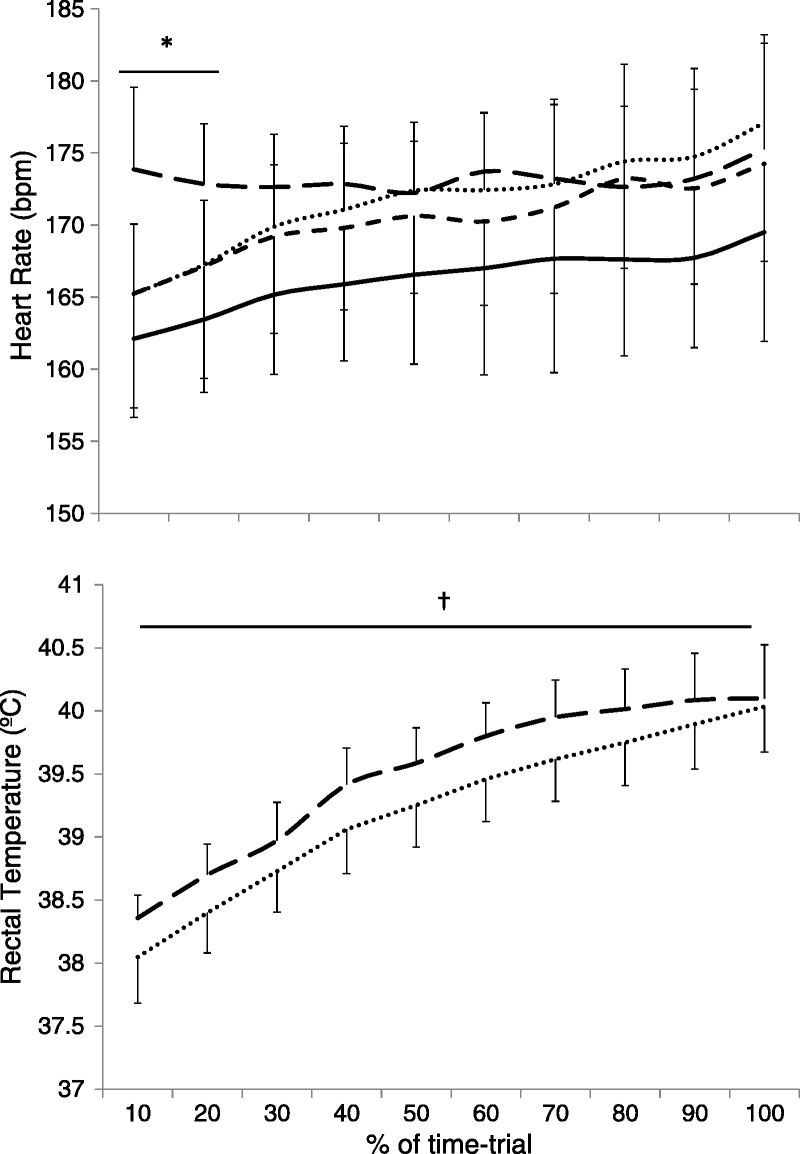
Results: TTH-1 (77 ± 6 min) was slower (P = 0.001) than TTH-2 (69 ± 5 min), and both were slower (P < 0.01) than TTC and TTH-3 (66 ± 3 and 66 ± 4 min, respectively), without differences between TTC and TTH-3 (P > 0.05). The cyclists initiated the first 20% of all TT at a similar power output, irrespective of climate and acclimatization status; however, during TTH-1, they subsequently had a marked decrease in power output, which was partly attenuated after 6 d of acclimatization and was further reduced after 14 d. HR was higher during the first 20% of TTH-1 than that in the other TT (P < 0.05), but there were no differences between conditions from 30% onward. Final rectal temperature was similar in all TTH (40.2°C ± 0.4°C, P = 1.000) and higher than that in TTC (38.5°C ± 0.6°C, P < 0.001).
Conclusions: After 2 wk of acclimatization, trained cyclists are capable of completing a prolonged TT in a similar time in the heat compared with cool conditions, whereas in the unacclimatized state, they experienced a marked decrease in power output during the TTH.
Figures
Comment in
-
Time trial performance and pacing in heat is determined by rate of heat gain.Med Sci Sports Exerc. 2015 Jan;47(1):218. doi: 10.1249/MSS.0000000000000487. Med Sci Sports Exerc. 2015. PMID: 25501395 No abstract available.
-
Response.Med Sci Sports Exerc. 2015 Jan;47(1):219. doi: 10.1249/MSS.0000000000000488. Med Sci Sports Exerc. 2015. PMID: 25501396 No abstract available.
References
-
- Arngrimsson SA, Stewart DJ, Borrani F, Skinner KA, Cureton KJ. Relation of heart rate to percent VO2 peak during submaximal exercise in the heat. J Appl Physiol (1985). 2003; 94: 1162– 8. - PubMed
-
- Barwood MJ, Corbett J, White D, James J. Early change in thermal perception is not a driver of anticipatory exercise pacing in the heat. Br J Sports Med. 2012; 46: 936– 42. - PubMed
-
- Basset DR, Jr, Kyle CR, Passfield L, Broker JR, Burke ER. Comparing cycling world hour records, 1967–1996: modeling with empirical data. Med Sci Sports Exerc. 1999; 31 (11): 1665– 76. - PubMed
-
- Byrne C, Lee JK, Chew SA, Lim CL, Tan EY. Continuous thermoregulatory responses to mass-participation distance running in heat. Med Sci Sports Exerc. 2006; 38 (5): 803– 10. - PubMed
-
- Dawson NJ, De Freitas CR, Mackey WK, Young AA. The stressful microclimate created by massed fun- runners. Trans Menzies Found. 1987; 14: 41– 4.
Publication types
MeSH terms
LinkOut - more resources
Full Text Sources
