Review
. 2014 Aug;107(2):164-71.
doi: 10.1097/HP.0000000000000082.

2013 Dade W. Moeller lecture: medical countermeasures against radiological terrorism

Affiliations
Review

2013 Dade W. Moeller lecture: medical countermeasures against radiological terrorism

John E Moulder. Health Phys. 2014 Aug.

Abstract

Soon after the 9-11 attacks, politicians and scientists began to question our ability to cope with a large-scale radiological terrorism incident. The outline of what was needed was fairly obvious: the ability to prevent such an attack, methods to cope with the medical consequences, the ability to clean up afterward, and the tools to figure out who perpetrated the attack and bring them to justice. The medical response needed three components: the technology to determine rapidly the radiation doses received by a large number of people, methods for alleviating acute hematological radiation injuries, and therapies for mitigation and treatment of chronic radiation injuries. Research done to date has shown that a realistic medical response plan is scientifically possible, but the regulatory and financial barriers to achieving this may currently be insurmountable.


Figures
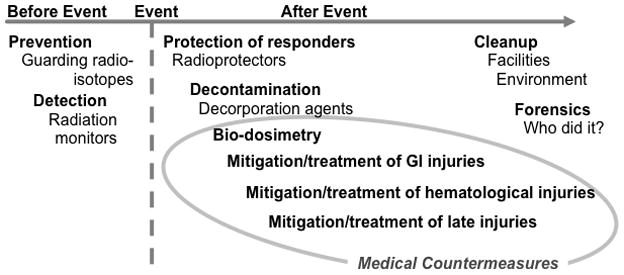
Figure 1
Figure 1
The components of a complete radiological terrorism countermeasures program. Adapted with permission (Moulder and Medhora 2011).
Figure 2
Figure 2
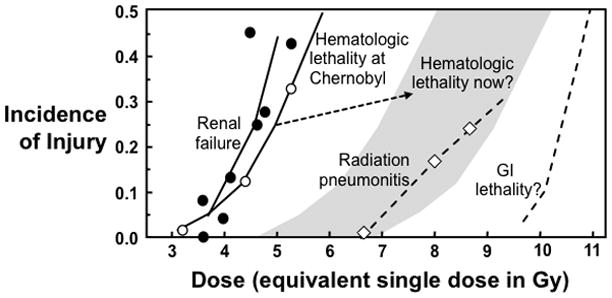
The relationship between total body irradiation (TBI) dose and morbidity. Data is shown for hematopoietic lethality after the Chernobyl accident (Mould 1988) and for what that lethality dose-response curve might look if a similar incident happened now (gray area). Data are also shown for radiation-induced chronic renal failure (Moulder and Cohen 2005), and pneumonitis (van Dyk et al. 1981) in humans. The dose-response curve for human GI lethality is speculative, based on data for nonhuman primates (MacVittie et al. 2012) and the limited data that is available for humans (Anno et al. 2003). Adapted with permission (Moulder and Medhora 2011).
Figure 3
Figure 3
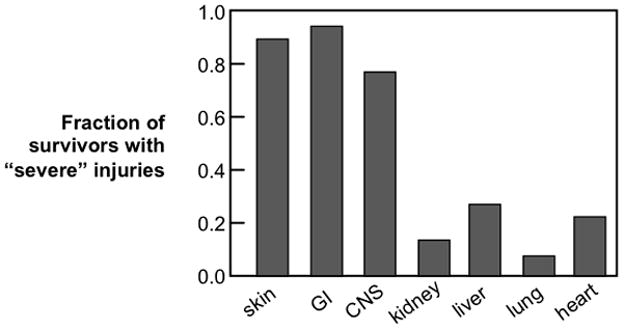
Non-hematological injuries in radiation accident survivors who had severe hematological injuries and who survived at least 90 days (Fliedner et al. 2005).
Figure 4
Figure 4
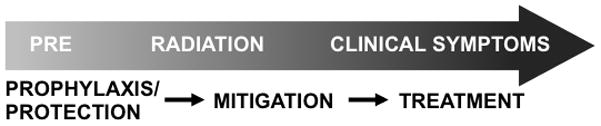
Recommended terminology for therapeutic approaches to radiation-induced normal tissue injuries (Stone et al. 2004).
Figure 5
Figure 5
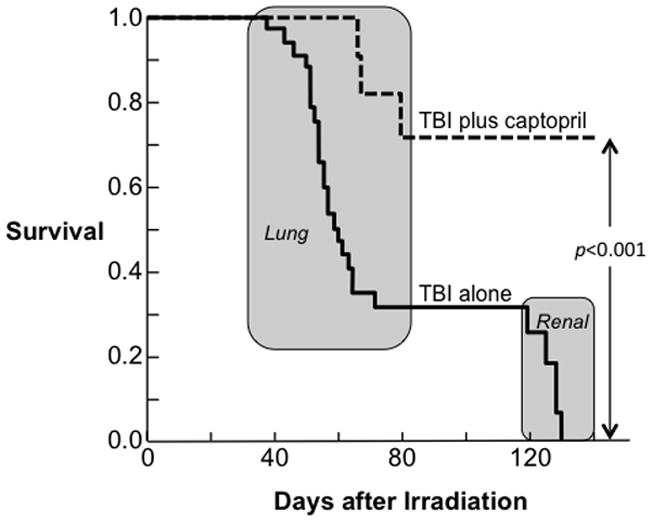
Mitigation of multiple organ system failure by the ACE inhibitor, captopril, after 11.5 Gy TBI plus a bone marrow transplant in a rat model. Kaplan-Meier plots for morbidity show the effects of captopril (176 mg/m2/day) started 7 days after irradiation and continued. Captopril significantly reduced morbidity during both the pneumonitis and the nephropathy phases as determined by Peto-Peto Wilcoxon tests. Adapted with permission (Medhora et al. 2013).
Figure 6
Figure 6
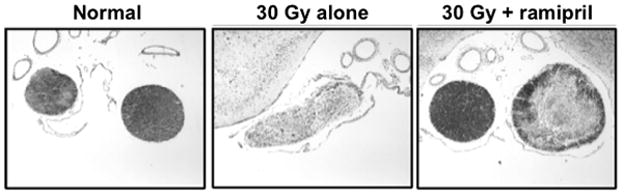
Effect of the ACE inhibitor ramipril on radiation injury to the optic nerve (Kim et al. 2004). Shown are histological sections (stained with Luxol Fast Blue for myelin) from representative rats 180 days after receiving 30 Gy to the optic chiasm: an untreated age-matched control rat, a rat that received irradiation alone, and a rat that received irradiation and daily administrations of ramipril (1.5mg/kg/day) in the drinking water starting 2 weeks after irradiation. Images are “blow-ups” of the optic nerve regions obtained using 4x magnification with a 10x eye lens objective. The corresponding semi-quantitative histology analysis (Luxol Fast Blue Optical Density, scale 1–256) yielded: 209±18 (mean±sd) for the control (n=3), 66±10 for irradiation alone (n=4) and 160±44 for irradiation plus ramipril (n=4).
Figure 7
Figure 7
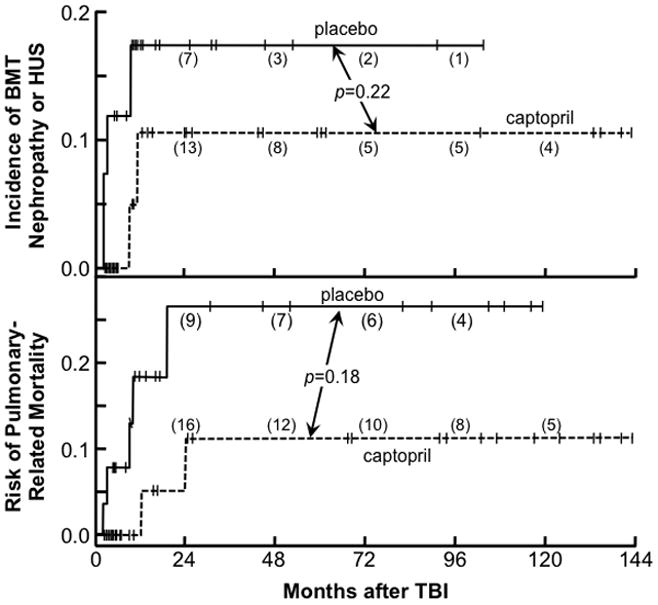
The cumulative incidence of bone marrow transplant (BMT) nephropathy (top) and pulmonary-related mortality (bottom) after total body irradiation (TBI) as conditioning for BMT according to use of captopril or placebo (Cohen et al. 2012). Cases censored are shown as vertical bars and the number at risk at 24 month intervals is shown in parentheses; not shown are placebo cases censored for pulmonary-related mortality at 1.8, 2.2, and 2.3 months and for nephropathy at 1.8, 1.9, 2.2, 2.3 and 2.7 months.

References

    1. Acevedo SF, McGinnis G, Raber J. Effects of 137Cs γ irradiation on cognitive performance and measures of anxiety in Apoe−/− and wild-type female mice. Radiat Res. 2008;170:422–428. - PubMed
    1. Aebersold P. FDA experience with medical countermeasures under the Animal Rule. Adv Prev Med. 2012;2012:507571. - PMC - PubMed
    1. Anno GH, McClellan GE, Dore MA. Protracted radiation-induced performance decrement. Volume 1: Model development. Santa Monica, United States: Pacific-Sierra Research Corporation; 1995.
    1. Anno GH, Young RW, Bloom RM, Mercier JR. Dose response relationships for acute ionizing-radiation lethality. Health Phys. 2003;84:565–75. - PubMed
    1. Baker JE, Moulder JE, Hopewell JW. Radiation as a risk factor for cardiovascular disease. Antiox Redox Signal. 2011;15:1945–1956. - PMC - PubMed

Publication types