Systematic fine-mapping of association with BMI and type 2 diabetes at the FTO locus by integrating results from multiple ethnic groups
- PMID: 24978468
- PMCID: PMC4076329
- DOI: 10.1371/journal.pone.0101329
Systematic fine-mapping of association with BMI and type 2 diabetes at the FTO locus by integrating results from multiple ethnic groups
Abstract
Background/objective: The 16q12.2 locus in the first intron of FTO has been robustly associated with body mass index (BMI) and type 2 diabetes in genome-wide association studies (GWAS). To improve the resolution of fine-scale mapping at FTO, we performed a systematic approach consisting of two parts.
Methods: The first part is to partition the associated variants into linkage disequilibrium (LD) clusters, followed by conditional and haplotype analyses. The second part is to filter the list of potential causal variants through trans-ethnic comparison.
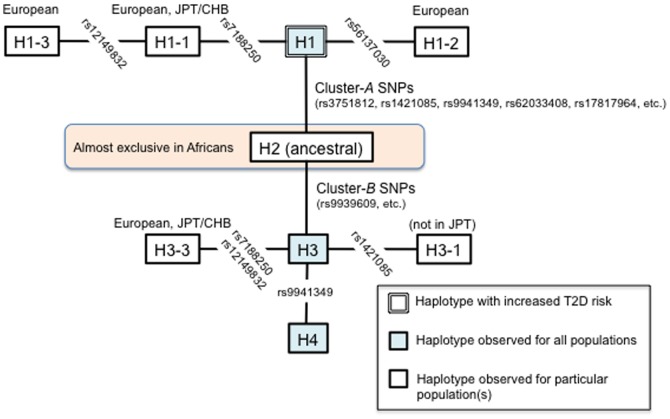
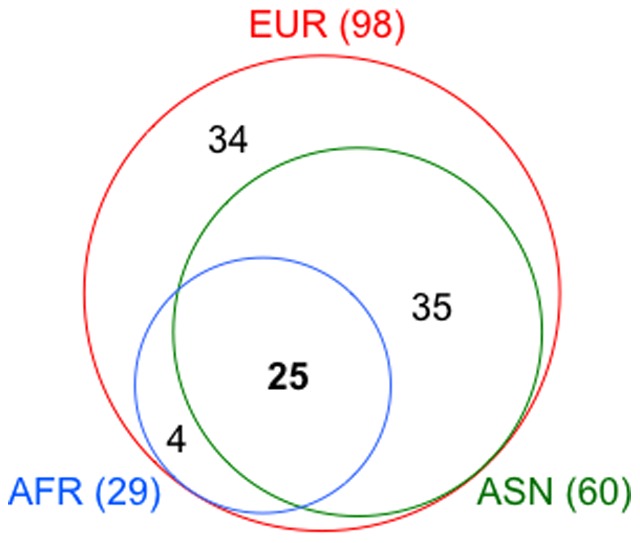
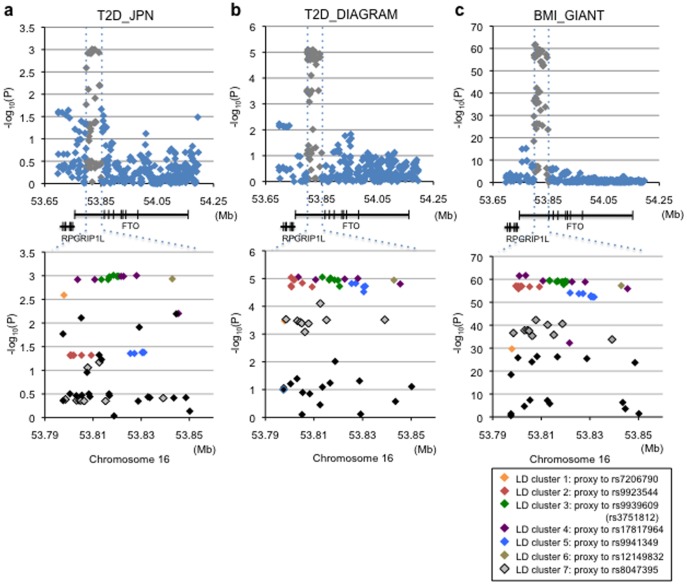
Results: We first examined the LD relationship between FTO SNPs showing significant association with type 2 diabetes in Japanese GWAS and between those previously reported in European GWAS. We could partition all the assayed or imputed SNPs showing significant association in the target FTO region into 7 LD clusters. Assaying 9 selected SNPs in 4 Asian-descent populations--Japanese, Vietnamese, Sri Lankan and Chinese (n≤26,109 for BMI association and n≤24,079 for type 2 diabetes association), we identified a responsible haplotype tagged by a cluster of SNPs and successfully narrowed the list of potential causal variants to 25 SNPs, which are the smallest in number among the studies conducted to date for FTO.
Conclusions: Our data support that the power to resolve the causal variants from those in strong LD increases consistently when three distant populations--Europeans, Asians and Africans--are included in the follow-up study. It has to be noted that this fine-mapping approach has the advantage of applicability to the existing GWAS data set in combination with direct genotyping of selected variants.
Conflict of interest statement
Figures
Similar articles
-
A systematic mapping approach of 16q12.2/FTO and BMI in more than 20,000 African Americans narrows in on the underlying functional variation: results from the Population Architecture using Genomics and Epidemiology (PAGE) study.PLoS Genet. 2013;9(1):e1003171. doi: 10.1371/journal.pgen.1003171. Epub 2013 Jan 17. PLoS Genet. 2013. PMID: 23341774 Free PMC article.
-
FTO variants are associated with obesity in the Chinese and Malay populations in Singapore.Diabetes. 2008 Oct;57(10):2851-7. doi: 10.2337/db08-0214. Epub 2008 Jul 3. Diabetes. 2008. PMID: 18599522 Free PMC article.
-
Functional genomic characterization of the FTO locus in African Americans.Physiol Genomics. 2019 Nov 1;51(11):517-528. doi: 10.1152/physiolgenomics.00057.2019. Epub 2019 Sep 18. Physiol Genomics. 2019. PMID: 31530225 Free PMC article.
-
Fine mapping of the association with obesity at the FTO locus in African-derived populations.Hum Mol Genet. 2010 Jul 15;19(14):2907-16. doi: 10.1093/hmg/ddq178. Epub 2010 Apr 29. Hum Mol Genet. 2010. PMID: 20430937 Free PMC article.
-
Implications of critical PPARγ2, ADIPOQ and FTO gene polymorphisms in type 2 diabetes and obesity-mediated susceptibility to type 2 diabetes in an Indian population.Mol Genet Genomics. 2016 Feb;291(1):193-204. doi: 10.1007/s00438-015-1097-4. Epub 2015 Aug 5. Mol Genet Genomics. 2016. PMID: 26243686
Cited by
-
Technologies, strategies, and cautions when deconvoluting genome-wide association signals: FTO in focus.Obes Rev. 2023 May;24(5):e13558. doi: 10.1111/obr.13558. Epub 2023 Mar 7. Obes Rev. 2023. PMID: 36882962 Free PMC article. Review.
-
Gene-environment interactions in the associations of PFAS exposure with insulin sensitivity and beta-cell function in a Faroese cohort followed from birth to adulthood.Environ Res. 2023 Jun 1;226:115600. doi: 10.1016/j.envres.2023.115600. Epub 2023 Mar 1. Environ Res. 2023. PMID: 36868448 Free PMC article.
-
Assessing efficiency of fine-mapping obesity-associated variants through leveraging ancestry architecture and functional annotation using PAGE and UKBB cohorts.Hum Genet. 2023 Oct;142(10):1477-1489. doi: 10.1007/s00439-023-02593-7. Epub 2023 Sep 1. Hum Genet. 2023. PMID: 37658231 Free PMC article.
-
Trans-ethnic fine-mapping of genetic loci for body mass index in the diverse ancestral populations of the Population Architecture using Genomics and Epidemiology (PAGE) Study reveals evidence for multiple signals at established loci.Hum Genet. 2017 Jun;136(6):771-800. doi: 10.1007/s00439-017-1787-6. Epub 2017 Apr 8. Hum Genet. 2017. PMID: 28391526 Free PMC article.
-
Complete re-sequencing of a 2Mb topological domain encompassing the FTO/IRXB genes identifies a novel obesity-associated region upstream of IRX5.Genome Med. 2015 Dec 7;7:126. doi: 10.1186/s13073-015-0250-3. Genome Med. 2015. PMID: 26642925 Free PMC article.
References
-
- Teo YY, Ong RT, Sim X, Tai ES, Chia KS (2010) Identifying candidate causal variants via trans-population fine-mapping. Genet Epidemiol 34: 653–664. - PubMed
Publication types
MeSH terms
Substances
Grants and funding
LinkOut - more resources
Full Text Sources
Other Literature Sources
Medical
Research Materials