Effect of patients' risks and preferences on health gains with plasma glucose level lowering in type 2 diabetes mellitus
- PMID: 24979148
- PMCID: PMC4299865
- DOI: 10.1001/jamainternmed.2014.2894
Effect of patients' risks and preferences on health gains with plasma glucose level lowering in type 2 diabetes mellitus
Abstract
Importance: Type 2 diabetes mellitus is common, and treatment to correct blood glucose levels is standard. However, treatment burden starts years before treatment benefits accrue. Because guidelines often ignore treatment burden, many patients with diabetes may be overtreated.
Objective: To examine how treatment burden affects the benefits of intensive vs moderate glycemic control in patients with type 2 diabetes.
Design, setting, and participants: We estimated the effects of hemoglobin A1c (HbA1c) reduction on diabetes outcomes and overall quality-adjusted life years (QALYs) using a Markov simulation model. Model probabilities were based on estimates from randomized trials and observational studies. Simulated patients were based on adult patients with type 2 diabetes drawn from the National Health and Nutrition Examination Study.
Interventions: Glucose lowering with oral agents or insulin in type 2 diabetes.
Main outcomes and measures: Main outcomes were QALYs and reduction in risk of microvascular and cardiovascular diabetes complications.
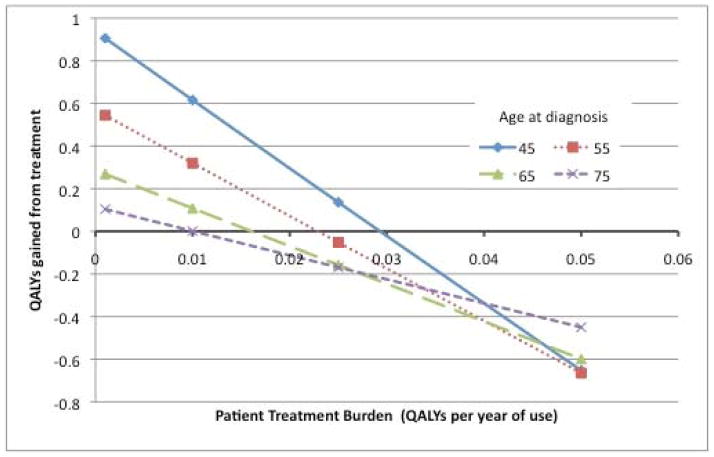
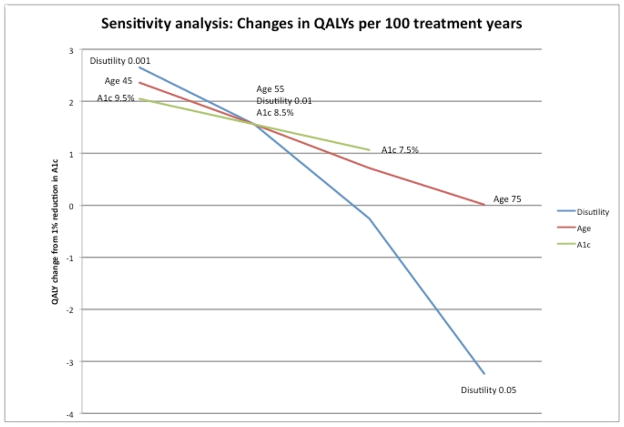
Results: Assuming a low treatment burden (0.001, or 0.4 lost days per year), treatment that lowered HbA1c level by 1 percentage point provided benefits ranging from 0.77 to 0.91 QALYs for simulated patients who received a diagnosis at age 45 years to 0.08 to 0.10 QALYs for those who received a diagnosis at age 75 years. An increase in treatment burden (0.01, or 3.7 days lost per year) resulted in HbA1c level lowering being associated with more harm than benefit in those aged 75 years. Across all ages, patients who viewed treatment as more burdensome (0.025-0.05 disutility) experienced a net loss in QALYs from treatments to lower HbA1c level.
Conclusions and relevance: Improving glycemic control can provide substantial benefits, especially for younger patients; however, for most patients older than 50 years with an HbA1c level less than 9% receiving metformin therapy, additional glycemic treatment usually offers at most modest benefits. Furthermore, the magnitude of benefit is sensitive to patients' views of the treatment burden, and even small treatment adverse effects result in net harm in older patients. The current approach of broadly advocating intensive glycemic control should be reconsidered; instead, treating patients with HbA1c levels less than 9% should be individualized on the basis of estimates of benefit weighed against the patient's views of the burdens of treatment.
Conflict of interest statement
Disclosures: No conflicts on interest regarding this work.
Figures
Comment in
-
[Is intensive glycemic control for patients with type 2 diabetes profitable? - Diabetes therapy should be more individualised].Dtsch Med Wochenschr. 2014 Oct;139(44):2224. doi: 10.1055/s-0033-1353924. Epub 2014 Oct 21. Dtsch Med Wochenschr. 2014. PMID: 25334072 German. No abstract available.
References
-
- National Committee for Quality Assurance. HEDIS 2013 [Internet] 2013 Available from: http://www.ncqa.org/HEDISQualityMeasurement/HEDISMeasures/HEDIS2013.aspx.
-
- UK Prospective Diabetes Study (UKPDS) Group. Intensive blood-glucose control with sulphonylureas or insulin compared with conventional treatment and risk of complications in patients with type 2 diabetes (UKPDS 33) Lancet. 1998;352:837–53. - PubMed
-
- Holman RR, Paul SK, Bethel MA, Matthews DR, Neil HA. 10-year follow-up of intensive glucose control in type 2 diabetes. The New England journal of medicine. 2008;359:1577–89. - PubMed
Publication types
MeSH terms
Substances
Grants and funding
LinkOut - more resources
Full Text Sources
Other Literature Sources
Medical