. 2014 Jun 30:2014:bau061.
doi: 10.1093/database/bau061. Print 2014.

Finding needles in haystacks: linking scientific names, reference specimens and molecular data for Fungi

Conrad L Schoch  1 Barbara Robbertse  1 Vincent Robert  1 Duong Vu  1 Gianluigi Cardinali  1 Laszlo Irinyi  1 Wieland Meyer  1 R Henrik Nilsson  1 Karen Hughes  1 Andrew N Miller  1 Paul M Kirk  1 Kessy Abarenkov  1 M Catherine Aime  1 Hiran A Ariyawansa  1 Martin Bidartondo  1 Teun Boekhout  1 Bart Buyck  1 Qing Cai  1 Jie Chen  1 Ana Crespo  1 Pedro W Crous  1 Ulrike Damm  1 Z Wilhelm De Beer  1 Bryn T M Dentinger  1 Pradeep K Divakar  1 Margarita Dueñas  1 Nicolas Feau  1 Katerina Fliegerova  1 Miguel A García  1 Zai-Wei Ge  1 Gareth W Griffith  1 Johannes Z Groenewald  1 Marizeth Groenewald  1 Martin Grube  1 Marieka Gryzenhout  1 Cécile Gueidan  1 Liangdong Guo  1 Sarah Hambleton  1 Richard Hamelin  1 Karen Hansen  1 Valérie Hofstetter  1 Seung-Beom Hong  1 Jos Houbraken  1 Kevin D Hyde  1 Patrik Inderbitzin  1 Peter R Johnston  1 Samantha C Karunarathna  1 Urmas Kõljalg  1 Gábor M Kovács  1 Ekaphan Kraichak  1 Krisztina Krizsan  1 Cletus P Kurtzman  1 Karl-Henrik Larsson  1 Steven Leavitt  1 Peter M Letcher  1 Kare Liimatainen  1 Jian-Kui Liu  1 D Jean Lodge  1 Janet Jennifer Luangsa-ard  1 H Thorsten Lumbsch  1 Sajeewa S N Maharachchikumbura  1 Dimuthu Manamgoda  1 María P Martín  1 Andrew M Minnis  1 Jean-Marc Moncalvo  1 Giuseppina Mulè  1 Karen K Nakasone  1 Tuula Niskanen  1 Ibai Olariaga  1 Tamás Papp  1 Tamás Petkovits  1 Raquel Pino-Bodas  1 Martha J Powell  1 Huzefa A Raja  1 Dirk Redecker  1 J M Sarmiento-Ramirez  1 Keith A Seifert  1 Bhushan Shrestha  1 Soili Stenroos  1 Benjamin Stielow  1 Sung-Oui Suh  1 Kazuaki Tanaka  1 Leho Tedersoo  1 M Teresa Telleria  1 Dhanushka Udayanga  1 Wendy A Untereiner  1 Javier Diéguez Uribeondo  1 Krishna V Subbarao  1 Csaba Vágvölgyi  1 Cobus Visagie  1 Kerstin Voigt  1 Donald M Walker  1 Bevan S Weir  1 Michael Weiß  1 Nalin N Wijayawardene  1 Michael J Wingfield  1 J P Xu  1 Zhu L Yang  1 Ning Zhang  1 Wen-Ying Zhuang  1 Scott Federhen  1
Affiliations

Finding needles in haystacks: linking scientific names, reference specimens and molecular data for Fungi

Conrad L Schoch et al. Database (Oxford). .

Abstract

DNA phylogenetic comparisons have shown that morphology-based species recognition often underestimates fungal diversity. Therefore, the need for accurate DNA sequence data, tied to both correct taxonomic names and clearly annotated specimen data, has never been greater. Furthermore, the growing number of molecular ecology and microbiome projects using high-throughput sequencing require fast and effective methods for en masse species assignments. In this article, we focus on selecting and re-annotating a set of marker reference sequences that represent each currently accepted order of Fungi. The particular focus is on sequences from the internal transcribed spacer region in the nuclear ribosomal cistron, derived from type specimens and/or ex-type cultures. Re-annotated and verified sequences were deposited in a curated public database at the National Center for Biotechnology Information (NCBI), namely the RefSeq Targeted Loci (RTL) database, and will be visible during routine sequence similarity searches with NR_prefixed accession numbers. A set of standards and protocols is proposed to improve the data quality of new sequences, and we suggest how type and other reference sequences can be used to improve identification of Fungi. Database URL: http://www.ncbi.nlm.nih.gov/bioproject/PRJNA177353.


Figures

Figure 1.
Figure 1.
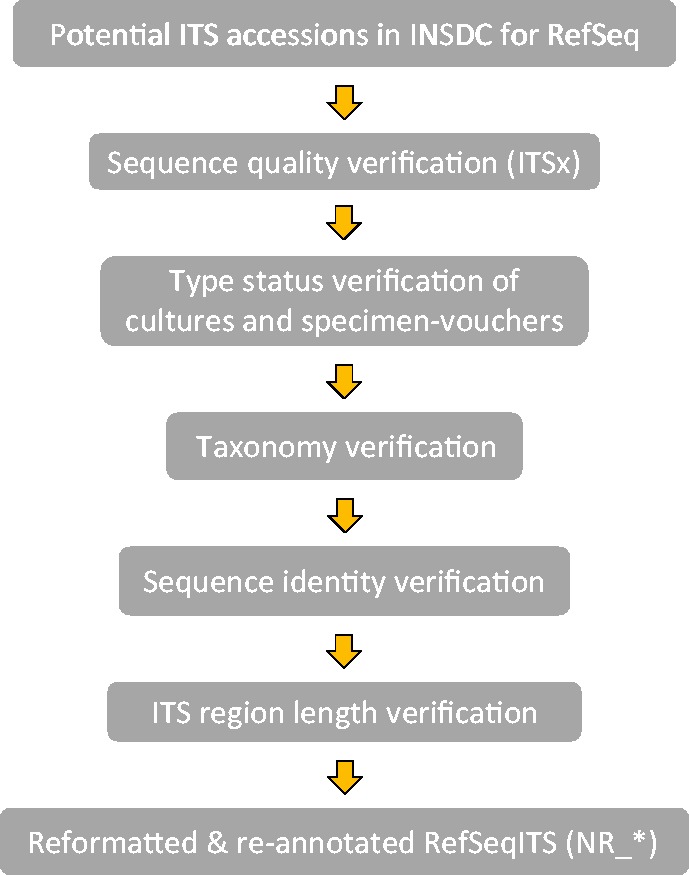
Workflow of the ITS verification for RTL ITS.
Figure 2.
Figure 2.
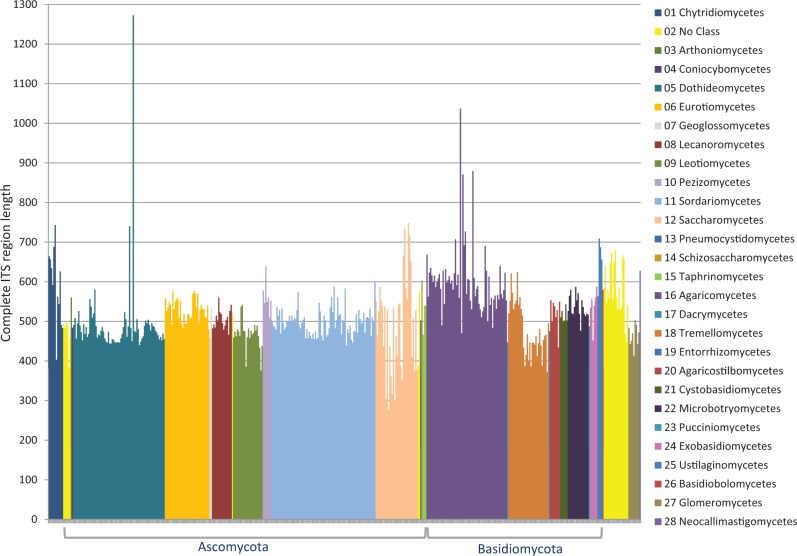
ITS length variation of complete ITS regions in the RTL data set according to class.
Figure 3.
Figure 3.
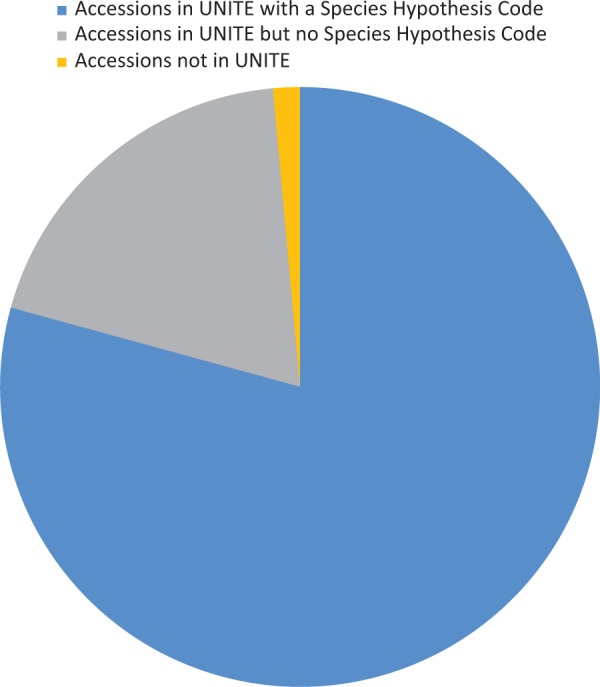
Diagram showing the proportion of accessions associated with UNITE (version 6) data.
Figure 4.
Figure 4.
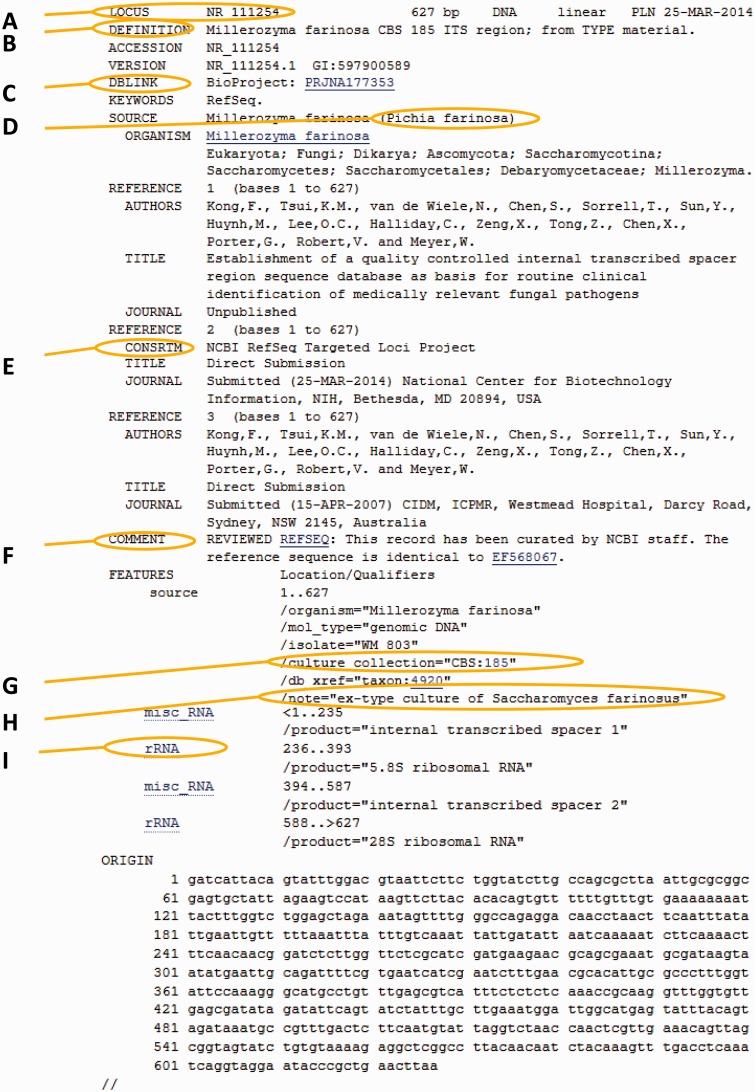
Anatomy of an RTL record. The marked areas indicate most common additions to the original nucleotide record. (A) New RTL accession number; (B) new simplified definition line; (C) Bioproject number for the ITS-targeted loci project; (D) GenBank synonym of current taxonomic name (used in cases of common usage); (E) label indicating that this is a RefSeq record; (F) comment regarding the source of the record; (G) the culture collection or specimen voucher presented as a validated structured triplet or doublet that can link directly to a relevant outside culture or specimen page; (H) additional information on the type and basionym name; (I) the ITS entry of all records was re-annotated to indicate the spacers and ribosomal genes.
Figure 5.
Figure 5.
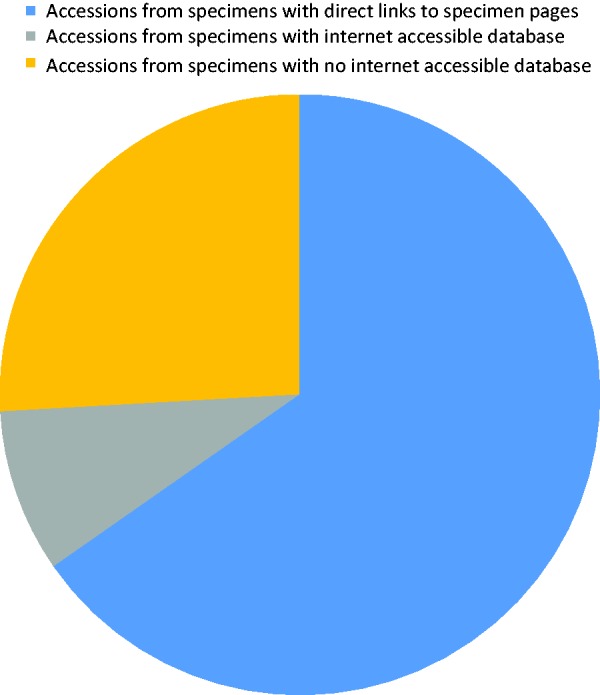
Diagram showing the proportion of accessions that originated from specimens associated with a collection that has an online database.
Figure 6.
Figure 6.
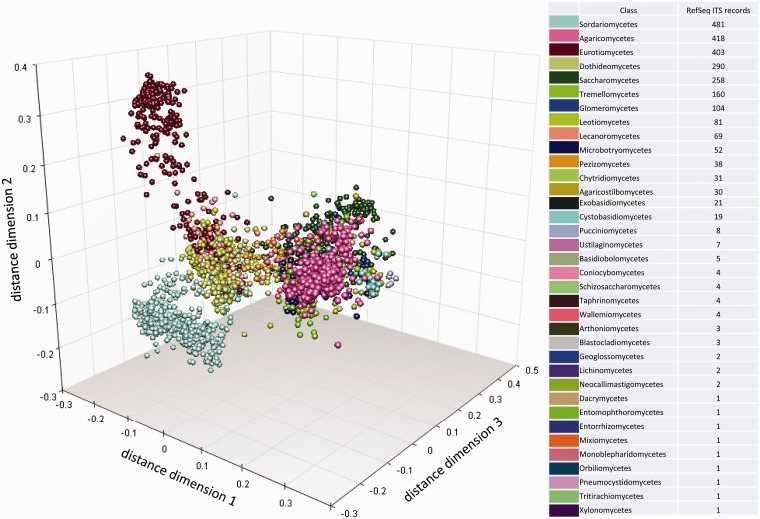
Multidimensional scaling clustering of RTL ITS sequences and coloring, according to the NCBI Taxonomy classification at class rank. Each marker represents an individual sequence.
Figure 7.
Figure 7.
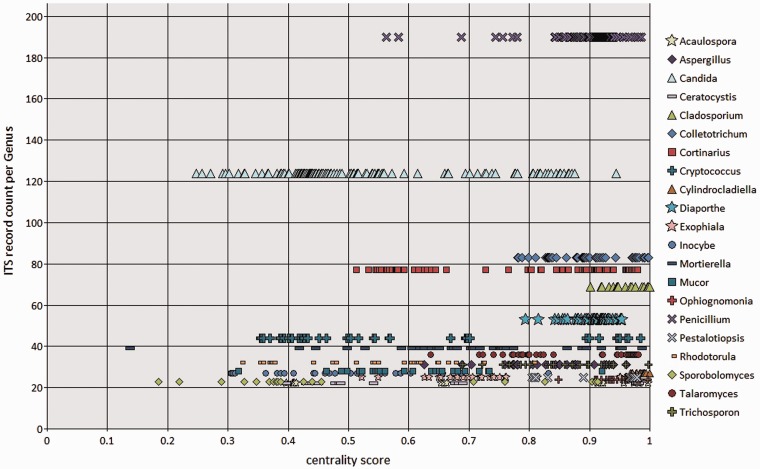
BioloMICS centrality scores of ITS sequences at genus rank, showing genera with ≥20 ITS records in the RefSeq data set. Each marker represents an individual sequence.

References

    1. Hibbett D.S., Ohman A., Glotzer D., et al. (2011) Progress in molecular and morphological taxon discovery in Fungi and options for formal classification of environmental sequences. Fungal Biol. Rev. , 25, 38–47
    1. Hawksworth D.L., Crous P.W., Redhead S.A., et al. (2011) The Amsterdam declaration on fungal nomenclature. IMA Fungus, 2, 105–112 - PMC - PubMed
    1. McNeill J., Barrie F.R., Buck W.R., et al. (2012) International Code of Nomenclature for algae, fungi, and plants (Melbourne Code). In: McNeill J. (ed). Regnum Vegetabile, Vol. 154 Koeltz Scientific Books, Königstein, p. 240
    1. Redhead S.A., Norvell L.L. (2013) Report of the Nomenclature Committee for Fungi 19: official repositories for fungal names. Taxon, 62, 173–174
    1. Kirk P.M., Stalpers J., Braun U., et al. (2013) A without-prejudice list of generic names of fungi for protection under the International Code of Nomenclature for algae, fungi, and plants. IMA Fungus, 4, 381–443 - PMC - PubMed

Publication types