


Development and evaluation of a sensitive mycotoxin risk assessment model (MYCORAM)
- PMID: 24980263
- PMCID: PMC4833022
- DOI: 10.1093/toxsci/kfu134
Development and evaluation of a sensitive mycotoxin risk assessment model (MYCORAM)
Abstract
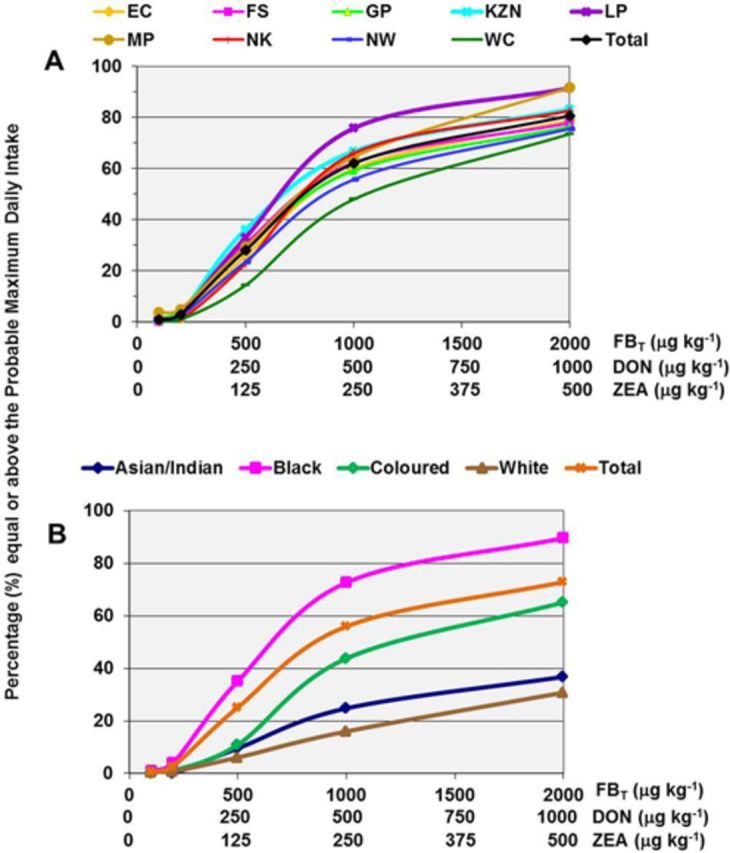
The differential risk of exposure to fumonisin (FB), deoxynivalenol (DON), and zearalenone (ZEA) mycotoxins to the South African population, residing in the nine Provinces was assessed during a cross-sectional grain consumer survey. The relative per capita maize intake (g/day) was stratified by gender, ethnicity, and Province and the probable daily intake (PDI) for each mycotoxin (ng/kg body weight/day) calculated utilizing SPECIAL and SUPER dry milled maize fractions representing different exposure scenarios. Men consumed on an average more maize (173 g/day) than women (142 g/day) whereas the black African ethnic group had the highest intake (279 g/day) followed by the Colored group (169 g/day) with the Asian/Indian and White groups consuming lower quantities of 101 and 80 g/day, respectively. The estimated mean PDIs for the various subgroups and Provinces, utilizing the different dry milled maize fractions, were below the provisional maximum tolerable daily intake (PMTDI) for each mycotoxin. A distinct and more sensitive mycotoxin risk assessment model (MYCORAM) for exposure, stratified by Province and ethnicity were developed utilizing specific maize intake increments (g/kg body weight/day) that provides information on the percentage of the population exposed above the PMTDI for each mycotoxin. Evaluation of the MYCORAM utilizing commercial and EXPERIMENTALLY DERIVED: SPECIAL milling fractions, containing predefined mycotoxins levels, predicts the percentage of maize consumers exposed above the respective PMTDI. Safety modeling using the MYCORAM could also predict a maximum tolerated level adequate to safeguard all South African maize consumers including the most vulnerable groups.
Keywords: South Africa; maize consumers; mycotoxins exposure; probable daily intakes; risk assessment model.
© The Author 2014. Published by Oxford University Press on behalf of the Society of Toxicology. All rights reserved. For permissions, please email: journals.permissions@oup.com.
Figures
References
-
- Ariño A., Juan T., Estopañan G., González-Cabo J.F. Natural occurrence of Fusarium species, fumonisin production by toxigenic strains, and concentrations of fumonisins B1, and B2 in conventional and organic maize grown in Spain. J. Food Protect. 2007;70:151–156. - PubMed
-
- Binder E.M., Tan L.M., Chin L.J., Handl J., Richard J. Worldwide occurrence of mycotoxins in commodities feeds and feed ingredients. Anim. Feed Sci. Technol. 2007;137:265–282.
-
- Blaauw D., Gilson L. Johannesburg: Centre for Health Policy, University of Witwatersrand; 2001. Health and poverty reduction policies in South Africa. Report prepared for the World Health Organisation.
-
- Bolger M., Coker R.D., DiNovi M., Gaylor D., Gelderblom W., Olsen M., Paster N., Riley R.T., Shephard G., Speijers G.J.A. Prepared by the Fifty-sixth Meeting of the Joint FAO/WHO Expert Committee on Food Additives (JECFA), Safety Evaluation of Certain Mycotoxins in Food. Geneva, Switzerland: WHO; 2001. Fumonisins; pp. 103–279. WHO Food Additives Series No. 47, FAO Food and Nutrition Paper No. 74.
Publication types
MeSH terms
Substances
LinkOut - more resources
Full Text Sources
Other Literature Sources
