Review
. 2014 Sep;12(3):252-62.
doi: 10.1007/s11914-014-0223-2.

Hypophosphatemic rickets: revealing novel control points for phosphate homeostasis

Affiliations
Review

Hypophosphatemic rickets: revealing novel control points for phosphate homeostasis

Kenneth E White et al. Curr Osteoporos Rep. 2014 Sep.

Abstract

Rapid and somewhat surprising advances have recently been made toward understanding the molecular mechanisms causing heritable disorders of hypophosphatemia. The results of clinical, genetic, and translational studies have interwoven novel concepts underlying the endocrine control of phosphate metabolism, with far-reaching implications for treatment of both rare Mendelian diseases as well as common disorders of blood phosphate excess such as chronic kidney disease (CKD). In particular, diseases caused by changes in the expression and proteolytic control of the phosphaturic hormone fibroblast growth factor-23 (FGF23) have come to the forefront in terms of directing new models explaining mineral metabolism. These hypophosphatemic disorders as well as others resulting from independent defects in phosphate transport or metabolism will be reviewed herein, and implications for emerging therapeutic strategies based upon these new findings will be discussed.


Conflict of interest statement

Conflict of interest statement:

KE White received royalties from Kyowa Hakko Kirin Co., Ltd. for licensing of the FGF23 gene and the anti-FGF23 monoclonal antibody trials.

JM Hum declares no conflicts of interest.

MJ Econs received royalties from Kyowa Hakko Kirin Co., Ltd. for licensing of the FGF23 gene and the anti-FGF23 monoclonal antibody trials and has also been a consultant to Kyowa Hakko Kirin for the anti-FGF23 monoclonal antibody trials.

Figures
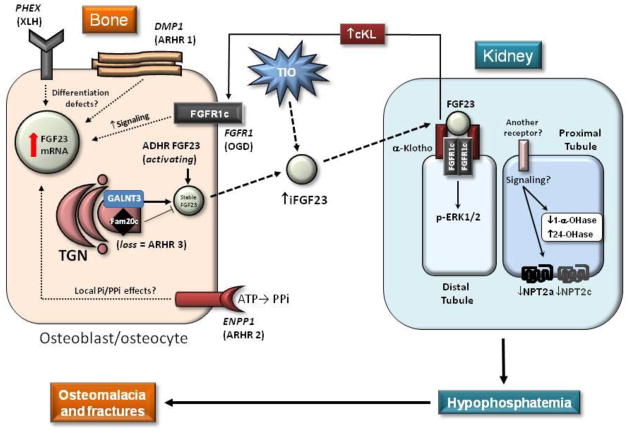
Figure 1
Figure 1. Schematic summary of genetic hypophosphatemias
Loss of function mutations in PHEX (causes XLH) and DMP1 (ARHR-1) result in osteoblast to osteocyte differentiation defects and are associated with elevated FGF23 mRNA and circulating iFGF23 protein. FGFR1c activating mutations lead to inappropriate receptor signaling in OGD, and ENPP1 inactivating mutations (ARHR-2) may alter bone cell differentiation or the cell’s responsiveness to PPi and Pi leading to increased FGF23 through mechanisms that remain unclear. The FGF23 ADHR mutations within the RXXR/SAE domain reduce the ability of SPC proteases to cleave and inactivate iFGF23. Loss of FAM20c (ARHR-3 or Raine’s Syndrome) results in reduced DMP1 expression, and may have direct effects on the phosphorylation of FGF23 resulting in stabilization of iFGF23 through permitting GALNT3 activity. TIO tumors over produce FGF23 mRNA due to unknown molecular changes and secrete high levels of iFGF23. Circulating iFGF23 acts in kidney through mKL and FGFRs (potentially FGFR1c) to down regulate NPT2a and NPT2c and Cyp27b1, and up regulate Cyp24a1. Whether FGF23 acts in the kidney distal tubule first, then the proximal tubule through an alternate receptor system is unclear. A syndrome of iFGF23 excess also occurs through over-production of cKL which likely acts through osteoblast/osteocyte FGFRs to increase FGF23 mRNA. The net effect of increased iFGF23 is to reduce renal Pi reabsorption and 1,25D production, thus resulting in hypophosphatemia, causing osteomalacia and fractures.
Figure 2
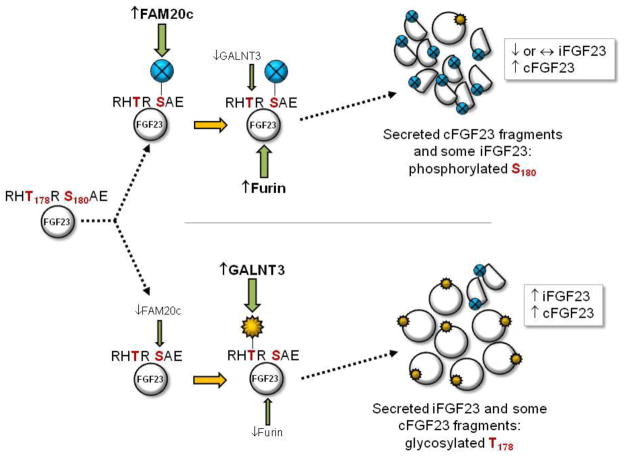
Figure 2. Model for dynamic control of iFGF23:cFGF23 ratios
The study of diseases involving altered iFGF23:cFGF23 ratios, including ADHR and Raine’s syndrome, has introduced a model for dynamic FGF23 regulation. FGF23 protein (far left) carries an RHT178R-S180AE motif that comprises an ‘RXXR/S’ subtilisin-like proprotein convertase (SPC) site. (Upper) When FAM20c activity/expression is increased, S180 is phosphorylated and GALNT3 O-glycosylation of T178 may be inhibited making iFGF23 a furin substrate, thus levels of secreted iFGF23 can remain constant (or potentially decrease) with a corresponding increase in cFGF23 proteolytic fragments. (Lower) When FAM20c activity/expression is reduced, GALNT3 O-glycosylates FGF23 T178, which prevents furin cleavage resulting in increased secretion of iFGF23.

References

    1. Tenenhouse HS, Econs MJ. Mendelian Hypophosphatemias. In: Valle D, editor. The Metabolic and Molecular Bases of Inherited Disease. The McGraw-Hill Companies; New York: 2001. pp. 1–9.
    1. Bacic D, Lehir M, Biber J, Kaissling B, Murer H, Wagner CA. The renal Na+/phosphate cotransporter NaPi-IIa is internalized via the receptor-mediated endocytic route in response to parathyroid hormone. Kidney Int. 2006;69(3):495–503. - PubMed
    1. Farrow EG, Davis SI, Ward LM, Summers LJ, Bubbear JS, Keen R, Stamp TC, Baker LR, Bonewald LF, White KE. Molecular analysis of DMP1 mutants causing autosomal recessive hypophosphatemic rickets. Bone. 2009;44(2):287–94. - PMC - PubMed
    1. Liu S, Tang W, Zhou J, Stubbs JR, Luo Q, Pi M, Quarles LD. Fibroblast growth factor 23 is a counter-regulatory phosphaturic hormone for vitamin D. J Am Soc Nephrol. 2006;17(5):1305–15. - PubMed
    1. Shimada T, Mizutani S, Muto T, Yoneya T, Hino R, Takeda S, Takeuchi Y, Fujita T, Fukumoto S, Yamashita T. Cloning and characterization of FGF23 as a causative factor of tumor-induced osteomalacia. Proc Natl Acad Sci U S A. 2001;98(11):6500–5. - PMC - PubMed

Publication types

MeSH terms

LinkOut - more resources