. 2014 Jul 1:12:108.
doi: 10.1186/1741-7015-12-108.

Opsonic phagocytosis of Plasmodium falciparum merozoites: mechanism in human immunity and a correlate of protection against malaria

Affiliations

Opsonic phagocytosis of Plasmodium falciparum merozoites: mechanism in human immunity and a correlate of protection against malaria

Faith Ha Osier et al. BMC Med. .

Abstract

Background: An understanding of the mechanisms mediating protective immunity against malaria in humans is currently lacking, but critically important to advance the development of highly efficacious vaccines. Antibodies play a key role in acquired immunity, but the functional basis for their protective effect remains unclear. Furthermore, there is a strong need for immune correlates of protection against malaria to guide vaccine development.

Methods: Using a validated assay to measure opsonic phagocytosis of Plasmodium falciparum merozoites, we investigated the potential role of this functional activity in human immunity against clinical episodes of malaria in two independent cohorts (n = 109 and n = 287) experiencing differing levels of malaria transmission and evaluated its potential as a correlate of protection.

Results: Antibodies promoting opsonic phagocytosis of merozoites were cytophilic immunoglobulins (IgG1 and IgG3), induced monocyte activation and production of pro-inflammatory cytokines, and were directed against major merozoite surface proteins (MSPs). Consistent with protective immunity in humans, opsonizing antibodies were acquired with increasing age and malaria exposure, were boosted on re-infection, and levels were related to malaria transmission intensity. Opsonic phagocytosis was strongly associated with a reduced risk of clinical malaria in longitudinal studies in children with current or recent infections. In contrast, antibodies to the merozoite surface in standard immunoassays, or growth-inhibitory antibodies, were not significantly associated with protection. In multivariate analyses including several antibody responses, opsonic phagocytosis remained significantly associated with protection against malaria, highlighting its potential as a correlate of immunity. Furthermore, we demonstrate that human antibodies against MSP2 and MSP3 that are strongly associated with protection in this population are effective in opsonic phagocytosis of merozoites, providing a functional link between these antigen-specific responses and protection for the first time.

Conclusions: Opsonic phagocytosis of merozoites appears to be an important mechanism contributing to protective immunity in humans. The opsonic phagocytosis assay appears to be a strong correlate of protection against malaria, a valuable biomarker of immunity, and provides a much-needed new tool for assessing responses to blood-stage malaria vaccines and measuring immunity in populations.


Figures
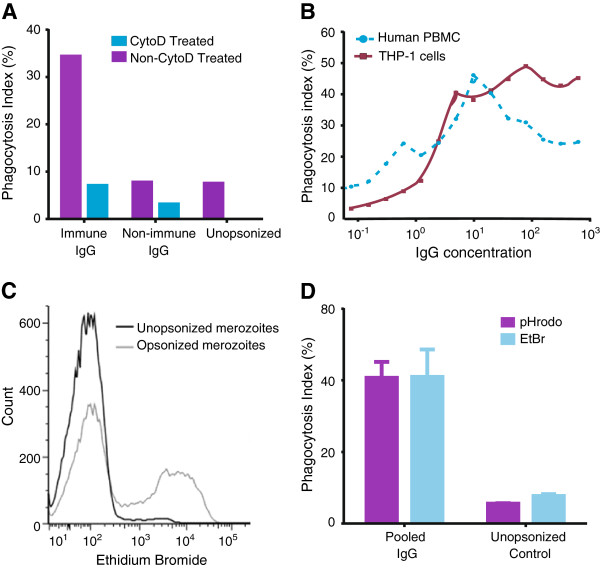
Figure 1
Figure 1
Phagocytosis assay validity. (A) Phagocytosis of whole merozoites is specific to malaria-immune sera and efficiently inhibited by treatment with cytochalasin D. (B) The IgG fraction purified from serum mediates phagocytosis in a concentration dependent fashion, in assays using cultured THP-1 cells and freshly isolated PBMCs. (C) Flow cytometry histogram overlay contrasting the phagocytosis in monocytes from human PBMCs when freshly isolated merozoites are opsonized with purified IgG from malaria-immune adults (grey line) with unopsonized merozoites (black line). (D) Equivalent levels of phagocytosis obtained when merozoites were stained with the pH dependent dye pHrodoTM or with ethidium bromide, indicating internalization of merozoites into acidic phago-lysosomes. Experiments were conducted using malaria-immune IgG (MIG). PBMCs. peripheral blood mononuclear cells.
Figure 2
Figure 2
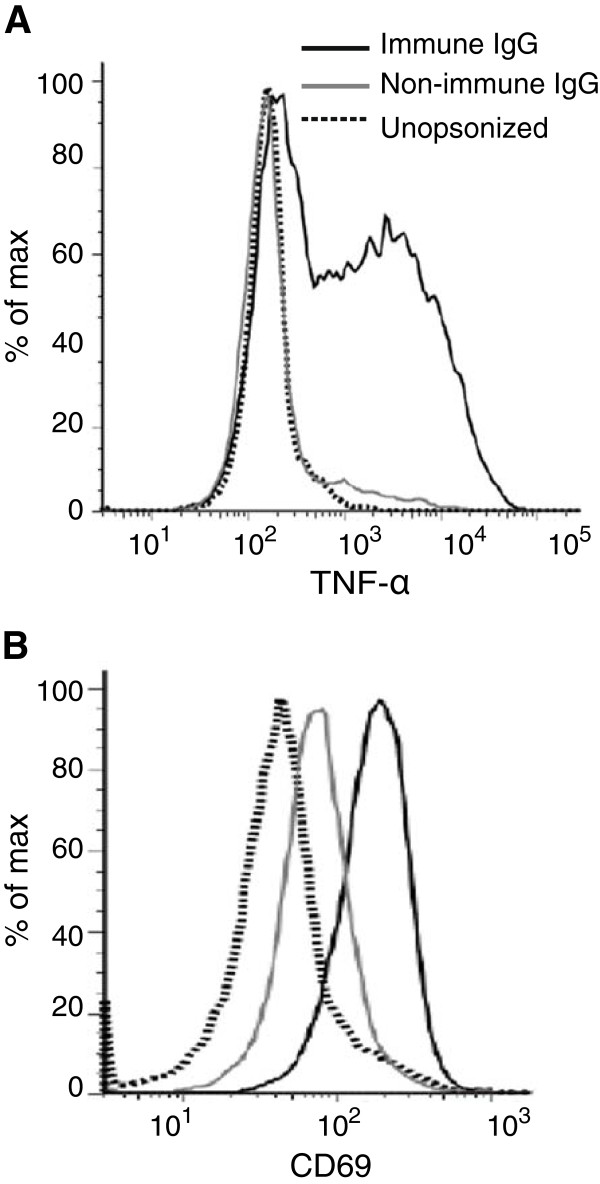
Monocyte activation and cytokine production following phagocytosis of merozoites. Production of intracellular TNF-α (A) and surface expression of CD69 (B) was significantly elevated in the monocytes co-incubated with malaria-immune IgG (MIG) opsonized merozoites (black solid line), while that in monocytes co-incubated with merozoites opsonized with non-immune Melbourne sera (grey solid line) was no different from baseline levels detected before phagocytosis (dark dotted line).
Figure 3
Figure 3
Visualization of opsonic phagocytosis of merozoites by THP-1 cells. (A) Scanning electron microscopy of THP-1 cells before and during ingestion of merozoites. (B) Immunofluorescence microscopy of phagocytosis of merozoites opsonized with purified IgG from malaria-immune adults (MIG). THP-1 cells were visualized by differential interference contrast (DIC), while merozoites were visualized with Hoechst (blue). Figures represent data acquired from at least two independent experiments.
Figure 4
Figure 4
Characteristics of antibodies promoting phagocytosis. (A) Pairwise correlation between the relative phagocytosis index and IgG ELISA optical density (OD) against whole merozoites. (B) IgG subclasses against whole merozoites measured by ELISA. (C) Pairwise correlation between the relative phagocytosis index and parasite growth inhibition measured in the GIA. (D) Pairwise correlation between IgG ELISA OD against whole merozoites and GIA. Data from GIAs (C and D) are expressed as parasite growth (%), relative to malaria-naive controls. Experiments were conducted using purified IgG from adults and children in Ngerenya , n = 33. GIA, growth inhibition assay.
Figure 5
Figure 5
The relative phagocytosis index (RPI) is correlated with malaria exposure and boosted by infection. (A) The prevalence of antibodies promoting phagocytosis in children with and without concurrent asymptomatic parasitemia. Samples were considered positive for phagocytosis if the RPI exceeded the mean plus three standard deviations of a panel of 10 non-malaria exposed sera from Melbourne blood donors. (B) The RPI increased significantly with age in the Ngerenya cohort, Cuzick non-parametric test for trend across ordered groups, z = 7.86, P <0.001. (C) The RPI increased modestly with age among parasite positive children in the Chonyi cohort, Cuzick test for trend across ordered groups, z = 1.24, P = 0.214. The levels of antibodies promoting phagocytosis were higher (D) in children with asymptomatic parasitemia (parasite positive) than in those without (parasite negative), and (E) in children with exposure to parasites in the preceding six months (recent infection) than in those without (no recent infection). White boxes, parasite negative; grey boxes, parasite positive. (F) The RPI was higher in age-matched parasite positive children from the high transmission cohort (Chonyi, grey boxes), compared to the low transmission cohort (Ngerenya, white boxes). Ngerenya cohort, n = 287; Chonyi cohort, n = 109.
Figure 6
Figure 6
Antibodies promoting phagocytosis are associated with a reduced risk of malaria in the Chonyi cohort. Children were categorized into tertiles according to their (A) relative phagocytosis index, (B) ELISA IgG1 optical density (OD) levels against whole merozoites and (C) ELISA IgG3 OD levels against whole merozoites. Top tertile (red line), middle tertile (green line) and bottom tertile (yellow line) levels. Phagocytosis of merozoites was significantly associated with a reduced risk of malaria (log rank test P = 0.007), while IgG subclass antibodies against whole merozoites were not (log rank test P = 0.914 and P = 0.396, for IgG1 and IgG3, respectively). (D) The phagocytosis index, (E) whole merozoite IgG1 and (F) whole merozoite IgG3 antibodies were significantly associated with the sum of IgG responses against any one of MSP2, MSP3, MSP119, AMA1, EBA175 and MSP1 block 2 [6] in the Chonyi cohort. Cuzick test for trend across ordered groups, z = 2.98, P = 0.004; z = 5.56, P <0.001 and z = 6.36, P <0.001, for the RPI, IgG1 and IgG3 against merozoites respectively. AMA1, apical membrane antigen 1; EBA, erythrocyte binding antigen; MSP, merozoite surface protein; OD, optical density.
Figure 7
Figure 7
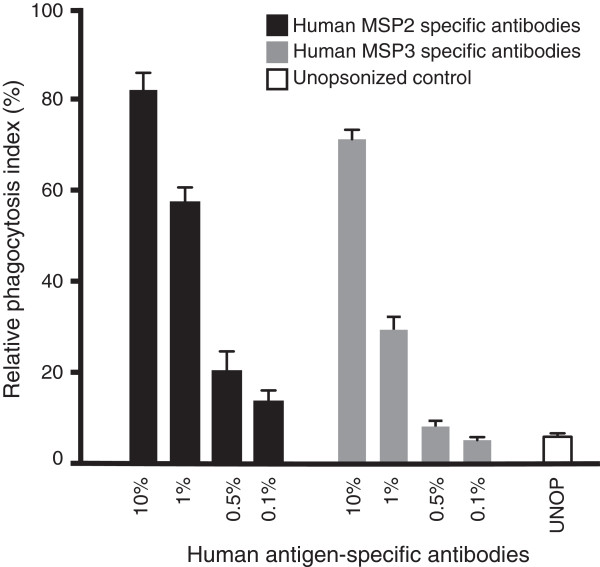
Merozoite surface antigens are targets of opsonic phagocytosis antibodies. Affinity purified human antibodies against MSP2 and MSP3 strongly promote opsonic phagocytosis in a concentration dependent fashion. Antibodies purified from pooled sera from Kenyan adults from Ngerenya village, n = 20. MSP, merozoite surface protein.

References

    1. Marsh K, Kinyanjui S. Immune effector mechanisms in malaria. Parasite Immunol. 2006;28:51–60. - PubMed
    1. Beeson JG, Osier FH, Engwerda CR. Recent insights into humoral and cellular immune responses against malaria. Trends Parasitol. 2008;24:578–584. - PubMed
    1. Cohen S, McGregor I, Carrington S. Gamma-globulin and acquired immunity to human malaria. Nature. 1961;192:733–737. - PubMed
    1. Sabchareon A, Burnouf T, Ouattara D, Attanath P, Bouharoun-Tayoun H, Chantavanich P, Foucault C, Chongsuphajaisiddhi T, Druilhe P. Parasitologic and clinical human response to immunoglobulin administration in falciparum malaria. Am J Trop Med Hyg. 1991;45:297–308. - PubMed
    1. Crompton PD, Kayala MA, Traore B, Kayentao K, Ongoiba A, Weiss GE, Molina DM, Burk CR, Waisberg M, Jasinskas A, Tan X, Doumbo S, Doumtabe D, Kone Y, Narum DL, Liang X, Doumbo OK, Miller LH, Doolan DL, Baldi P, Felgner PL, Pierce SK. A prospective analysis of the Ab response to Plasmodium falciparum before and after a malaria season by protein microarray. Proc Natl Acad Sci U S A. 2010;107:6958–6963. - PMC - PubMed

Publication types

LinkOut - more resources