. 2014 Jul 1:9:26.
doi: 10.1186/1750-1326-9-26.

Gene expression changes consistent with neuroAIDS and impaired working memory in HIV-1 transgenic rats

Affiliations

Gene expression changes consistent with neuroAIDS and impaired working memory in HIV-1 transgenic rats

Vez Repunte-Canonigo et al. Mol Neurodegener. .

Abstract

Background: A thorough investigation of the neurobiology of HIV-induced neuronal dysfunction and its evolving phenotype in the setting of viral suppression has been limited by the lack of validated small animal models to probe the effects of concomitant low level expression of multiple HIV-1 products in disease-relevant cells in the CNS.

Results: We report the results of gene expression profiling of the hippocampus of HIV-1 Tg rats, a rodent model of HIV infection in which multiple HIV-1 proteins are expressed under the control of the viral LTR promoter in disease-relevant cells including microglia and astrocytes. The Gene Set Enrichment Analysis (GSEA) algorithm was used for pathway analysis. Gene expression changes observed are consistent with astrogliosis and microgliosis and include evidence of inflammation and cell proliferation. Among the genes with increased expression in HIV-1 Tg rats was the interferon stimulated gene 15 (ISG-15), which was previously shown to be increased in the cerebrospinal fluid (CSF) of HIV patients and to correlate with neuropsychological impairment and neuropathology, and prostaglandin D2 (PGD2) synthase (Ptgds), which has been associated with immune activation and the induction of astrogliosis and microgliosis. GSEA-based pathway analysis highlighted a broad dysregulation of genes involved in neuronal trophism and neurodegenerative disorders. Among the latter are genesets associated with Huntington's disease, Parkinson's disease, mitochondrial, peroxisome function, and synaptic trophism and plasticity, such as IGF, ErbB and netrin signaling and the PI3K signal transduction pathway, a mediator of neural plasticity and of a vast array of trophic signals. Additionally, gene expression analyses also show altered lipid metabolism and peroxisomes dysfunction. Supporting the functional significance of these gene expression alterations, HIV-1 Tg rats showed working memory impairments in spontaneous alternation behavior in the T-Maze, a paradigm sensitive to prefrontal cortex and hippocampal function.

Conclusions: Altogether, differentially regulated genes and pathway analysis identify specific pathways that can be targeted therapeutically to increase trophic support, e.g. IGF, ErbB and netrin signaling, and reduce neuroinflammation, e.g. PGD2 synthesis, which may be beneficial in the treatment of chronic forms of HIV-associated neurocognitive disorders in the setting of viral suppression.


Figures
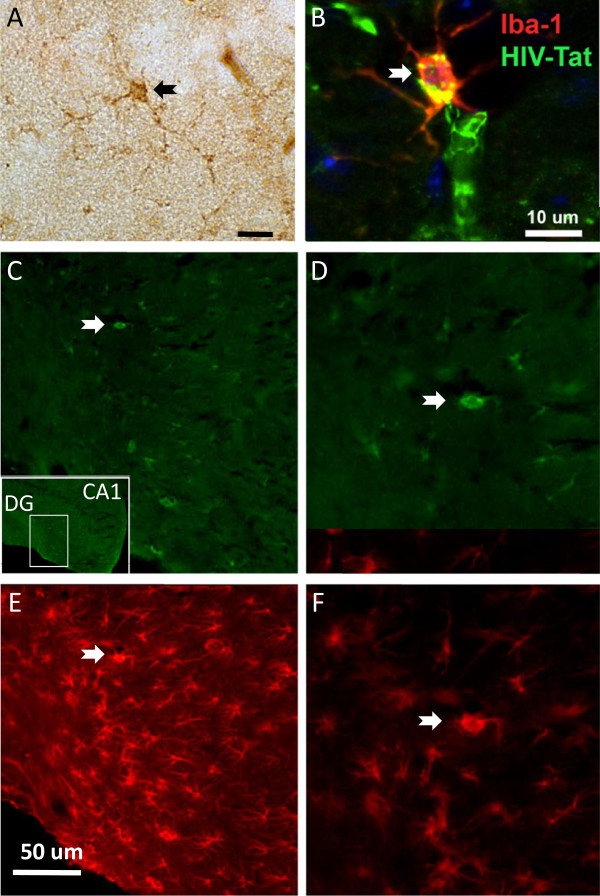
Figure 1
Figure 1
Expression of HIV-1 products in HIV-1 Tg rats. A) HIV protein Tat was detected by immunohistochemistry with peroxydase detection in the hippocampus in cells with microglia morphology (arrow) and B) by immunofluorescence with double labeling of HIV-1 Tat and the microglia marker Ionized calcium binding adaptor molecule 1 (Iba-1) (arrow). C-F) Double immunofluorescence for HIV-1 gp120 (C-D) and for the astrocytic marker glial fibrillary acidic protein (GFAP) (E-F) in the hippocampus of HIV-1 Tg rats revealed gp120-immunoreactive astrocytes (arrow). The location of the field shown in C-F is indicated by the inset in C.
Figure 2
Figure 2
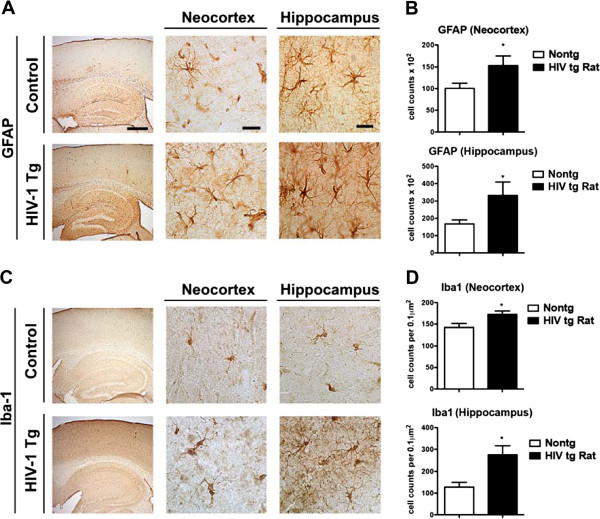
Astrogliosis and microgliosis in the brain of HIV-1 Tg rats. A) Immunostaining for the astrocytic marker GFAP in HIV-1 Tg and control rats. The panel to the left is a low power view (4X) of the neocortex and hippocampus, while the panels in the middle and right are at higher magnification (400X) (B) Computer aided image analysis of the numbers of GFAP positive cells in the neocortex and hippocampus demonstrate a significant increase in astroglial cells in the HIV-1 tg rats (Student’s t-test). C) Immunostaining for the microglial marker Iba-1 in HIV-1 Tg and control rats. The panel to the left is a low power view (4X) of the neocortex and hippocampus, while the panels in the middle and right are at higher magnification (400X); D) Computer aided image analysis of the numbers of Iba-1 positive cells in the neocortex and hippocampus demonstrate a significant increase in astroglial cells in the HIV-1 Tg rats (* = p < 0.01; n = 6, by t-test). Bar = 250 and 25 μm at 4X and 400x, respectively.
Figure 3
Figure 3
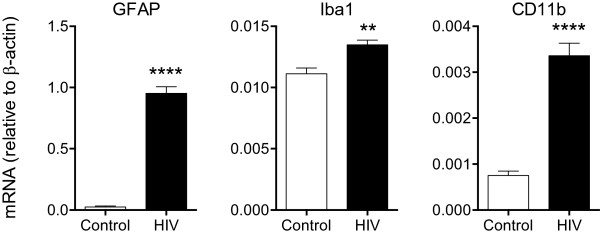
RT-PCR validation of increased expression of astrogliosis and microgliosis markers in the hippocampus of HIV-1 Tg rats. The mRNA for the astrocytic marker GFAP, and the microglia markers Iba-1 and CD11b (Mac1) were significantly increased in HIV-1 Tg rats over controls, consistent with the immunohistochemistry results in Figure 2 (n = 6, **p < 0.01, ****p < 0.0001, by t-test).
Figure 4
Figure 4
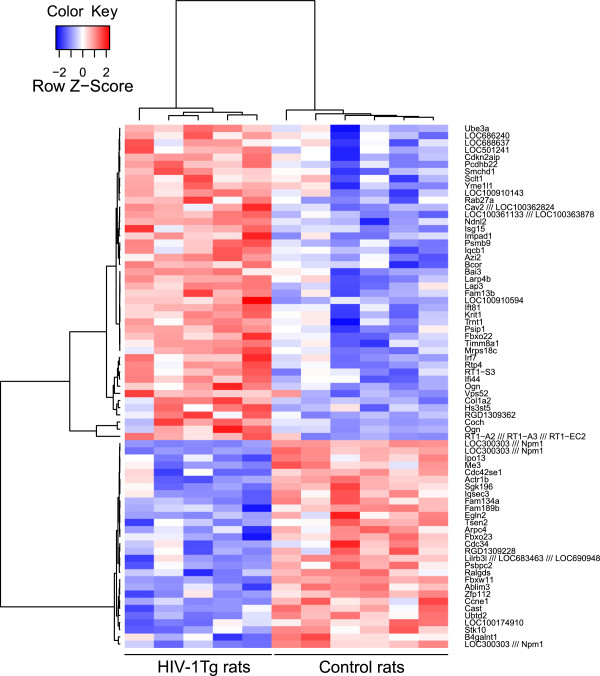
Hierarchical clustering of top differentially expressed genes in the hippocampus of HIV-1 Tg rats (HIV) versus wild-type littermate controls (Control). Gene expression was profiled in the hippocampi of HIV-1 and wild-type rats with high-density Affymetrix microarrays. The dendrogram shows 73 of the top 100 differentially expressed probesets that were found to be associated with gene names (Additional file 3: Table S3). Genes are colored according to their expression values. Red indicates upregulated genes in HIV-1 Tg rats, while blue indicates downregulated genes. Brightness is proportional to the extent of change in gene expression.
Figure 5
Figure 5
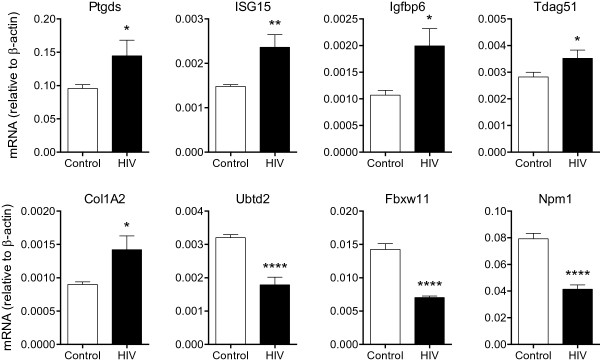
RT-PCR validation of differentially expressed genes in the hippocampus of HIV-1 Tg rats. Examples of genes that were found to be differentially regulated in the hippocamous of HIV-1 Tg rats include PGD2 synthase (Ptgds), interferon stimulated gene ISG-15 (ISG-15), IGF binding protein 6 (Igfbp6) and the IGF-activated gene T cell death-associated gene 51 (TDAG51), Col1A2 (procollagen type1-a2), and the mitochondrial protein ubiquitin domain containing 2 (Ubtd2). Lastly, among differentially expressed genes are Fbxw11 and Npm1, which interact with HIV-1 proteins Vpu and Tat, respectively. Please see text (n = 6, *p < 0.05, **p < 0.01, ***p < 0.001, ****p < 0.0001, by t-test).
Figure 6
Figure 6
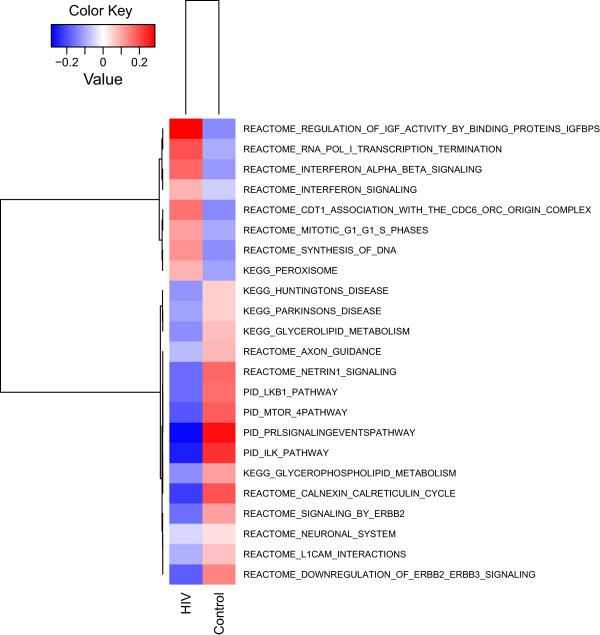
Top 23 differentially regulated pathways in the hippocampus of HIV-1 Tg rats and controls by GSEA. The Gene Set Enrichment Analysis (GSEA) algorithm was used for pathway analysis using the MSigDB C2 canonical pathway collection [28]. Of the significantly differentially regulated pathways with statistical significance of p ≤ 0.01, 8 showed increased activation, while the rest was decreased. Among the increased ones are pathways consistent with astrocyte and microglia activation, inflammatory processes, and interferon activation. Decreased pathways indicate substantial downregulation of signaling systems involved in neuronal trophism and synaptic synaptic function. Pathways are colored according to their expression values: red indicates upregulated genes in HIV-1 Tg rats, while blue indicates downregulated pathways. Brightness is proportional to the extent of change in pathway expression.
Figure 7
Figure 7
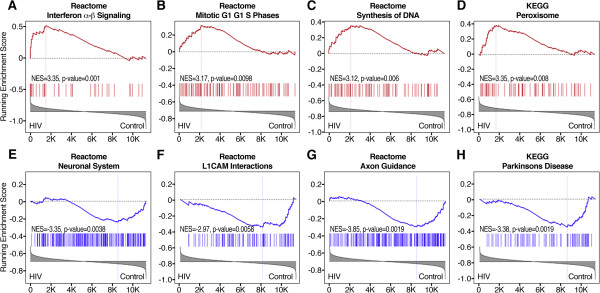
GSEA plots of selected differentially regulated pathways. Representative differentially regulated pathways are shown including pathways with increased and reduced activation in the hippocampus of HIV-1 Tg rats. Pathways with increased activation included pathways indicative of (A) interferon activation; (B, C) cell division, consistent with astrogliosis and microgliosis; (D) peroxisome dysregulation. Pathways with reduced activation (E-H) are indicative of reduced neuronal trophism and neurodegeneration.
Figure 8
Figure 8
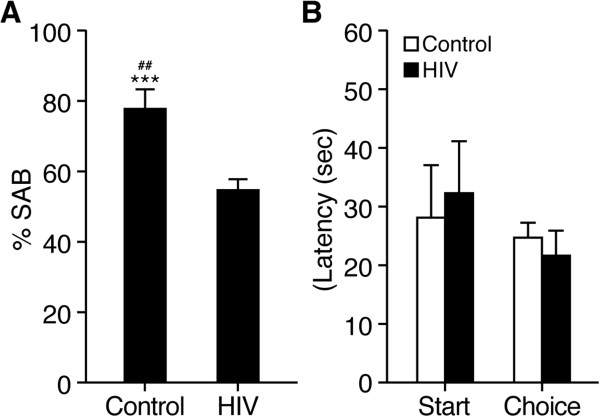
Working memory impairment in HIV-1 Tg rats. Working memory was significantly impaired in adult (4–5 months old) HIV-1 Tg rats compared to wild-type controls (CONT) using the spontaneous alternation behavior in the T-Maze, a paradigm sensitive to prefrontal cortex and hippocampal impairments. A) HIV-1 Tg rats exhibited a marked decrease of spontaneous alternation behavior (SAB), a measure of working memory, compared to control rats (n = 7 for both groups; t10 = 4.2, p < 0.01). Only the control rats alternated significantly above chance (t6 = 7.1, p < 0.001) whereas HIV-1 Tg rats were not significantly different from chance level (t4 = 1.2, p = ns). There was no difference between the two groups in the latency to leave the start box or the latency to make a choice (B). ***p < 0.001 vs. chance; p < 0.01 vs. HIV-1 Tg rats.

References

    1. Maschke M, Kastrup O, Esser S, Ross B, Hengge U, Hufnagel A. Incidence and prevalence of neurological disorders associated with HIV since the introduction of highly active antiretroviral therapy (HAART) J Neurol Neurosurg Psychiatry. 2000;69:376–380. - PMC - PubMed
    1. D'Arminio Monforte A, Cinque P, Mocroft A, Goebel FD, Antunes F, Katlama C, Justesen US, Vella S, Kirk O, Lundgren J. Changing incidence of central nervous system diseases in the EuroSIDA cohort. Ann Neurol. 2004;55:320–328. - PubMed
    1. Everall IP, Hansen LA, Masliah E. The shifting patterns of HIV encephalitis neuropathology. Neurotox Res. 2005;8:51–61. - PubMed
    1. Everall I, Vaida F, Khanlou N, Lazzaretto D, Achim C, Letendre S, Moore D, Ellis R, Cherne M, Gelman B, Morgello S, Singer E, Grant I, Masliah E. National NeuroAIDS Tissue Consortium (NNTC) Cliniconeuropathologic correlates of human immunodeficiency virus in the era of antiretroviral therapy. J Neurovirol. 2009;1:11. - PMC - PubMed
    1. Heaton RK, Franklin DR, Ellis RJ, McCutchan JA, Letendre SL, Leblanc S, Corkran SH, Duarte NA, Clifford DB, Woods SP, Collier AC, Marra CM, Morgello S, Mindt MR, Taylor MJ, Marcotte TD, Atkinson JH, Wolfson T, Gelman BB, McArthur JC, Simpson DM, Abramson I, Gamst A, Fennema-Notestine C, Jernigan TL, Wong J, Grant I. CHARTER Group; HNRC Group. HIV-associated neurocognitive disorders before and during the era of combination antiretroviral therapy: differences in rates, nature, and predictors. J Neurovirol. 2011;17:3–16. - PMC - PubMed

Publication types