Clinical Trial
. 2014 Jun 30:11:105.
doi: 10.1186/1743-0003-11-105.

The application of precisely controlled functional electrical stimulation to the shoulder, elbow and wrist for upper limb stroke rehabilitation: a feasibility study

Affiliations
Clinical Trial

The application of precisely controlled functional electrical stimulation to the shoulder, elbow and wrist for upper limb stroke rehabilitation: a feasibility study

Katie L Meadmore et al. J Neuroeng Rehabil. .

Abstract

Background: Functional electrical stimulation (FES) during repetitive practice of everyday tasks can facilitate recovery of upper limb function following stroke. Reduction in impairment is strongly associated with how closely FES assists performance, with advanced iterative learning control (ILC) technology providing precise upper-limb assistance. The aim of this study is to investigate the feasibility of extending ILC technology to control FES of three muscle groups in the upper limb to facilitate functional motor recovery post-stroke.

Methods: Five stroke participants with established hemiplegia undertook eighteen intervention sessions, each of one hour duration. During each session FES was applied to the anterior deltoid, triceps, and wrist/finger extensors to assist performance of functional tasks with real-objects, including closing a drawer and pressing a light switch. Advanced model-based ILC controllers used kinematic data from previous attempts at each task to update the FES applied to each muscle on the subsequent trial. This produced stimulation profiles that facilitated accurate completion of each task while encouraging voluntary effort by the participant. Kinematic data were collected using a Microsoft Kinect, and mechanical arm support was provided by a SaeboMAS. Participants completed Fugl-Meyer and Action Research Arm Test clinical assessments pre- and post-intervention, as well as FES-unassisted tasks during each intervention session.

Results: Fugl-Meyer and Action Research Arm Test scores both significantly improved from pre- to post-intervention by 4.4 points. Improvements were also found in FES-unassisted performance, and the amount of arm support required to successfully perform the tasks was reduced.

Conclusions: This feasibility study indicates that technology comprising low-cost hardware fused with advanced FES controllers accurately assists upper limb movement and may reduce upper limb impairments following stroke.


Figures
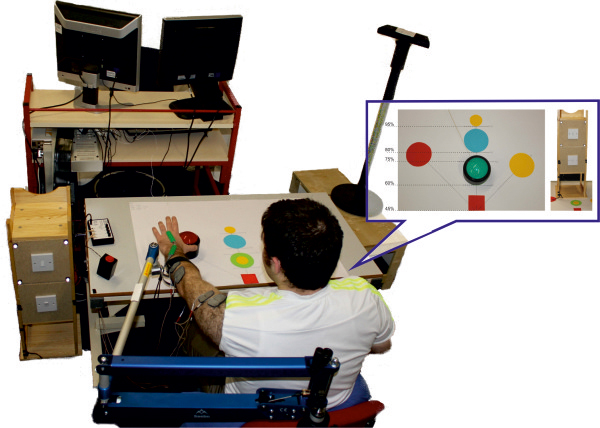
Figure 1
Figure 1
System design. The participant sat at a workstation. The impaired arm was strapped to a SaeboMAS arm support and electrodes were positioned on the anterior deltoid, triceps and wrist extensors. An electro-goniometer over the wrist joint and a Microsoft Kinect captured the participant’s movements. The bubble displays the task template customised to each participants arm length. Green = button located at 60% of arm length; Blue = button located at 80% of arm length; Red = button located at 75% of arm length, 45° to the impaired side; Yellow = button located at 75% of arm length, 45° across body; small yellow circles = location that object was grasped from and repositioned to (60% and 95% of arm length). The cabinet housed the light switch tasks (located at 75 and 80% of reach for the high and low light switch tasks respectively); the draw task (located at 80% of reach) was on the reverse side of the cabinet.
Figure 2
Figure 2
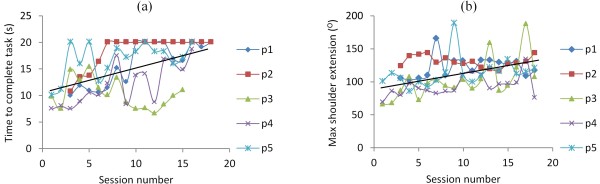
High light switch task. The figure shows (a) the time taken and (b) the maximum extension achieved in the high light switch task for each participant across the 18 training sessions. The black solid line = the line of best fit across all participants. For maximum extension 0 degrees = arm is by side of body, 90 degrees = arm is held horizontal to body; 180 degrees arm is pointing to ceiling.
Figure 3
Figure 3
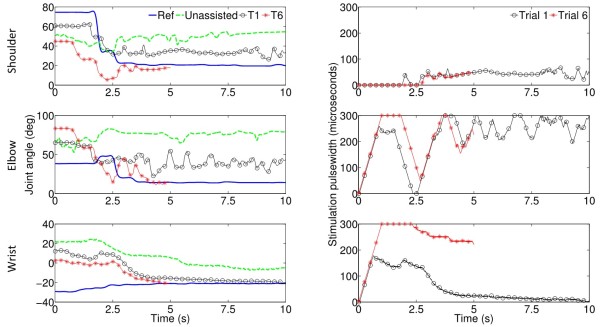
Tracking detail. The left panel shows the reference movement (blue line) and a participant’s movement when unassisted (dashed green line), assisted for trial 1 (black line with circles) and trial 6 (red line with asterisks) of a set of button pressing tasks at 80% of reach for the shoulder (top panel), elbow (middle panel) and wrist (bottom panel). Note that the movement produced in trial 6 is shorter than trial 1 (i.e. participant completes the task more quickly) and more closely resembles the ideal reference movement. Note also that the reference movement is completed when the movement plateaus but the end position is held until 20 seconds elapses. The right panel shows the stimulation applied on trial 1 (black line with circles) and trial 6 (red line with asterisks). Note that the ILC stimulation applied on trial 6 has adjusted to meet the participant’s needs over the 6 trials. This is achieved by the ILC component of the control system.
Figure 4
Figure 4
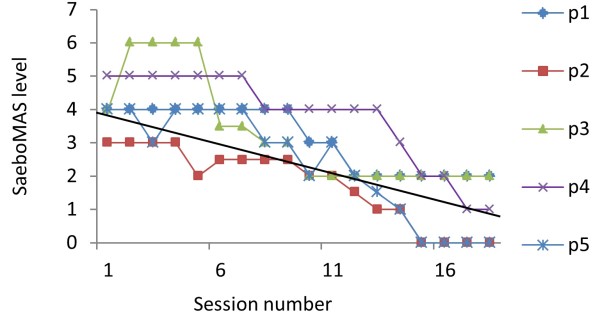
Arm support levels. The figure shows the arm support levels for the button pressing tasks for each participant across the 18 training sessions. The black solid line = the line of best fit across all participants.

References

    1. Royal College of Physicians. National Clinical Guideline for Stroke. 2012.
    1. National Audit Office Department of Health. Progress in Improving Stroke Care. 2010.
    1. Scarborough P, Peto V, Bhatnagar P, Kaur A, Leal J, Luengo-Fernandez R, Gray A, Rayner M, Allender S. Stroke statistics. British Heart Foundation Statistics Database. 2009.
    1. Feigin VL, Barker-Collo S, McNaughton H, Brown P, Kerse N. Long-term neuropsychological and functional outcomes in stroke survivors: current evidence and perspectives for new research. Int J Stroke. 2008;3:33–40. doi: 10.1111/j.1747-4949.2008.00177.x. - DOI - PubMed
    1. Oujamaa L, Rlave I, Froger J, Mottet D, Pelissier J-Y. Rehabilitation of arm function after stroke. Literature review. Annuals Phys Rehabil Med. 2009;52:269–293. doi: 10.1016/j.rehab.2008.10.003. - DOI - PubMed

Publication types