


How art changes your brain: differential effects of visual art production and cognitive art evaluation on functional brain connectivity
- PMID: 24983951
- PMCID: PMC4077746
- DOI: 10.1371/journal.pone.0101035
How art changes your brain: differential effects of visual art production and cognitive art evaluation on functional brain connectivity
Erratum in
- PLoS One. 2014;9(12):e116548
Abstract
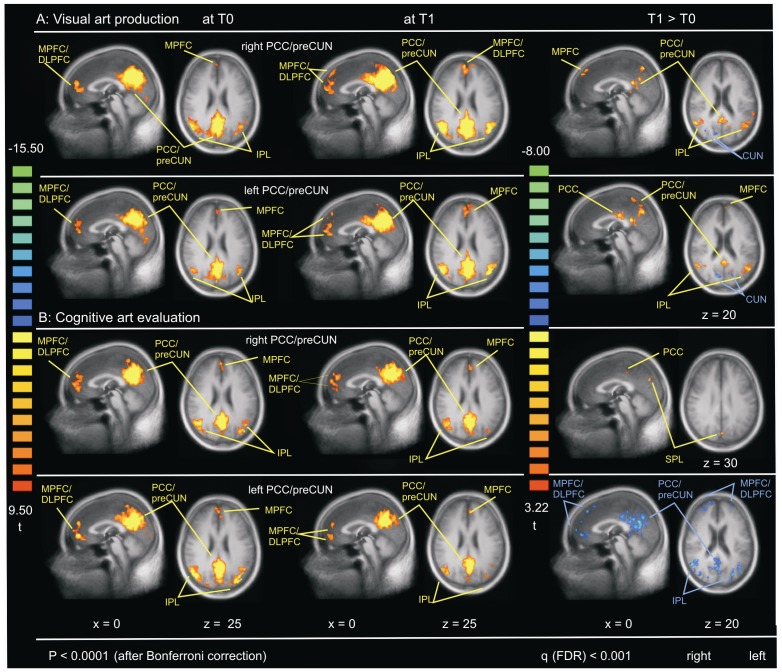
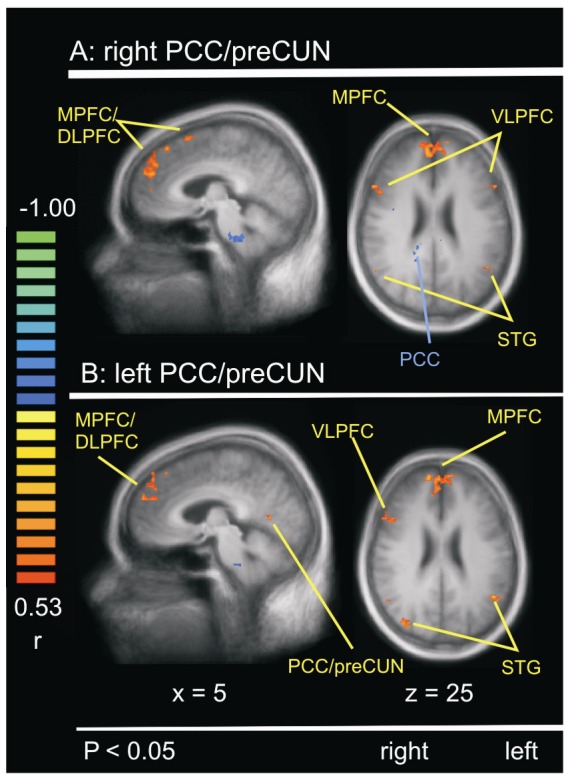
Visual art represents a powerful resource for mental and physical well-being. However, little is known about the underlying effects at a neural level. A critical question is whether visual art production and cognitive art evaluation may have different effects on the functional interplay of the brain's default mode network (DMN). We used fMRI to investigate the DMN of a non-clinical sample of 28 post-retirement adults (63.71 years ±3.52 SD) before (T0) and after (T1) weekly participation in two different 10-week-long art interventions. Participants were randomly assigned to groups stratified by gender and age. In the visual art production group 14 participants actively produced art in an art class. In the cognitive art evaluation group 14 participants cognitively evaluated artwork at a museum. The DMN of both groups was identified by using a seed voxel correlation analysis (SCA) in the posterior cingulated cortex (PCC/preCUN). An analysis of covariance (ANCOVA) was employed to relate fMRI data to psychological resilience which was measured with the brief German counterpart of the Resilience Scale (RS-11). We observed that the visual art production group showed greater spatial improvement in functional connectivity of PCC/preCUN to the frontal and parietal cortices from T0 to T1 than the cognitive art evaluation group. Moreover, the functional connectivity in the visual art production group was related to psychological resilience (i.e., stress resistance) at T1. Our findings are the first to demonstrate the neural effects of visual art production on psychological resilience in adulthood.
Conflict of interest statement
Figures
References
-
- Cohen GD, Perlstein S, Chaplin J, Kelly J, Firth KM, et al. (2006) The Impact of Professionally Conducted Cultural Programs on the Physical Health, Mental Health, and Social Functioning of Older Adults. Gerontologist 46: 726–734. - PubMed
-
- Leckey J (2011) The therapeutic effectiveness of creative activities on mental well-being: a systematic review of the literature. J Psychiatr Ment Health Nurs 18: 501–509. - PubMed
-
- Geue K, Goetze H, Buttstaedt M, Kleinert E, Richter D, et al. (2010) An overview of art therapy interventions for cancer patients and the results of research. Complement Ther Med 18: 160–170. - PubMed
-
- Clow A, Fredhoi C (2006) Normalisation of salivary cortisol levels and self-report stress by a brief lunchtime visit to an art gallery by London City workers. J Holist Health 3: 29–32.
Publication types
MeSH terms
LinkOut - more resources
Full Text Sources
Other Literature Sources
Medical
