Review
. 2014 Jul 1;6(7):a008524.
doi: 10.1101/cshperspect.a008524.

Genetic variation and adaptation in Africa: implications for human evolution and disease

Affiliations
Review

Genetic variation and adaptation in Africa: implications for human evolution and disease

Felicia Gomez et al. Cold Spring Harb Perspect Biol. .

Abstract

Because modern humans originated in Africa and have adapted to diverse environments, African populations have high levels of genetic and phenotypic diversity. Thus, genomic studies of diverse African ethnic groups are essential for understanding human evolutionary history and how this leads to differential disease risk in all humans. Comparative studies of genetic diversity within and between African ethnic groups creates an opportunity to reconstruct some of the earliest events in human population history and are useful for identifying patterns of genetic variation that have been influenced by recent natural selection. Here we describe what is currently known about genetic variation and evolutionary history of diverse African ethnic groups. We also describe examples of recent natural selection in African genomes and how these data are informative for understanding the frequency of many genetic traits, including those that cause disease susceptibility in African populations and populations of recent African descent.


Figures

Figure 1.
Figure 1.
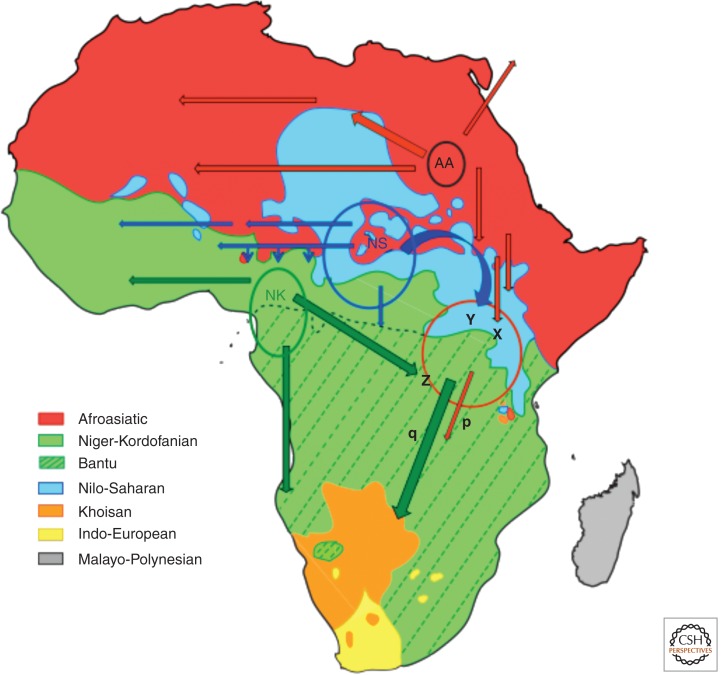
The geographic distribution of the major linguistic groups in Africa. The map was drawn using information (geographic locations of ethnic speakers in Africa that are based on published sources) from Haspelmath et al. (2008) (wals.info/), www.ethnologue.com (International HapMap 2005), Greenberg (1963, 1972), Vansina (1995), and Ehret (1971, 1993, 1995, 2001b). Geographic range occupied by Bantu speakers, the major linguistic subfamily within the Niger-Kordofanian phylum mentioned in the text, is also shown. Putative centers of origin and estimated time of initial expansion based on linguistic studies for three of the four language families are also listed: AA, Afroasiatic (14 kya) (Ehret 1995); NS, Nilo-Saharan (Blench 1993; Ehret 1993; Blench 2006); NK, Niger-Kordofanian (5 kya) (Nurse 1997; Ehret 2001a). Afroasiatic-speaking pastoralists were the first food-producing populations to migrate into East Africa circa 5 kya (X) (Leakey 1931; Butzer 1969; Robbins 1972; Barthelme 1977); followed by Nilo-Saharan-speaking pastoralists circa 3 kya (Y) (Leakey 1931; Bower 1973; Ambrose 1982; Distefano 1990), and later Bantu-speaking agriculturalists after circa 2.5 kya (Z) (Posnansky 1961a,b). P and q represent initial expansion of pastoralists (2.5 kya) and later Bantu-speaking agriculturalists (after 2 kya) to southern Africa from East Africa, respectively.
Figure 2.
Figure 2.
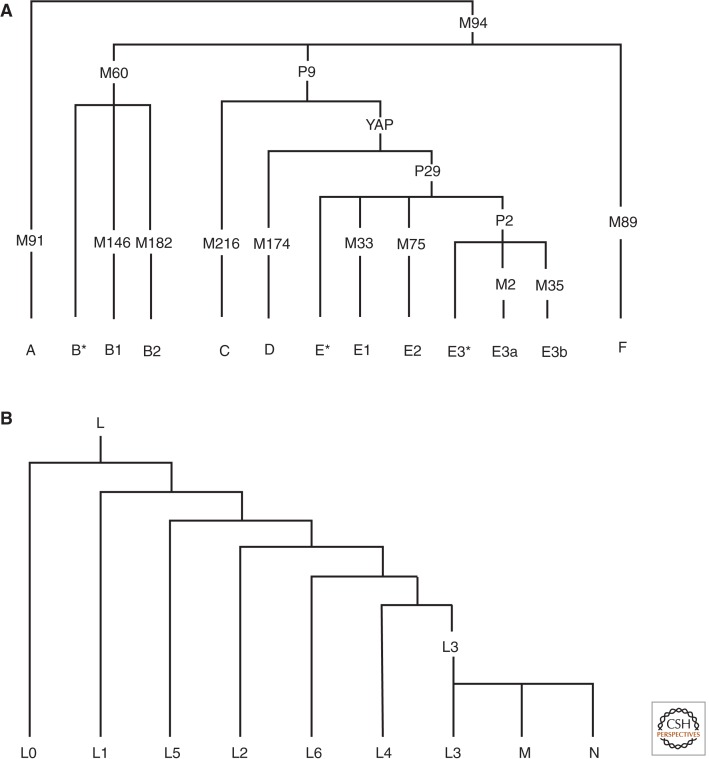
Evolutionary tree of Y chromosome and mtDNA haplogroups. (A) Nomenclature for major lineages of Y chromosome haplotypes. The M, P, and YAP labels leading to haplogroup/s are SNPs and indels that are used to define these haplogroups. Haplogroup F encompasses haplogroups F to T. Haplogroups A, B, and E are mainly found in Africa, whereas the rest are found mainly outside Africa. (B) Overview of mtDNA haplogroup phylogeny. In the mtDNA haplogroup nomenclature, the letter names of the haplogroups run from A to Z, with further subdivisions using numbers (from 0) and lowercase letters (from a). The naming was done in the order of their discovery and does not reflect the actual genetic relationships. Haplogroup M and N encompasses all of the haplogroups lettered A to Z excluding haplogroup L. Haplogroups L (L0–L6) are mainly found in Africa, whereas the rest are found mainly outside Africa (Richards et al. 1998; Macaulay et al. 1999; Quintana-Murci et al. 1999; Salas et al. 2002; Kivisild et al. 2004; Behar et al. 2008).
Figure 3.
Figure 3.
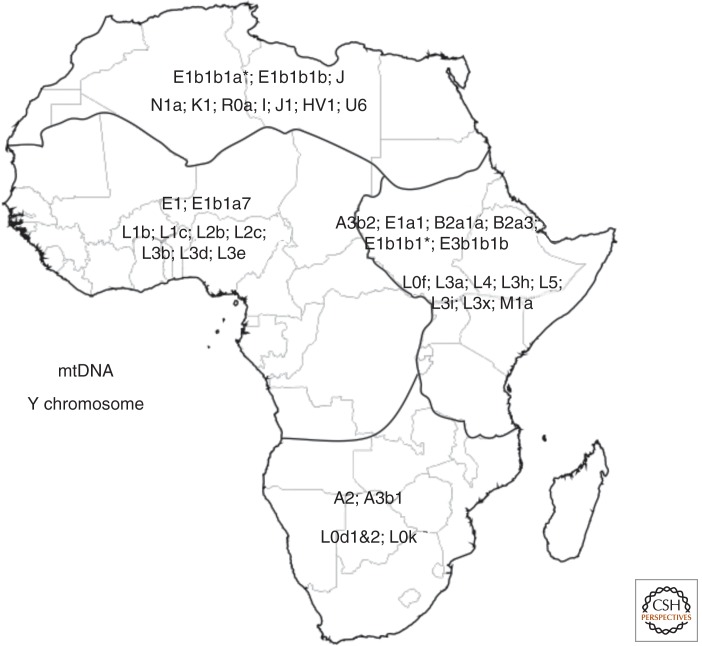
Distribution of mtDNA and Y chromosome haplogroups across Africa. The black lines represent the approximate geographical boundaries of the distribution of each haplogroup cluster, with each of the clusters predominantly observed in the demarcated regions.
Figure 4.
Figure 4.
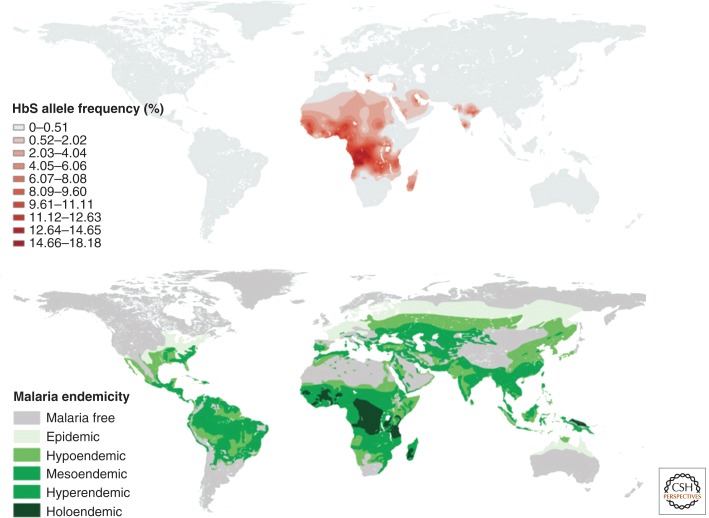
Global distribution of the HbS sickle cell anemia allele compared to the historic geographic distribution of malaria. (Top) Global distribution of HbS allele frequency predicted from Bayesian geostatistical modeling. (Bottom) Historical map of malaria endemicity. The classes are defined by PfPr2−10 (PfPr2−10 = proportion of 2- to 10-year olds with confirmed blood stage asexual parasites): malaria free, PfPr2−10 = 0; epidemic, PfPr2−10 ≈ 0; hypoendemic, PfPr2−10 < 0.10; mesoendemic, PfPr2−10 ≥ 0.10 and < 0.50; hyperendemic, PfPr2−10 ≥ 0.50 and < 0.75; holoendemic, PfPr0−1 − 1 ≥ 0.75 (this class was measured in children ages 0–1) (From Piel et al. (2010); reproduced, with express permission, from Nature Publishing Group © 2010.)

References

    1. The 1000 Genomes Project Consortium. 2010. A map of human genome variation from population-scale sequencing. Nature 467: 1061–1073 - PMC - PubMed
    1. Abi-Rached L, Jobin MJ, Kulkarni S, McWhinnie A, Dalva K, Gragert L, Babrzadeh F, Gharizadeh B, Luo M, Plummer FA, et al. 2011. The shaping of modern human immune systems by multiregional admixture with archaic humans. Science 334: 89–94 - PMC - PubMed
    1. Adeyemo AA, Chen G, Chen Y, Rotimi C 2005. Genetic structure in four West African population groups. BMC Genet 6: 38. - PMC - PubMed
    1. Adeyemo A, Gerry N, Chen G, Herbert A, Doumatey A, Huang H, Zhou J, Lashley K, Chen Y, Christman M, et al. 2009. A genome-wide association study of hypertension and blood pressure in African Americans. PLoS Genet 5: e1000564. - PMC - PubMed
    1. Alves-Silva J, da Silva Santos M, Guimaraes PE, Ferreira AC, Bandelt HJ, Pena SD, Prado VF 2000. The ancestry of Brazilian mtDNA lineages. Am J Hum Genet 67: 444–461 - PMC - PubMed

LinkOut - more resources