Agitation onset, frequency, and associated temporal factors in critically ill adults
- PMID: 24986170
- PMCID: PMC4451814
- DOI: 10.4037/ajcc2014186
Agitation onset, frequency, and associated temporal factors in critically ill adults
Abstract
Background: Agitation is a frequent complication in critically ill adults, can result in life-threatening events for patients or care providers, and extends the hospital length of stay, thereby increasing hospital costs.
Objectives: To describe the incidence, onset, and temporal factors related to agitation in critically ill adults.
Methods: Data were collected for the first 5 days of stay of all adult patients consecutively admitted to a medical respiratory intensive care unit and a surgical trauma intensive care unit during a 2-month period. Agitation was documented by using scores on the Richmond Agitation-Sedation Scale or notation of agitation in the medical record. The hour was used as the documentation epoch, and data were summarized by hour, 4-hour block, and day for each patient.
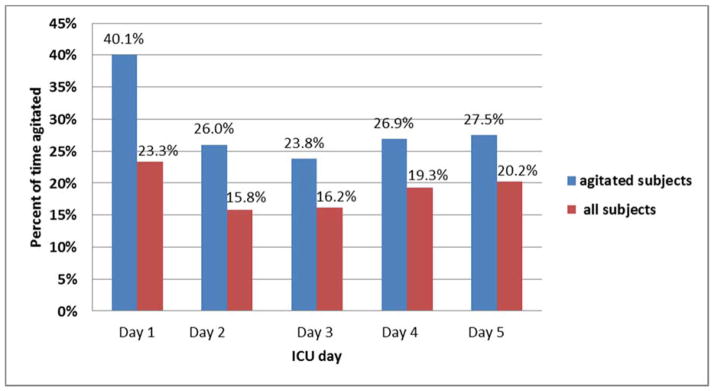
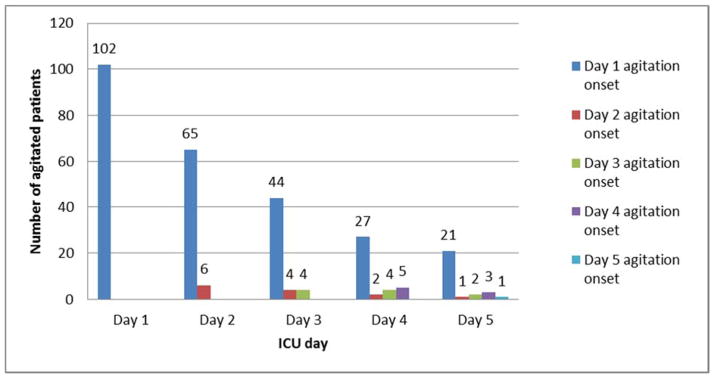
Results: Data were collected on 200 patients, 100 from each unit. Among the sample, 118 (59%) were agitated at some time during the 5 days. The overall agitation rate was 7.8% of the total hourly time. Mean onset of agitation was 11.6 hours from time of admission to the unit. Of the 118 patients who were agitated at some time, 102 (86%) had agitation on day 1. Compared with patients in the surgical trauma unit, patients in the medical respiratory unit had significantly more hours of agitation the first day and first hour of admission and significantly earlier onset of agitation.
Conclusions: Agitation was present in more than one-half of the patients in the sample, typically developed on the first day, and involved consecutive days.
©2014 American Association of Critical-Care Nurses.
Figures
- ●
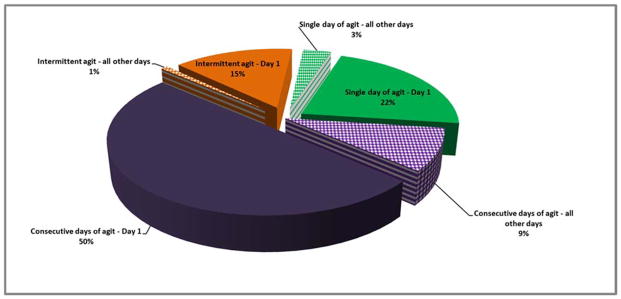
Intermittent agitation – day 1: The percent of total agitation of all patients that had intermittent agitation on day 1
- ●
Intermittent agitation – all other days: The percent of total agitation of all patients that had intermittent agitation on any day other than day 1
- ➢
Single day of agitation – day 1: The percent of total agitation of all patients that had a single day of agitation on day 1
- ➢
Single day of agitation – all other days: The percent of total agitation of all patients that had a single day of agitation on any day other than day 1
- ○
Consecutive days of agitation – day 1: The percent of total agitation of all patients that had consecutive days of agitation beginning on day 1
- ○
Consecutive days of agitation – all other days: The percent of total agitation of all patients that had consecutive days of agitation beginning on any day other than day 1
References
-
- Harvey MA. Managing agitation in critically ill patients. Am J Crit Care. 1996;5:7–16. - PubMed
-
- Cohen IL, Gallagher TJ, Pohlman AS, Dasta JF, Abraham E, Papadokos PJ. The management of the agitated ICU patient. Crit Care Med. 2002;30:S97–123. - PubMed
-
- Jacobi J, Fraser GL, Coursin DB, et al. Clinical practice guidelines for the sustained use of sedatives and analgesics in the critically ill adult. Crit Care Med. 2002;30:119–141. - PubMed
-
- Gardner K, Sessler CN, Grap MJ. Clinical factors associated with agitation. Am J Crit Care. 2006;15:330–331.
-
- Woods JC, Mion LC, Connor JT, et al. Severe agitation among ventilated medical intensive care unit patients: frequency, characteristics and outcomes. Intensive Care Med. 2004;30:1066–1072. - PubMed
Publication types
MeSH terms
Grants and funding
LinkOut - more resources
Full Text Sources
Other Literature Sources