


Black-white disparity in disability among U.S. older adults: age, period, and cohort trends
- PMID: 24986183
- PMCID: PMC4189652
- DOI: 10.1093/geronb/gbu010
Black-white disparity in disability among U.S. older adults: age, period, and cohort trends
Abstract
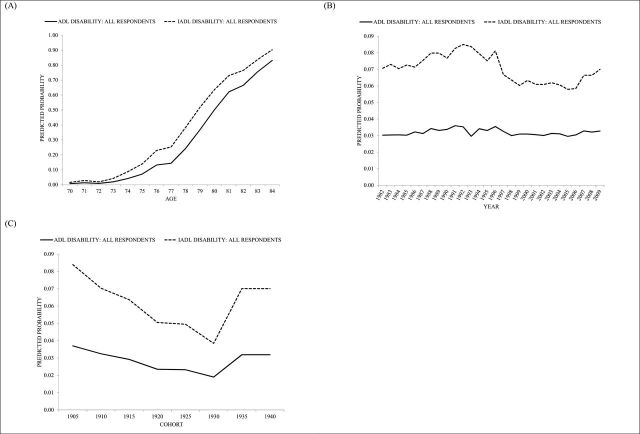
Objectives: This study delineates activities of daily living (ADL) and instrumental activities of daily living (IADL) black-white disparity trends by age, period, and cohort (APC) and explores sociodemographic contributors of cohort-based disparity trends.
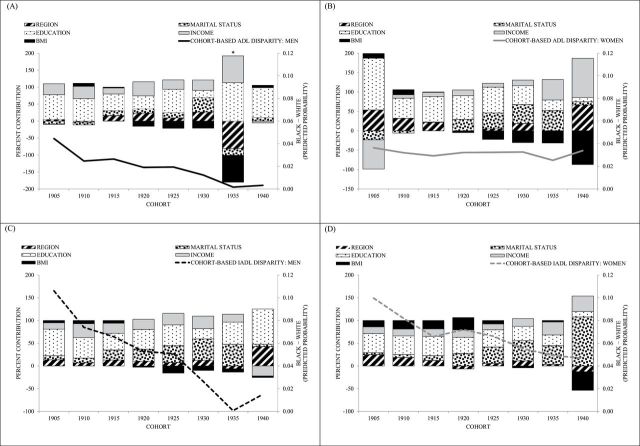
Method: We utilized multiple cross-sectional waves of National Health Interview Survey data (1982-2009) to describe APC trends of ADL and IADL disparities using a cross-classified random effect model. Further, we decomposed the cohort-based disparity trends using Fairlie's decomposition method for nonlinear outcomes.
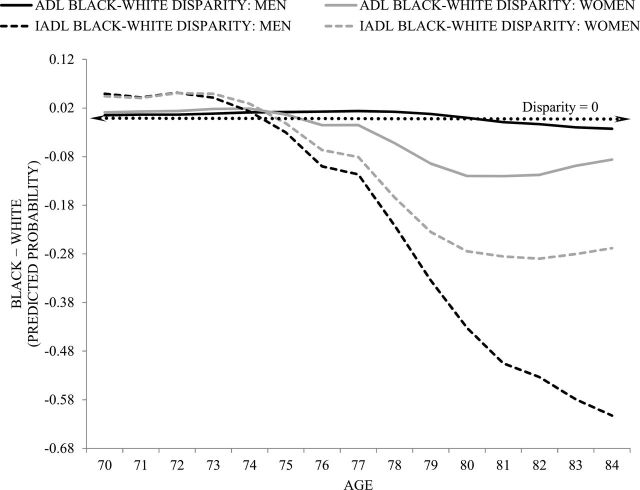
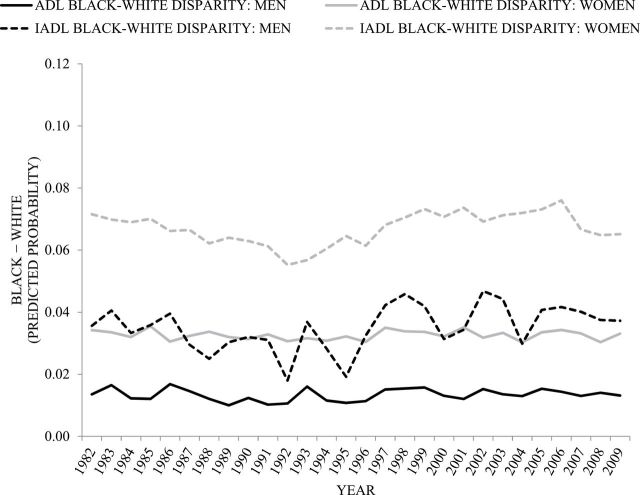
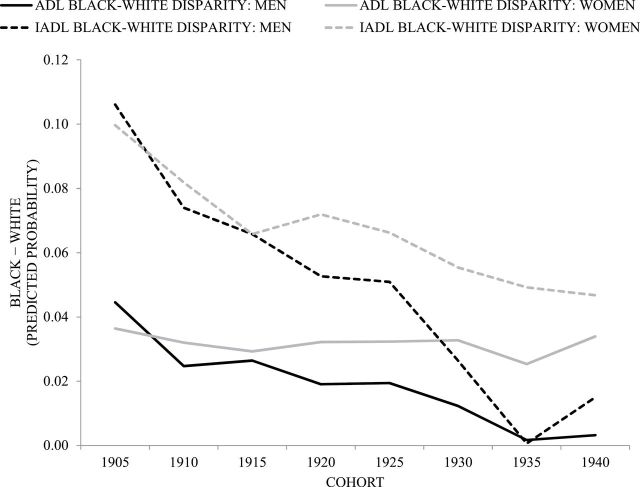
Results: The crossover ADL and IADL disparities (whites > blacks) occurring at age 75 increased with age and reached a plateau at age of 80, whereas period-based ADL and IADL disparities remained constant for the past 3 decades. The cohort disparity trends for both disabilities showed a decline with each successive cohort except for ADL disparity among women.
Discussion: We examined the role of aging on racial disparity in disability and found support for the racial crossover effect. Further, the racial disparity in disability will disappear should the observed pattern of declining cohort-based ADL and IADL disparities persist. Although education, income, and marital status are important sociodemographic contributors to cohort disparity trends, future studies should investigate individual behavioral health determinants and cohort-specific characteristics that explain the cohort-based racial difference in ADL and IADL disabilities.
Keywords: Age-period-cohort model; Black–white disparity; Disability; Older adults..
© The Author 2014. Published by Oxford University Press on behalf of The Gerontological Society of America. All rights reserved. For permissions, please e-mail: journals.permissions@oup.com.
Figures
References
-
- Alley D. E., Chang V. W. (2007). The changing relationship of obesity and disability, 1988-2004. JAMA: the journal of the American Medical Association, 298, 2020–2027. 298/17/2020 [pii] 10.1001/jama.298.17.2020 - PubMed
-
- Bennett N. G., Bloom D. E., Craig P. H. (1989). The divergence of black and white marriage pattern. American Journal of Sociology, 95, 692–722. 10.1086/229330
-
- Blinder A. S. (1973). Wage discrimination: reduced form and structural variables. Journal of Human Resources, 8, 436–455. :http://dx.doi.org/10.2307/144855
-
- Bumpass L., Cherlin A., Sweet J. (1991). The role of cohabitation in declining rates of marriage. Journal of Marriage and the Family, 53, 913–925. :http://dx.doi.org/10.2307/352997
-
- Bureau of Labor Statistics. (2010). Consumer Price Index. Retrieved April 18, 2010, from http://www.bls.gov/cpi/tables.htm
Publication types
MeSH terms
Grants and funding
LinkOut - more resources
Full Text Sources
Other Literature Sources
Medical
Miscellaneous
