


Mechanisms of generating polyubiquitin chains of different topology
- PMID: 24987835
- PMCID: PMC4197637
- DOI: 10.3390/cells3030674
Mechanisms of generating polyubiquitin chains of different topology
Abstract
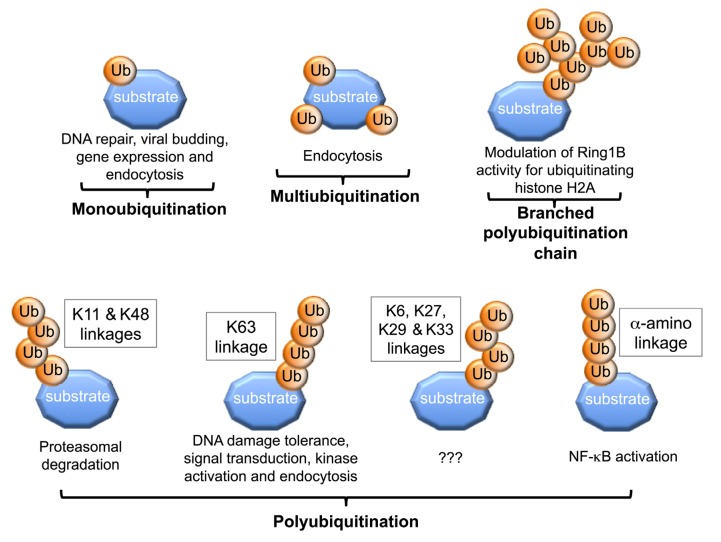
Ubiquitination is an important post-translational process involving attachment of the ubiquitin molecule to lysine residue/s on a substrate protein or on another ubiquitin molecule, leading to the formation of protein mono-, multi- or polyubiquitination. Protein ubiquitination requires a cascade of three enzymes, where the interplay between different ubiquitin-conjugating and ubiquitin-ligase enzymes generates diverse ubiquitinated proteins topologies. Structurally diverse ubiquitin conjugates are recognized by specific proteins with ubiquitin-binding domains (UBDs) to target the substrate proteins of different pathways. The mechanism/s for generating the different ubiquitinated proteins topologies is not well understood. Here, we will discuss our current understanding of the mechanisms underpinning the generation of mono- or polyubiquitinated substrates. In addition, we will discuss how linkage-specific polyubiquitin chains through lysines-11, -48 or -63 are formed to target proteins to different fates by binding specific UBD proteins.
Figures

References
LinkOut - more resources
Full Text Sources
Other Literature Sources
