


High-dose vitamin D3 supplementation in children and young adults with HIV: a randomized, placebo-controlled trial
- PMID: 24988118
- PMCID: PMC4281504
- DOI: 10.1097/INF.0000000000000483
High-dose vitamin D3 supplementation in children and young adults with HIV: a randomized, placebo-controlled trial
Abstract
Background: Suboptimal vitamin D status is prevalent in HIV-infected patients and associated with increased risk of disease severity and morbidity. We aimed to determine 12-month safety and efficacy of daily 7000 IU vitamin D3 (vitD3) versus placebo to sustain increased serum 25-hydroxyvitamin D (25(OH)D) and improve immune status in HIV-infected subjects.
Methods: This was a double-blind trial of perinatally acquired HIV (PHIV)-infected subjects or behaviorally acquired HIV (BHIV)-infected subjects (5.0-24.9 years). Safety, 25(OH)D-related parameters and immune status were assessed at baseline, 3, 6 and 12 months.
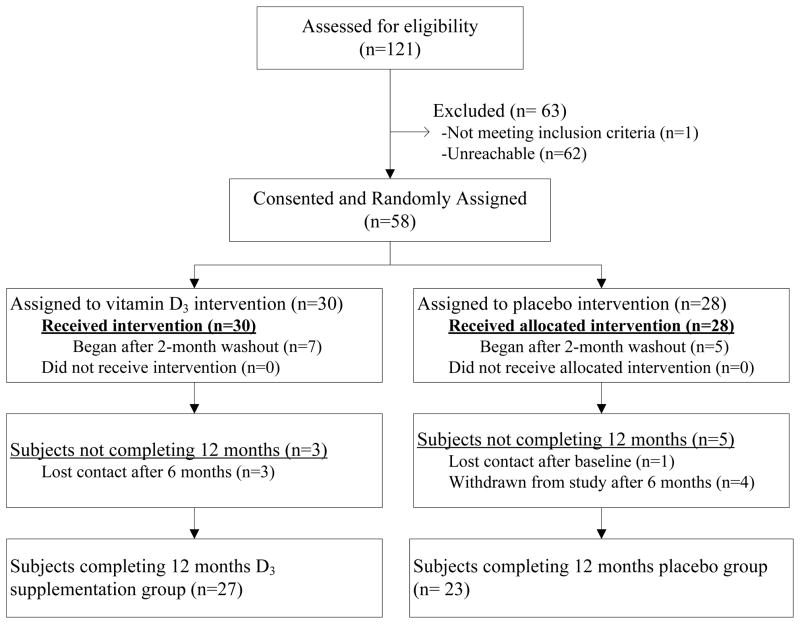
Results: Fifty-eight subjects enrolled (67% male, 85% African American and 64% BHIV) and 50 completed with no safety concerns. In unadjusted analyses, there were no differences between randomization groups at baseline; at 3, 6 and 12 months, 25(OH)D was higher with supplementation than baseline and higher than with placebo (P < 0.05). In adjusted mixed models, in the supplementation group, the fixed effect of 25(OH)D was higher (P < 0.001). Percentage of naive T-helper cells (Th naive%) were significantly (P < 0.01) and T-helper cells (CD4%) marginally (P < 0.10) increased with supplementation in those taking highly active antiretroviral therapy (HAART), and RNA viral load was reduced (P ≤ 0.05). In exploratory linear models, change in 25(OH)D predicted RNA viral load at 3 and 12 months and CD4% at 3 months (P < 0.05).
Conclusions: Daily 7000 IU vitD3 for 12 months was safe in HIV-infected subjects and effective in increasing 25(OH)D. Supplementation improved some clinically important HIV immune markers in subjects on HAART. Adjunct therapy with high-dose, daily vitD3 for HIV-infected subjects and for those on/off HAART requires further investigation.
Figures
References
-
- Viard JP, Souberbielle JC, Kirk O, et al. Vitamin D and clinical disease progression in HIV infection: results from the EuroSIDA study. AIDS. 2011;25:1305–1315. - PubMed
-
- Vescini F, Cozzi-Lepri A, Borderi M, et al. Prevalence of hypovitaminosis D and factors associated with vitamin D deficiency and morbidity among HIV-infected patients enrolled in a large Italian cohort. J Acquir Immune Defic Syndr. 2011;58:163–172. - PubMed
-
- von Essen MR, Kongsbak M, Schjerling P, Olgaard K, Odum N, Geisler C. Vitamin D controls T cell antigen receptor signaling and activation of human T cells. Nat Immunol. 2010;11:344–349. - PubMed
Publication types
MeSH terms
Substances
Grants and funding
LinkOut - more resources
Full Text Sources
Medical
Research Materials
