Review
. 2014:5:e29770.
doi: 10.4161/sgtp.29770. Epub 2014 Jul 2.

Rho GTPases as regulators of mitosis and cytokinesis in mammalian cells

Affiliations
Review

Rho GTPases as regulators of mitosis and cytokinesis in mammalian cells

Megan Chircop. Small GTPases. 2014.

Abstract

Rho GTPases regulate a diverse range of cellular functions primarily through their ability to modulate microtubule dynamics and the actin-myosin cytoskeleton. Both of these cytoskeletal structures are crucial for a mitotic cell division. Specifically, their assembly and disassembly is tightly regulated in a temporal manner to ensure that each mitotic stage occurs in the correct sequential order and not prematurely until the previous stage is completed. Thus, it is not surprising that the Rho GTPases, RhoA, and Cdc42, have reported roles in several stages of mitosis: cell cortex stiffening during cell rounding, mitotic spindle formation, and bi-orient attachment of the spindle microtubules to the kinetochore and during cytokinesis play multiple roles in establishing the division plane, assembly, and activation of the contractile ring, membrane ingression, and abscission. Here, I review the molecular mechanisms regulating the spatial and temporal activation of RhoA and Cdc42 during mitosis, and how this is critical for mitotic progression and completion.

Keywords: Cdc42; RhoA; abscission; actin; cleavage furrow; cytokinesis; cytoskeleton; metaphase; microtubules; spindle assembly.


Figures
None
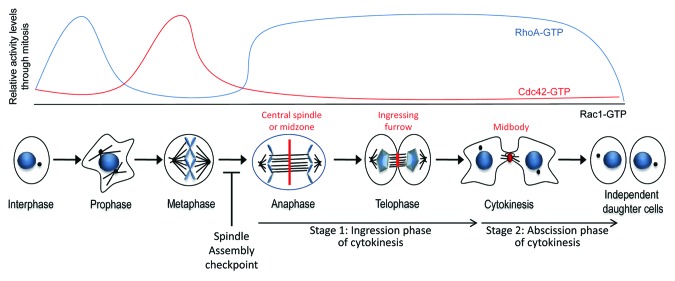
Figure 1. Phases of mitosis and the relative activity levels of Rho GTPases throughout mitosis. A profile of the relative activity levels (upper panel) of RhoA-GTP (blue), Cdc42-GTP (red), and Rac1-GTP (black) corresponding with the phases of mitosis (lower panel) is shown.
None
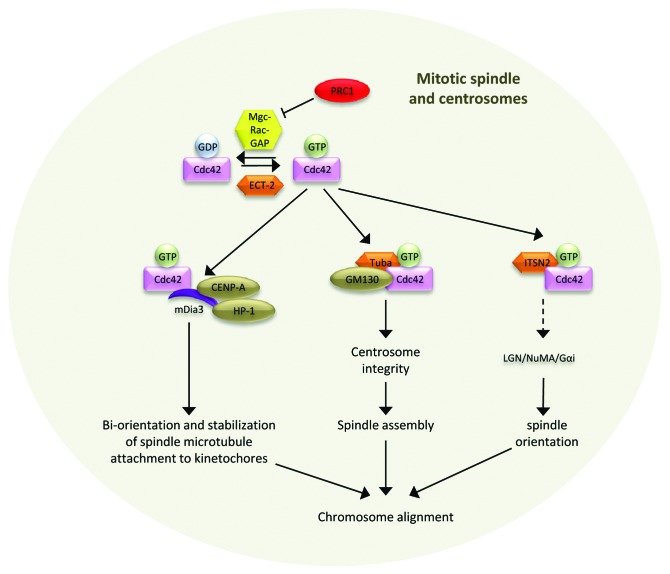
Figure 2. Cdc42-mediated signaling at the mitotic spindle and centrosomes during prometaphase and/or metaphase. In contrast to other mitotic stages, the primary Rho GTPase driving prometaphase and/or metaphase transition is Cdc42, which locates to the mitotic spindle and centrosomes. Here, it is activated by several GEFs (Ect-2, Tuba, and ITSN-2). Cdc42 is also a target of MgcRacGAP. However, its activity it inhibited by binding to PRC1, thus favoring Cdc42 activation. Depending on the localized pool of Cdc42-GTP, it interacts with mDia3/CENP-A/HP-1 (mitotic spindle), GM130/Tuba (Golgi), or ITSN-2 (centrosomes) to regulate a specific metaphase function. As such Cdc42 has roles in (1) bi-orientation and stabilization of spindle microtubule attachment to kinetochores, (2) spindle assembly, and (3) spindle orientation. All three roles contribute to chromosome alignment at the metaphase plate.
None
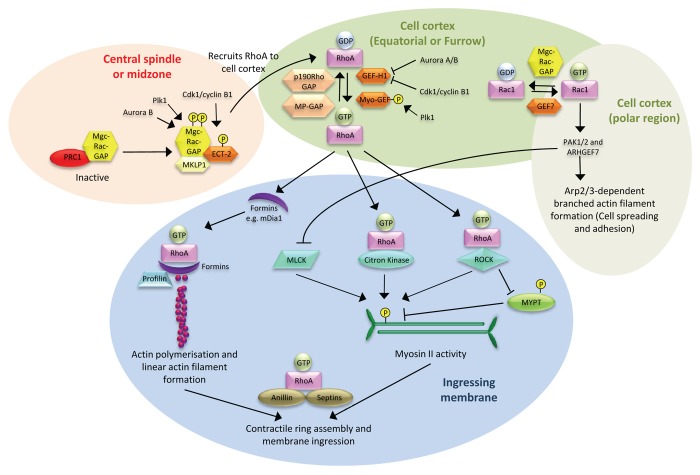
Figure 3. Spatial regulation of the signaling pathways mediated by Rho GTPases during the ingression phase of cytokinesis. Upon anaphase onset, the site of the division plane is established. This involves in-part the interaction between the centralspindlin complex and Ect-2, which is facilitated by phosphorylation, and occurs at the central spindle and/or midzone. RhoA is subsequently recruited to the equator of the cell cortex where its activation is tightly regulated. Its activity is confined to a narrow zone (defining the division plane) by several Rho GEFs (GEF-H1, Myo-GEF) and GAPs (p190RhoGAP, MP-GAP). At the same time, cell cortex localized Rac1 is maintained in an inactive state by MgcRacGAP to inhibit the formation of Arp2/3-mediated branched actin filaments. However, this pathway may be active at the polar regions to allow for cell elongation. At the equatorial cell cortex, RhoA activates the effectors, mDia1 for linear actin filament polymerization, as well as the kinases, MLCK, ROCK, and citron kinase, to activate myosin II. The outcome is assembly and activation of the actin-myosin II contractile ring to mediate membrane ingression. Anillin and septin proteins maintain all furrow components within this narrow zone for efficient and complete membrane ingression.

References

    1. Etienne-Manneville S, Hall A. Rho GTPases in cell biology. Nature. 2002;420:629–35. doi: 10.1038/nature01148. - DOI - PubMed
    1. Dransart E, Olofsson B, Cherfils J. RhoGDIs revisited: novel roles in Rho regulation. Traffic. 2005;6:957–66. doi: 10.1111/j.1600-0854.2005.00335.x. - DOI - PubMed
    1. Oceguera-Yanez F, Kimura K, Yasuda S, Higashida C, Kitamura T, Hiraoka Y, Haraguchi T, Narumiya S. Ect2 and MgcRacGAP regulate the activation and function of Cdc42 in mitosis. J Cell Biol. 2005;168:221–32. doi: 10.1083/jcb.200408085. - DOI - PMC - PubMed
    1. Yasuda S, Oceguera-Yanez F, Kato T, Okamoto M, Yonemura S, Terada Y, Ishizaki T, Narumiya S. Cdc42 and mDia3 regulate microtubule attachment to kinetochores. Nature. 2004;428:767–71. doi: 10.1038/nature02452. - DOI - PubMed
    1. Jordan SN, Canman JC. Rho GTPases in animal cell cytokinesis: an occupation by the one percent. Cytoskeleton (Hoboken) 2012;69:919–30. doi: 10.1002/cm.21071. - DOI - PMC - PubMed

Publication types

Substances

LinkOut - more resources