. 2014 Jul 3:4:5565.
doi: 10.1038/srep05565.

Association between the MLX interacting protein-like, BUD13 homolog and zinc finger protein 259 gene polymorphisms and serum lipid levels

Affiliations

Association between the MLX interacting protein-like, BUD13 homolog and zinc finger protein 259 gene polymorphisms and serum lipid levels

Lynn-Htet-Htet Aung et al. Sci Rep. .

Abstract

This study aimed to detect the association between the MLX interacting protein-like (MLXIPL), BUD13 homolog (BUD13) and zinc finger protein 259 (ZNF259) single nucleotide polymorphisms (SNPs) and serum lipid levels in the Chinese Mulao and Han populations. Genotyping of 9 SNPs was performed in 825 Mulao and 781 Han participants. The genotype and allele frequencies of ZNF259 rs2075290 and rs964184, and BUD13 rs10790162 SNPs were different between the Mulao and Han populations (P < 0.001). The SNPs of ZNF259 rs2075290 and BUD13 rs10790162 were associated with serum total cholesterol levels; ZNF259 rs2075290 and rs964184, BUD13 rs10790162, and MLXIPL rs3812316 and rs13235543 were associated with triglyceride (TG); and MLXIPL rs35332062 was associated with apolipoprotein (Apo) A1 in the Mulaos (P < 0.006-0.001). However, in the Hans, the SNPs of ZNF259 rs2075290 and BUD13 rs10790162 were associated with serum TG levels; ZNF259 rs2075290 was associated with low-density lipoprotein cholesterol and the ApoA1/ApoB ratio (P < 0.006-0.001). Significant linkage disequilibria were noted among ZNF259 rs2075290 and rs964184 and BUD13 rs10790162, and between MLXIPL rs3812316 and rs13235543 (r(2) > 0.05, P < 0.001). The haplotypes of A-C-G-A-C (rs2075290A-rs964184C-rs10790162G-rs17119975A-rs11556024C) and C-C-C-C (rs799161C-rs35332062C-rs3812316C-rs13235543C) accounted for over half of the % haplotype of each ethnic group.


Conflict of interest statement

The authors declare no competing financial interests.

Figures
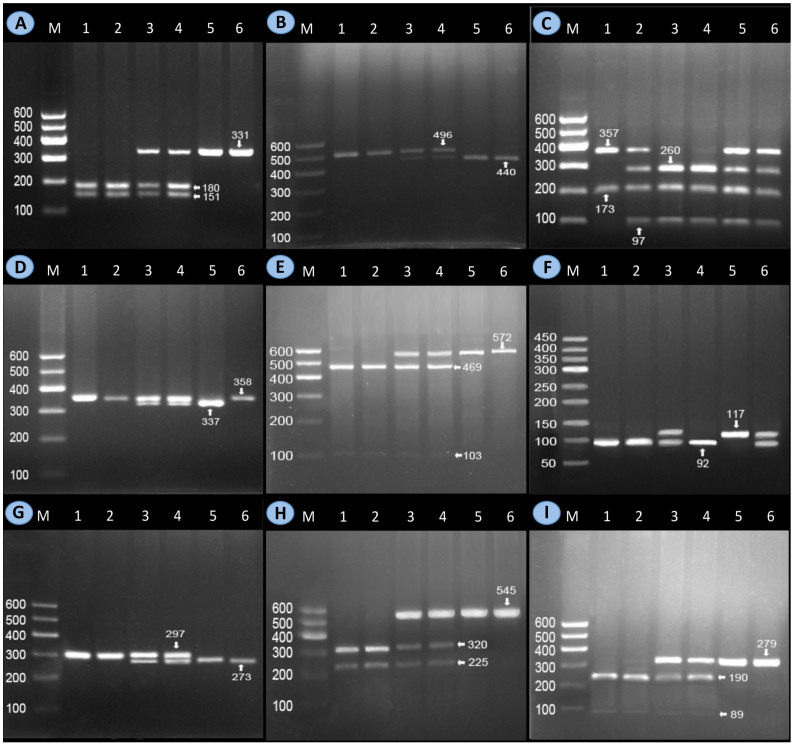
Figure 1
Figure 1. Genotyping of the MLXIPL, BUD13 and ZNF259 SNPs.
Lane M, 100 bp marker ladder; (A) ZNF259 rs2075290: lanes 1 and 2, AA genotype (180- and 151-bp) lanes 3 and 4, GA genotype (331-, 180- and 151-bp); and lanes 5 and 6, GG genotype (331 bp). (B) ZNF259 rs964184: lanes 1 and 2, CC genotype (496 bp); lanes 3 and 4, CG genotype (496-, 440- and 56-bp); and lanes 5 and 6, GG genotype (440- and 56-bp). (C) BUD13 rs10790162: lane 1, AA genotype (357- and 173-bp); lanes 2, 5 and 6, AG genotype (357-, 260-, 173- and 97-bp); and lanes 3 and 4, GG genotype (260-, 173- and 97-bp). (D) BUD13 rs17119975 SNP: lanes 1, 2 and 6, AA genotype (358 bp); lanes 3 and 4, AG genotype (358-, 337- and 21-bp); and lane 5, GG genotype (337- and 21-bp). (E) BUD13 rs11556024: lanes 1 and 2, CC genotype (469- and 103-bp); lanes 3 and 4, CT genotype (572-, 469- and 103-bp); and lanes 5 and 6, TT genotype (572 bp). (F) MLXIPL rs799161: lanes 1, 2 and 4, CC genotype (92- and 25-bp); lanes 3 and 6, CT genotype (117-, 92- and 25-bp); and lane 5, TT genotype (117 bp). (G) MLXIPL rs35332062: lanes 1 and 2, CC genotype (297 bp); lanes 3 and 4, CT genotype (297-, 273- and 24-bp); and lanes 5 and 6, TT genotype (273- and 24-bp). (H) MLXIPL rs3812316: lanes 1 and 2, GG genotype (320- and 225-bp); lanes 3 and 4, CG genotype (545-, 320- and 225-bp); and lanes 5 and 6, CC genotype (545 bp). (I) MLXIPL rs13235543: lanes 1 and 2, CC genotype (190- and 89-bp); lanes 3 and 4, CT genotype (279-, 190- and 89-bp); and lanes 5 and 6, TT genotype (279 bp). The bands less than 90-bp fragments were not visible in the gel owing to their fast migration speed.
Figure 2
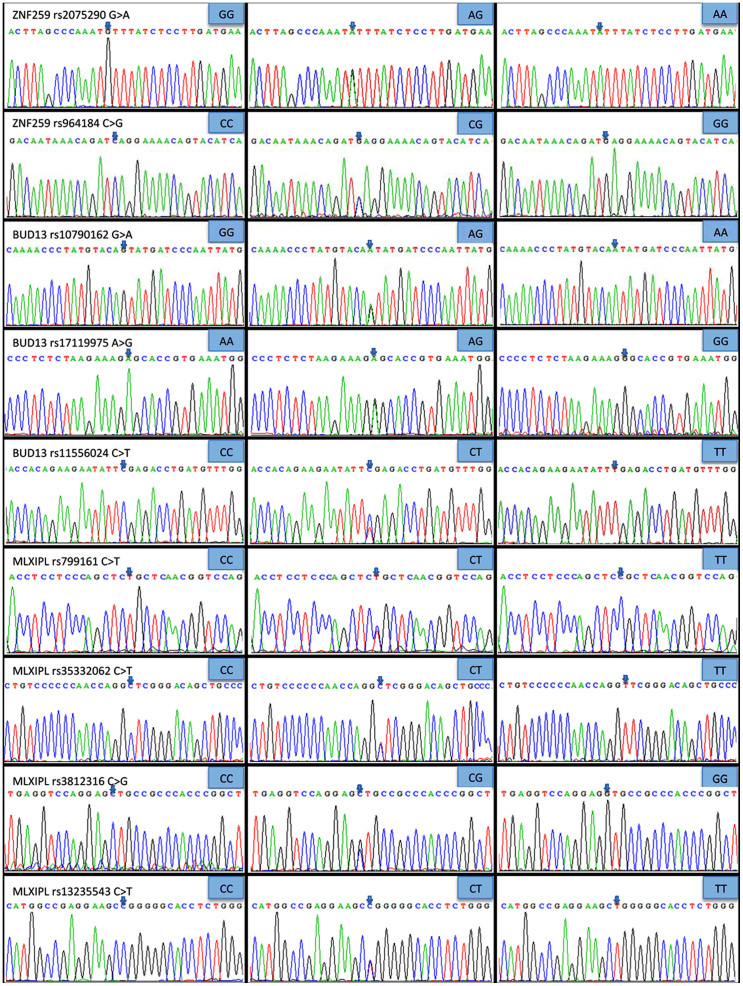
Figure 2. A part of the nucleotide sequences of the MLXIPL, BUD13 and ZNF259 SNPs by direct sequencing.
MLXIPL: MLX interacting protein-like, BUD13: BUD13 homolog and ZNF259: zinc finger protein 259.
Figure 3
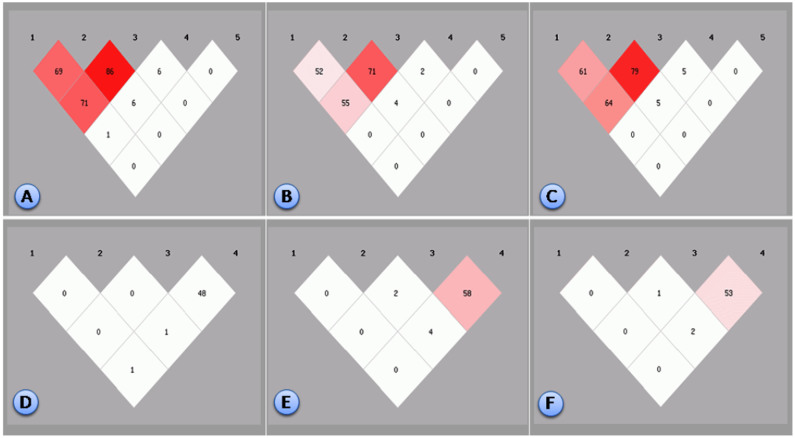
Figure 3. Linkage disequilibrium statuses of the MLXIPL, BUD13 and ZNF259 SNPs.
Linkage disequilibrium among the (1) ZNF259 rs2075290, (2) ZNF259 rs964184 and (3) BUD13 rs10790162, (4) BUD13 rs17119975 and (5) BUD13 rs11556024 SNPs in the Mulao (A), Han (B) and combined Mulao and Han populations (C). Linkage disequilibrium among the (1) MLXIPL rs799161, (2) MLXIPL rs35332062, (3) MLXIPL rs3812316 and (4) MLXIPL rs13235543 SNPs in the Mulao (D), Han (E) and combined Mulao and Han populations (F). The linkage disequilibrium status is illustrated by the magnitude of the r2 value.

References

    1. Shekelle R. B. et al. Diet, serum cholesterol, and death from coronary heart disease. The Western Electric study. N. Engl. J. Med. 304, 65–70 (1981). - PubMed
    1. Wu L. L. Review of risk factors for cardiovascular diseases. Ann. Clin. Lab. Sci. 29, 127–133 (1999). - PubMed
    1. Kannel W. B. & Vasan R. S. Triglycerides as vascular risk factors: new epidemiologic insights. Curr. Opin. Cardiol. 24, 345–350 (2009). - PMC - PubMed
    1. Merched A. J. & Chan L. Nutrigenetics and nutrigenomics of atherosclerosis. Curr. Atheroscler. Rep. 15, 328 (2013). - PMC - PubMed
    1. Heller D. A., DeFaire U., Pedersen N. L., Dahlen G. & McClearn G. E. Genetic and environmental influences on serum lipid levels in twins. N. Engl. J. Med. 328, 1150–1156 (1993). - PubMed

Publication types

MeSH terms

LinkOut - more resources