


Maternal hyperlipidemia and the risk of preeclampsia: a meta-analysis
- PMID: 24989239
- PMCID: PMC4565654
- DOI: 10.1093/aje/kwu145
Maternal hyperlipidemia and the risk of preeclampsia: a meta-analysis
Abstract
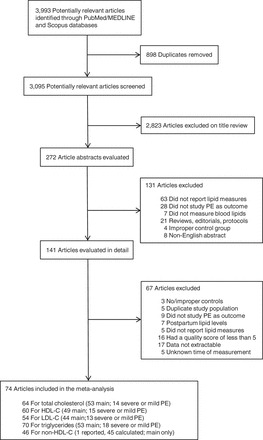
Published reports examining lipid levels during pregnancy and preeclampsia have been inconsistent. The objective of this meta-analysis was to test the association between preeclampsia and maternal total cholesterol, high-density lipoprotein cholesterol (HDL-C), low-density lipoprotein cholesterol (LDL-C), non-HDL-C, and triglyceride levels measured during pregnancy. We conducted a systematic search for studies published between the index date until July 2013 reporting maternal lipid levels in women with preeclampsia and normotensive pregnant women. Seventy-four studies met all eligibility criteria and were included in the meta-analysis. Weighted mean differences in lipid levels were calculated using a random-effects model. Statistical heterogeneity was investigated using the I(2) statistic. Meta-regression was used to identify sources of heterogeneity. Preeclampsia was associated with elevated total cholesterol, non-HDL-C, and triglyceride levels, regardless of gestational age at the time of blood sampling, and with lower levels of HDL-C in the third trimester. A marginal association was found with LDL-C levels. Statistical heterogeneity was detected in all analyses. Meta-regression analyses suggested that differences in body mass index (weight (kg)/height (m)(2)) across studies may be partially responsible for the heterogeneity in the triglyceride and LDL-C analyses. This systematic review and meta-analysis demonstrates that women who develop preeclampsia have elevated levels of total cholesterol, non-HDL-C, and triglycerides during all trimesters of pregnancy, as well as lower levels of HDL-C during the third trimester.
Keywords: body mass index; cholesterol; hyperlipidemia; hypertriglyceridemia; meta-analysis; preeclampsia; systematic review; triglycerides.
© The Author 2014. Published by Oxford University Press on behalf of the Johns Hopkins Bloomberg School of Public Health. All rights reserved. For permissions, please e-mail: journals.permissions@oup.com.
Figures
References
-
- Duley L. The global impact of pre-eclampsia and eclampsia. Semin Perinatol. 2009;33(3):130–137. - PubMed
-
- Roberts JM, Cooper DW. Pathogenesis and genetics of pre-eclampsia. Lancet. 2001;357(9249):53–56. - PubMed
-
- ACOG Committee on Practice Bulletins—Obstetrics ACOG practice bulletin. Diagnosis and management of preeclampsia and eclampsia. Number 33, January 2002. Obstet Gynecol. 2002;99(1):159–167. - PubMed
-
- Hubel CA. Oxidative stress in the pathogenesis of preeclampsia. Proc Soc Exp Biol Med. 1999;222(3):222–235. - PubMed
-
- Brown MC, Best KE, Pearce MS, et al. Cardiovascular disease risk in women with pre-eclampsia: systematic review and meta-analysis. Eur J Epidemiol. 2013;28(1):1–19. - PubMed
Publication types
MeSH terms
Substances
LinkOut - more resources
Full Text Sources
Other Literature Sources
Miscellaneous
