


Antipsychotic polypharmacy in children and adolescents at discharge from psychiatric hospitalization
- PMID: 24990538
- PMCID: PMC4165554
- DOI: 10.1002/phar.1453
Antipsychotic polypharmacy in children and adolescents at discharge from psychiatric hospitalization
Abstract
Study objective: Antipsychotic polypharmacy-the use of more than one antipsychotic concomitantly-has increased in children and adolescents and may be associated with increased adverse effects, nonadherence, and greater costs. Thus, we sought to examine the demographic and clinical characteristics of psychiatrically hospitalized children and adolescents who were prescribed antipsychotic polypharmacy and to identify predictors of this prescribing pattern.
Design: Retrospective medical record review.
Setting: The inpatient psychiatric unit of a large, acute care, urban children's hospital.
Patients: One thousand four hundred twenty-seven children and adolescents who were consecutively admitted and discharged between September 2010 and May 2011.
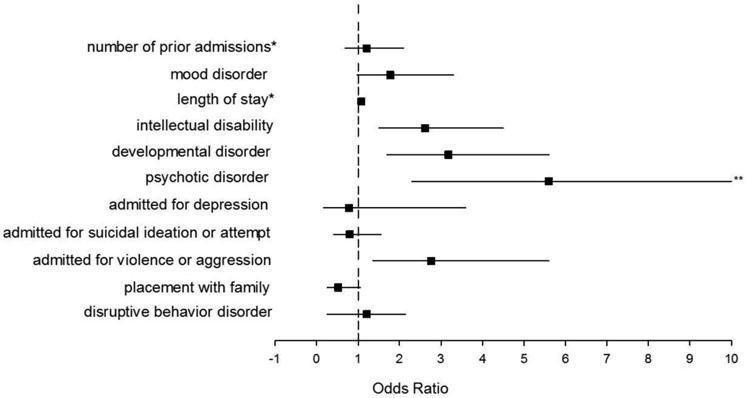
Measurements and main results: At discharge, 840 (58.9%) of the 1427 patients were prescribed one or more antipsychotics, and 99.3% of these received second-generation antipsychotics. Of these 840 patients, 724 (86.2%) were treated with antipsychotic monotherapy, and 116 (13.8%) were treated with antipsychotic polypharmacy. Positive correlations with antipsychotic polypharmacy were observed for placement or custody outside the biological family; a greater number of previous psychiatric admissions; longer hospitalizations; admission for violence/aggression or psychosis; and intellectual disability, psychotic, disruptive behavior, or developmental disorder diagnoses. Negative correlations with antipsychotic polypharmacy included admission for suicidal ideation/attempt or depression, and mood disorder diagnoses. Significant predictors of antipsychotic polypharmacy included admission for violence or aggression (odds ratio [OR] 2.76 [95% confidence interval (CI) 1.36-5.61]), greater number of previous admissions (OR 1.21 [95% CI 1.10-1.33]), and longer hospitalizations (OR 1.08 [95% CI 1.04-1.12]). In addition, diagnoses of intellectual disability (OR 2.62 [95% CI 1.52-4.52]), psychotic disorders (OR 5.60 [95% CI 2.29-13.68]), and developmental disorders (OR 3.18 [95% CI 1.78-5.65]) were predictors of antipsychotic polypharmacy.
Conclusion: Certain youth may have a higher likelihood of being prescribed antipsychotic polypharmacy, which should prompt careful consideration of medication treatment options during inpatient hospitalization. Future examinations of the rationale for combining antipsychotics, along with the long-term safety, tolerability, and cost effectiveness of these therapies, in youth are urgently needed.
Keywords: antipsychotic; child and adolescent psychiatry; polypharmacy; psychiatric hospitalization.
© 2014 Pharmacotherapy Publications, Inc.
Conflict of interest statement
Dr. Saldaña, Ms. Wehry, and Mr. Blom report no biomedical conflicts of interest.
Figures
References
-
- Blader JC. Acute inpatient care for psychiatric disorders in the United States, 1996 through 2007. Arch Gen Psychiatry. 2011 Dec;68(12):1276–1283. - PubMed
-
- Olfson M, Blanco C, Liu SM, et al. National trends in the office-based treatment of children, adolescents, and adults with antipsychotics. Arch Gen Psychiatry. 2012 Dec 1;69(12):1247–1256. - PubMed
-
- Olfson M, Crystal S, Huang C, et al. Trends in antipsychotic drug use by very young, privately insured children. J Am Acad Child Adolesc Psychiatry. 2010 Jan;49(1):13–23. - PubMed
-
- Patel NC, Crismon ML, Hoagwood K, et al. Trends in the use of typical and atypical antipsychotics in children and adolescents. J Am Acad Child Adolesc Psychiatry. 2005 Jun;44(6):548–556. - PubMed
MeSH terms
Substances
Grants and funding
LinkOut - more resources
Full Text Sources
Other Literature Sources
Medical
