


Mechanism of impaired afferent arteriole myogenic response in Dahl salt-sensitive rats: role of 20-HETE
- PMID: 24990891
- PMCID: PMC4250233
- DOI: 10.1152/ajprenal.00283.2014
Mechanism of impaired afferent arteriole myogenic response in Dahl salt-sensitive rats: role of 20-HETE
Abstract
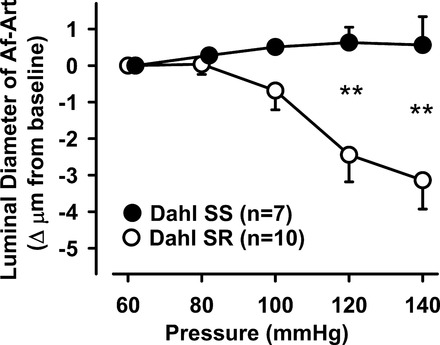
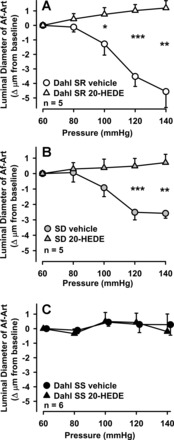
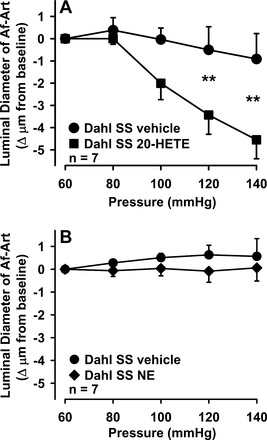
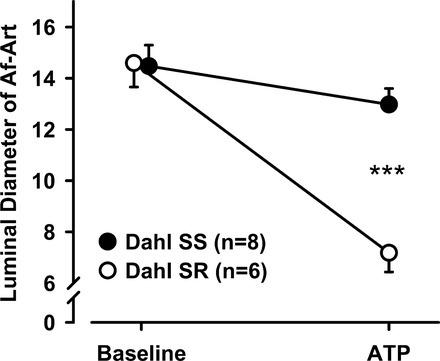
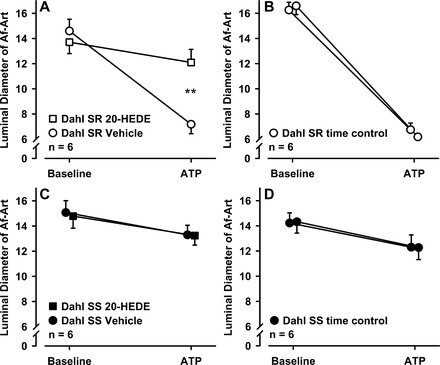
The afferent arteriole (Af-Art) controls glomerular capillary pressure, an important determinant of glomerular injury. Af-Art myogenic response is mediated by ATP, and ATP signaling is in turn mediated by 20-HETE. Dahl salt-sensitive rats (Dahl SS) have decreased renal 20-HETE production. We hypothesized that Dahl SS have an impaired myogenic response and constrictor response to ATP, due to decreased 20-HETE. Af-Arts from Dahl SS or Dahl salt-resistant rats (Dahl SR) were microdissected and perfused. When myogenic response was induced by increasing Af-Art perfusion pressure from 60 to 140 mmHg, luminal Af-Art diameter decreased in Dahl SR but not in Dahl SS (-3.1 ± 0.8 vs. 0.5 ± 0.8 μm, P < 0.01). The 20-HETE antagonist 20-HEDE (10(-6) M) blocked the myogenic response in Dahl SR but had no effect in Dahl SS. Addition of a subconstrictor concentration of 20-HETE (but not a subconstrictor concentration of norepinephrine) restored the myogenic response in Dahl SS. We then perfused Af-Arts at 60 mmHg and tested the effects of the ATP analog α,β-methylene-ATP (10(-6) M). Maximum ATP-induced constriction was attenuated in Dahl SS compared with Dahl SR (1.5 ± 0.5 vs. 7.4 ± 0.8 μm, P < 0.001). 20-HEDE attenuated ATP-induced Af-Art constriction in Dahl SR but not in Dahl SS, and consequently, ATP-induced constriction was no longer different between strains. In conclusion, Dahl SS have an impaired myogenic response and ATP-induced Af-Art constriction due to a decrease in Af-Art 20-HETE. The impaired myogenic responses may contribute to the nephrosclerosis that develops in Dahl SS.
Keywords: 20-HETE; ATP; afferent arteriole; myogenic response; salt-sensitive hypertension.
Copyright © 2014 the American Physiological Society.
Figures
References
-
- Alonso-Galicia M, Maier KG, Greene AS, Cowley AW, Jr, Roman RJ. Role of 20-hydroxyeicosatetraenoic acid in the renal and vasoconstrictor actions of angiotensin II. Am J Physiol Regul Integr Comp Physiol 283: R60–R68, 2002. - PubMed
-
- Arima S, Ito S. Role of renal eicosanoids in the control of intraglomerular and systemic blood pressure during development of hypertension. Contrib Nephrol 143: 65–76, 2004. - PubMed
-
- Azar S, Limas C, Iwai J, Weller D. Single nephron dynamics during high sodium intake and early hypertension in Dahl rats. Jpn Heart J 20: 138–140, 1979.
-
- Bidani AK, Hacioglu R, bu-Amarah I, Williamson GA, Loutzenhiser R, Griffin KA. “Step” vs. “dynamic” autoregulation: implications for susceptibility to hypertensive injury. Am J Physiol Renal Physiol 285: F113–F120, 2003. - PubMed
-
- Briggs JP, Schnermann J. The tubuloglomerular feedback mechanism: functional and biochemical aspects. Annu Rev Physiol 49: 251–273, 1987. - PubMed
MeSH terms
Substances
Grants and funding
LinkOut - more resources
Full Text Sources
Other Literature Sources
Medical
Research Materials
