


Number and characteristics of medical professionals working in Chinese mental health facilities
- PMID: 24991167
- PMCID: PMC4054572
- DOI: 10.3969/j.issn.1002-0829.2013.05.003
Number and characteristics of medical professionals working in Chinese mental health facilities
Abstract
Background: Mental disorders account for a substantial proportion of the total disease burden in China but the number, distribution and characteristics of the mental health professionals available to provide services for mentally ill individuals is unknown.
Aim: Describe the distribution and characteristics of medical professionals working in mental health facilities around China.
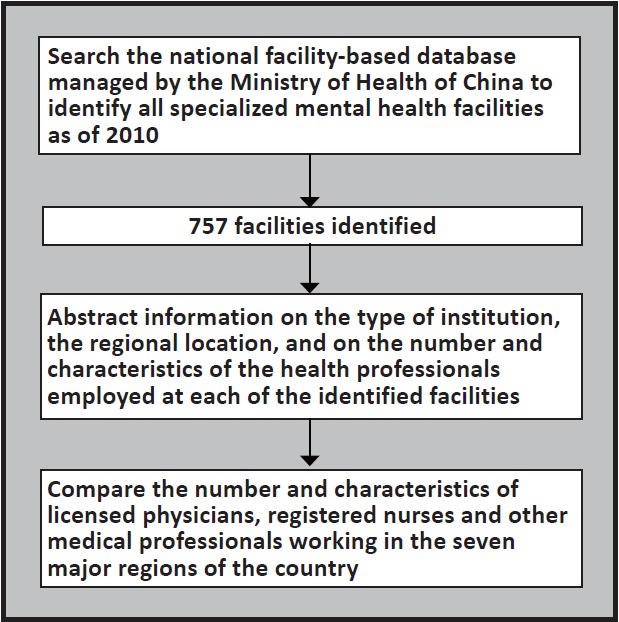
Methods: Information on the numbers and characteristics of health professionals working in mental health facilities in China in 2010 was obtained from the Statistical Information Center of the Ministry of Health and the population-adjusted ratios and characteristics of these mental health professionals were compared across the seven geographic regions of the country.
Results: Among the 757 specialized mental health facilities identified, 649 (86%) were psychiatric hospitals. A total of 68,796 medical professionals (5.16/100,000 population) were working in these facilities, including 20,480 psychiatrists (1.54/100,000) and 35,337 registered nurses (2.65/100,000). Over 98% of these medical professionals worked in psychiatric hospitals. Among the psychiatrists, 29% only had a technical school degree and 14% had no academic degree at all; among the nurses, 46% had no academic qualifications. The duration of employment as a psychiatrist or as a psychiatric nurse was longer among medical professionals working in the economically less dynamic northern parts of the country. The population ratios of licensed physicians and registered nurses working in mental health facilities were significantly higher than average in the relatively wealthy eastern and northeastern parts of the country.
Conclusions: Almost all mental health professionals in China work in specialty psychiatric hospitals. The numbers and geographic distribution of trained mental health professionals in China are grossly inadequate to meet the mental health needs of the population. China has a much smaller mental health workforce per 100,000 residents than other upper-middle-income countries, and the range of professionals who provide mental health services is much narrower.
背景: 精神障碍在我国疾病总负担中占有相当大的比例,但可提供于精神障碍患者心理卫生服务的专业人员数量,分布和特点还是未知数。
目的: 全面了解我国精神卫生机构人力资源分布现状和特点。
方法: 从卫生部统计信息中心获得2010年在中国精神卫生机构中工作的卫生技术人员的数量和特征,比较七个地理区域精神卫生专业人员的人口比例和特征。
结果: 在757家精神卫生机构内,649家(86%)是精神病院。在这些机构内卫生技术人员共计68,796人(5.16人/10万人口),包括精神科医师20,480人(1.54人/10万人口)和注册护士35,337人(2.65人/10万人口)。超过80%的卫生技术人员都工作在精神病院。29%的精神科医生人仅具有技校学历,而14%的精神科医生没有学位。在护士中有46%的护士没有学历。我国经济比较落后的北部地区精神科医生或护士的工龄较其长。在我国相对较富裕的东部和东北部地区,精神卫生机构中执业医师和注册护士的人口比例要高于平均水平。
结论: 我国几乎所有的精神卫生技术人员都工作在精神科专科医院。训练有素的卫生技术人员在数量和地区的分布上远远无法满足人们对卫生健康的需求。与其他中上等收入国家相比,我国每10万人口拥有的精神卫生资源较少,所能提供精神卫生服务的专业人员范围也较窄。
Conflict of interest statement
References
-
- Patel V. Mental health in low- and middle-income countries. Br Med Bull. 2007;81-82:81–96. - PubMed
-
- Demyttenaere K, Bruffaerts R, Posada-Villa J, Gasquet I, Kovess V, Lepine JP, et al. Prevalence, severity, and unmet need for treatment of mental disorders in the World Health Organization World Mental Health Surveys. JAMA. 2004;291:2581–2590. - PubMed
LinkOut - more resources
Full Text Sources