Review
. 2014 May 8:5:64.
doi: 10.4103/2152-7806.132138. eCollection 2014.

Glioblastoma multiforme: State of the art and future therapeutics

Affiliations
Review

Glioblastoma multiforme: State of the art and future therapeutics

Taylor A Wilson et al. Surg Neurol Int. .

Abstract

Background: Glioblastoma multiforme (GBM) is the most common and lethal primary malignancy of the central nervous system (CNS). Despite the proven benefit of surgical resection and aggressive treatment with chemo- and radiotherapy, the prognosis remains very poor. Recent advances of our understanding of the biology and pathophysiology of GBM have allowed the development of a wide array of novel therapeutic approaches, which have been developed. These novel approaches include molecularly targeted therapies, immunotherapies, and gene therapy.

Methods: We offer a brief review of the current standard of care, and a survey of novel therapeutic approaches for treatment of GBM.

Results: Despite promising results in preclinical trials, many of these therapies have demonstrated limited therapeutic efficacy in human clinical trials. Thus, although survival of patients with GBM continues to slowly improve, treatment of GBM remains extremely challenging.

Conclusion: Continued research and development of targeted therapies, based on a detailed understanding of molecular pathogenesis can reasonably be expected to yield improved outcomes for patients with GBM.

Keywords: Glioblastoma multiforme; gene therapy; immunotherapy; molecularly targeted therapy.


Figures
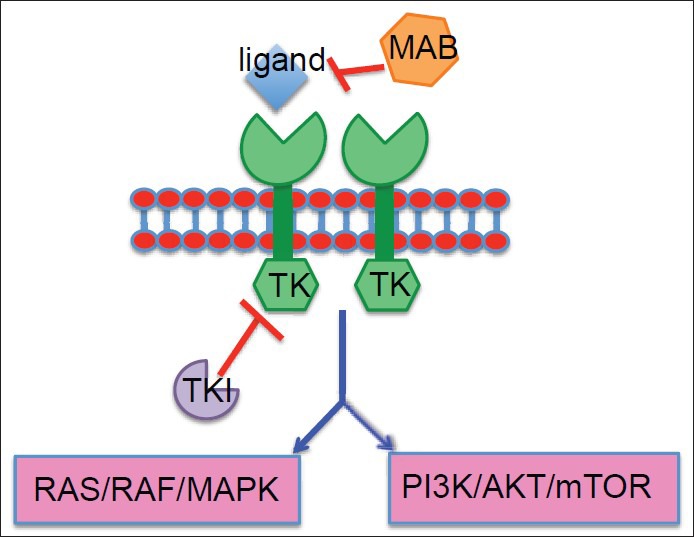
Figure 1
Figure 1
Activation of RTKs triggers a cascade of downstream signaling events, and inappropriate activation of these pathways drives tumor growth, survival, invasion into normal brain, and secretion of angiogenic factors. The hexagons labeled with TK represent the intracellular component of the RTK, and the TKI is shown inhibiting the TK activity. MABs are too large to cross cell membranes, so they are used to target cell surface proteins and other extracellular peptides.[5961] The MAB is shown inhibiting the ligand from binding and activating the extracellular ligand-binding domain of the RTK
Figure 2
Figure 2
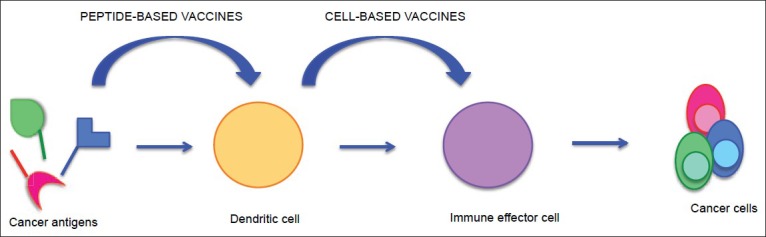
In peptide-based therapies, GBM-related antigens are administered to the patient as a vaccine to stimulate an immune response. Once administered, DCs, which are professional APCs, internalize these GBM-related antigens and present them to the immune effector cells to stimulate an immune response. In cell-based therapies, APCs are activated with GBM-related antigens, rather than the antigen itself, to prime the immune system and then injected into the patients to generate an immune response
Figure 3
Figure 3
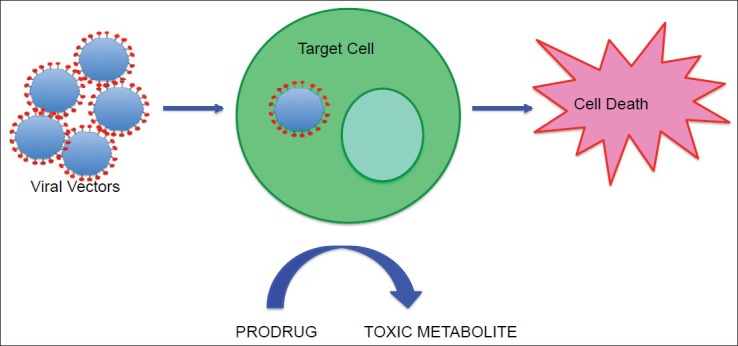
This figure shows conditionally cytotoxic gene therapy, also referred to as enzyme-prodrug activating therapy or suicide gene therapy, which is the most commonly used gene therapy. In conditionally cytotoxic approaches, as described in the text, the transgene for a noncytotoxic enzyme is delivered into tumor cells using a vector, and this enzyme remains noncytotoxic until the administration of a noncytotoxic prodrug. Upon prodrug administration, the enzyme converts the noncytotoxic prodrug into a toxic metabolite that induces tumor cell death
Figure 4
Figure 4
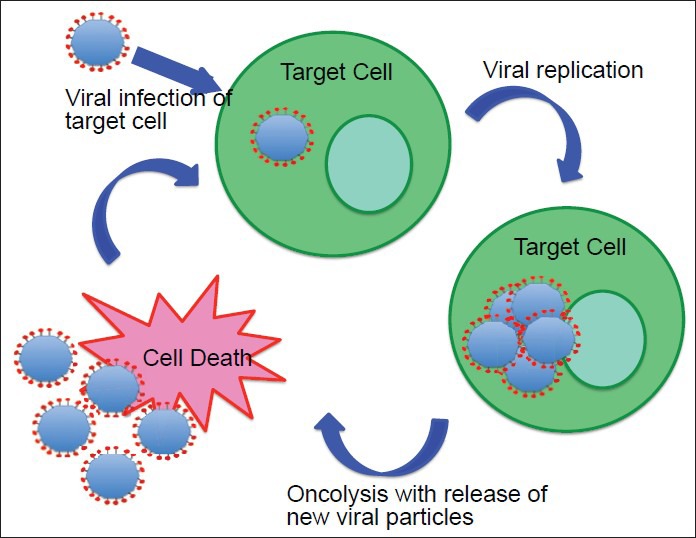
This figure shows conditionally cytotoxic gene therapy, also referred to as enzyme-prodrug activating therapy or suicide gene therapy, which is the most commonly used gene therapy. In conditionally cytotoxic approaches, as described in the text, the transgene for a noncytotoxic enzyme is delivered into tumor cells using a vector, and this enzyme remains noncytotoxic until the administration of a noncytotoxic prodrug. Upon prodrug administration, the enzyme converts the noncytotoxic prodrug into a toxic metabolite that induces tumor cell death

References

    1. Aguilar LK, Arvizu M, Aguilar-Cordova E, Chiocca EA. The spectrum of vaccine therapies for patients with glioblastoma multiforme. Curr Treat Options Oncol. 2012;13:437–50. - PMC - PubMed
    1. Ahmed AU, Thaci B, Alexiades NG, Han Y, Qian S, Liu F, et al. Neural stem cell-based cell carriers enhance therapeutic efficacy of an oncolytic adenovirus in an orthotopic mouse model of human glioblastoma. Mol Ther. 2011;19:1714–26. - PMC - PubMed
    1. Ahmed AU, Tyler MA, Thaci B, Alexiades NG, Han Y, Ulasov IV, et al. A comparative study of neural and mesenchymal stem cell-based carriers for oncolytic adenovirus in a model of malignant glioma. Mol Pharm. 2011;8:1559–72. - PMC - PubMed
    1. Anton K, Baehring JM, Mayer T. Glioblastoma multiforme: Overview of current treatment and future perspectives. Hematol Oncol Clin North Am. 2012;26:825–53. - PubMed
    1. Ardon H, De Vleeschouwer S, Van Calenbergh F, Claes L, Kramm CM, Rutkowski S, et al. Adjuvant dendritic cell-based tumour vaccination for children with malignant brain tumours. Pediatr Blood Cancer. 2010;54:519–25. - PubMed