


Numerical simulation of callus healing for optimization of fracture fixation stiffness
- PMID: 24991809
- PMCID: PMC4081589
- DOI: 10.1371/journal.pone.0101370
Numerical simulation of callus healing for optimization of fracture fixation stiffness
Abstract
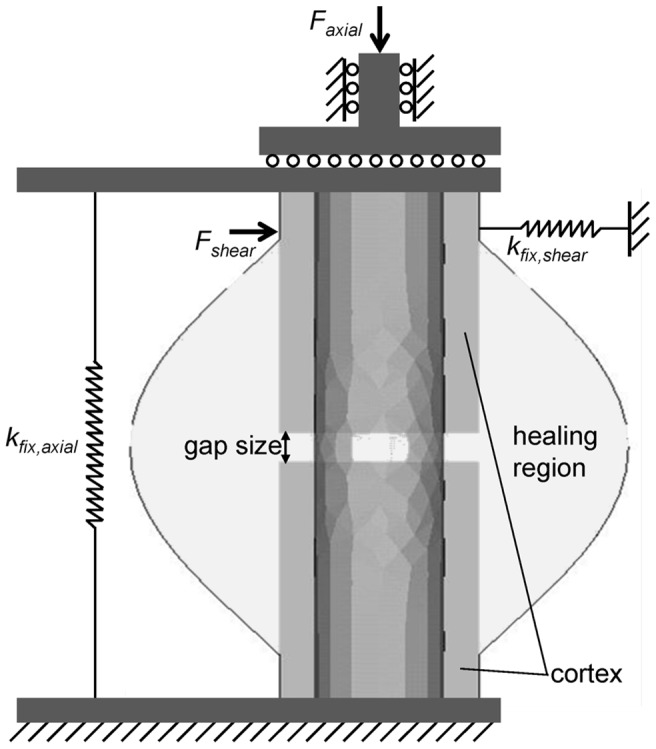
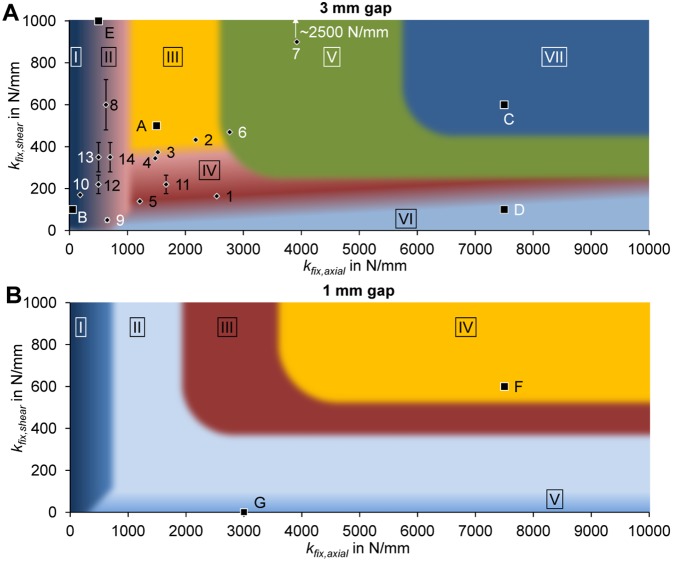
The stiffness of fracture fixation devices together with musculoskeletal loading defines the mechanical environment within a long bone fracture, and can be quantified by the interfragmentary movement. In vivo results suggested that this can have acceleratory or inhibitory influences, depending on direction and magnitude of motion, indicating that some complications in fracture treatment could be avoided by optimizing the fixation stiffness. However, general statements are difficult to make due to the limited number of experimental findings. The aim of this study was therefore to numerically investigate healing outcomes under various combinations of shear and axial fixation stiffness, and to detect the optimal configuration. A calibrated and established numerical model was used to predict fracture healing for numerous combinations of axial and shear fixation stiffness under physiological, superimposed, axial compressive and translational shear loading in sheep. Characteristic maps of healing outcome versus fixation stiffness (axial and shear) were created. The results suggest that delayed healing of 3 mm transversal fracture gaps will occur for highly flexible or very rigid axial fixation, which was corroborated by in vivo findings. The optimal fixation stiffness for ovine long bone fractures was predicted to be 1000-2500 N/mm in the axial and >300 N/mm in the shear direction. In summary, an optimized, moderate axial stiffness together with certain shear stiffness enhances fracture healing processes. The negative influence of one improper stiffness can be compensated by adjustment of the stiffness in the other direction.
Conflict of interest statement
Figures




References
-
- Bhandari M, Tornetta P, Sprague S, Najibi S, Petrisor T, et al. (2003) Predictors of reoperation following operative management of fractures of the tibial shaft. Journal of Orthopaedic Trauma 17: 353–361. - PubMed
-
- Einhorn TA (1995) Enhancement of fracture healing. Journal of Bone and Joint Surgery-American Volume 77A: 940–956. - PubMed
-
- Karladani AH, Granhed H, Karrholm J, Styf J (2001) The influence of fracture etiology and type on fracture healing: a review of 104 consecutive tibial shaft fractures. Archives of Orthopaedic and Trauma Surgery 121: 325–328. - PubMed
-
- Brinker MR, O’Connor DP (2004) The incidence of fractures and dislocations referred for orthopaedic services in a capitated population. Journal of Bone and Joint Surgery-American Volume 86A: 290–297. - PubMed
-
- Praemer A, Furner S, Rice DP (1992) Musculoskeletal conditions in the United States. Rosemont, IL: American Academy of Orthopaedic Surgeons Park Ridge.
Publication types
MeSH terms
LinkOut - more resources
Full Text Sources
Other Literature Sources
Medical
