


Advances in the pathophysiology and treatment of heparin-induced thrombocytopenia
- PMID: 24992313
- PMCID: PMC4232774
- DOI: 10.1097/MOH.0000000000000066
Advances in the pathophysiology and treatment of heparin-induced thrombocytopenia
Abstract
Purpose of review: To review the recent developments in understanding the pathophysiology of heparin-induced thrombocytopenia (HIT) and in applying this knowledge to the treatment of patients with suspected and proven HIT.
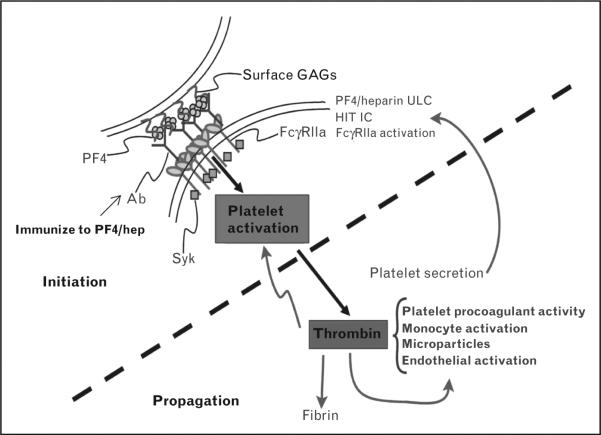
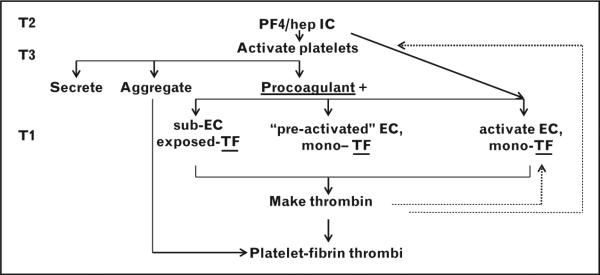
Recent findings: HIT pathophysiology is dynamic and complex. HIT pathophysiology is initiated by four essential components--heparin (Hep), platelet factor 4 (PF4), IgG antibodies against the Hep-PF4 complex, and platelet FcγRIIa. HIT is propagated by activated platelets, monocytes, endothelial cells, and coagulation proteins. Insights into the unique HIT antibody response continue to emerge, but without consensus as to the relative roles of B cells, T cells, and antigen-presenting cells. Platelet activation via FcγRIIa, the sine qua non of HIT, has become much better appreciated. Therapy remains challenging for several reasons. Suspected HIT is more frequent than proven HIT, because of the widespread use of Hep and the inadequacies of current diagnostic tests and scoring systems. In proven HIT, approved treatments reduce but do not eliminate thrombosis, and have substantial bleeding risk. Rational novel therapeutic strategies, directed at the initiating steps in HIT pathophysiology and with potential combinations staged over time, are in various phases of development.
Summary: Progress continues in understanding the breadth of molecular and cellular players in HIT. Translation to improved diagnosis and treatment is needed.
Figures
References
-
- Potschke C, Selleng S, Broker BM, Greinacher A. Heparin-induced thrombocytopenia: further evidence for a unique immune response. Blood. 2012;120:4238–4245. - PubMed
-
- Greinacher A, Holtfreter B, Krauel K, et al. Association of natural antiplatelet factor 4/heparin antibodies with periodontal disease. Blood. 2011;118:1395–1401. - PubMed
-
- Krauel K, Potschke C, Weber C, et al. Platelet factor 4 binds to bacteria, [corrected] inducing antibodies cross-reacting with the major antigen in heparin-induced thrombocytopenia. Blood. 2011;117:1370–1378. - PubMed
Publication types
MeSH terms
Substances
Grants and funding
LinkOut - more resources
Full Text Sources
Other Literature Sources
Medical
Miscellaneous
