. 2014 Aug;6(8):995-1002.
doi: 10.15252/emmm.201403959.

TORC2-a new player in genome stability

Affiliations

TORC2-a new player in genome stability

Ronit Weisman et al. EMBO Mol Med. 2014 Aug.

Abstract

The inhibition of the central growth regulatory kinase TOR, which participates in two complexes, TORC1 and TORC2, has been a focus of metabolic and cancer studies for many years. Most studies have dealt with TORC1, the canonical target of rapamycin, and the role of this complex in autophagy, protein synthesis, and cell growth control. Recent work on TORC2 in budding and fission yeast species points to a conserved role of this lesser-known TOR complex in the survival of DNA damage. In budding yeast, TORC2 controls lipid biosynthesis and actin cytoskeleton through downstream AGC kinases, which are now, surprisingly, implicated in the survival of oxidative DNA damage. Preliminary data from mTORC2 modulation in cancer cells suggest that an extension to human chemotherapy is worth exploring.

Keywords: DNA damage; TORC1; TORC2; cancer therapies; mTOR.


Figures

Figure 1
Figure 1. TORC2 complex signaling to AGC kinases
Shown is a summary of TORC2 in human, S. cerevisiae and S. pombe. The human proteins Rictor and Sin1 are TORC2-specific subunits conserved in both yeast species, being known as Avo3 (Rictor) and Avo1 (Sin1) in S. cerevisiae (Loewith et al, 2002) or Ste20 (Rictor) or Sin1 in S. pombe (Hayashi et al, ; Matsuo et al, 2007). The target kinases of TORC2 are AKT1 (Sarbassov et al, 2005), SGK1 (Garcia-Martinez & Alessi, 2008), PKC-α (Facchinetti et al, ; Ikenoue et al, 2008), and PKC-ζ (Li & Gao, 2014) in higher eukaryotes, while they are Ypk1 and Ypk2 (Kamada et al, 2005), and the PKC ortholog Pkc1 (Facchinetti et al, 2008) in budding yeast. Fission yeast has only one identified AGC-kinase, Gad8 (Matsuo et al, 2003).
Figure 2
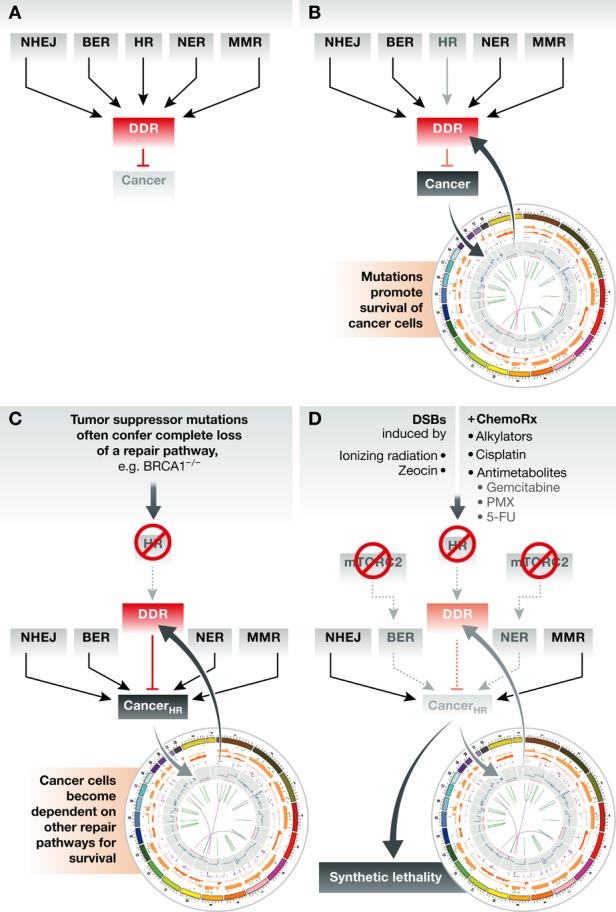
Figure 2. Combinational therapies that impair multiple repair pathways can provoke synergistic lethality in “damage-addicted” cancer cells
(A) Multiple repair pathways including non-homologous end joining (NHEJ), base-excision repair (BER), homologous recombination (HR), nucleotide excision repair (NER), and mismatch repair (MMR) protect the cellular genome from damage through conserved pathways that collectively activate the DNA damage response (DDR). (B) In precancerous lesions, overwhelming damage or weakened repair capacity (for example. loss of HR) can lead to selection for mutations that promote survival. Transformed cells often exhibit constitutively activated DDR and enhanced genomic instability. (C) Loss of a repair pathway (through inherited or incurred mutation, e.g. HR) can render cancer cells “addicted” or dependent on the other repair pathways (CancerHR). (D) Combined therapies that are effective against tumors bearing mutant repair pathways often inhibit a second repair pathway. This could be by targeting a general repair factor (e.g. PARP) or—as suggested here—the mTORC2 complex. The resulting accumulation of irreparable damage leads to cell death (synthetic lethality). DNA-damaging agents could enhance the synthetic lethality. Illustration partially adapted (with permission) from Forbes et al (2011).

References

    1. Alvarez B, Moreno S. Fission yeast Tor2 promotes cell growth and represses cell differentiation. J Cell Sci. 2006;119:4475–4485. - PubMed
    1. Aronova S, Wedaman K, Aronov PA, Fontes K, Ramos K, Hammock BD, Powers T. Regulation of ceramide biosynthesis by TOR complex 2. Cell Metab. 2008;7:148–158. - PMC - PubMed
    1. Barbet NC, Schneider U, Helliwell SB, Stansfield I, Tuite MF, Hall MN. TOR controls translation initiation and early G1 progression in yeast. Mol Biol Cell. 1996;7:25–42. - PMC - PubMed
    1. Bass KL, Murray JM, O'Connell MJ. Brc1-dependent recovery from replication stress. J Cell Sci. 2012;125:2753–2764. - PMC - PubMed
    1. Belin BJ, Mullins RD. What we talk about when we talk about nuclear actin. Nucleus. 2013;4:291–297. - PMC - PubMed

Publication types

MeSH terms

Substances