. 2014 Sep 1:142:110-9.
doi: 10.1016/j.drugalcdep.2014.06.003. Epub 2014 Jun 17.

You are the danger: attenuated insula response in methamphetamine users during aversive interoceptive decision-making

Affiliations

You are the danger: attenuated insula response in methamphetamine users during aversive interoceptive decision-making

Jennifer L Stewart et al. Drug Alcohol Depend. .

Abstract

Background: Drug dependent individuals often make drug-taking decisions when they do not feel well. Yet, few studies have examined the influence of an aversive state on decision-making related neural processing.

Methods: We investigate brain activation to decision-making during an aversive interoceptive challenge in methamphetamine users using functional magnetic resonance imaging (fMRI). Recently abstinent inpatients with methamphetamine use disorder (METH; n=20) and healthy comparison subjects (CTL; n=22) performed a two-choice prediction task at three fixed error rates (ER; 20%=reward, 50%=uncertainty, 80%=punishment) while anticipating and experiencing episodes of inspiratory breathing load during fMRI.

Results: METH exhibited higher trait anxiety in conjunction with lower anterior insula (AI) and inferior frontal gyrus (IFG) activation than CTL across trials. METH also showed lower posterior insula (PI) and anterior cingulate cortex (ACC) activation than CTL during breathing load independent of ER. For the crucial ER by interoception interaction, METH displayed lower ACC activation to punishment/loss than CTL during breathing load. Within METH, lower trait anxiety was linked to AI/IFG attenuation across trials.

Conclusions: AI/IFG attenuations in METH are suggestive of an executive functioning deficit, particularly in users with low anxiety, reflecting reduced resources allocated to choice selection. In contrast, PI/ACC reductions in METH appear specific to impairments in registering and evaluating interoceptive experiences. Taken together, inadequate activation of brain areas that are important for regulating when one does not feel well may be the neural basis for poor decision-making by METH.

Keywords: Breathing load; Decision-making; Error processing; Functional magnetic resonance imaging (fMRI); Interoception; Methamphetamine.


Conflict of interest statement

Conflict of Interest: All authors declare that they have no conflicts of interest.

Figures

Figure 1
Figure 1
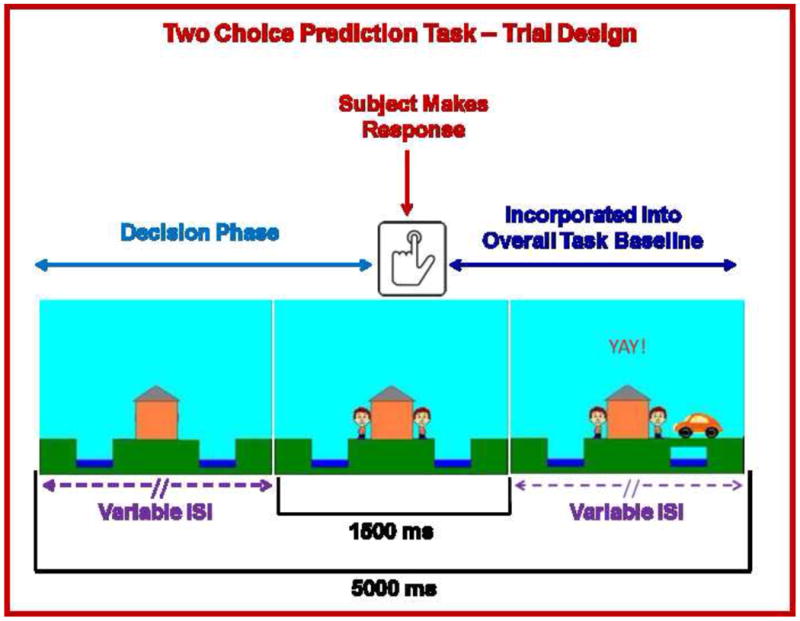
Illustration of two choice prediction task. For each trial, a house was shown in the center with two people: one on the left and one on the right of the house. Subjects pressed a button to predict whether a car would come by on the left or right side to pick up the person. After the subject made a decision, the car was presented on the left or right side of the screen. If the selected response matched the side where the car was presented, the person on the selected side met up with the car. Although each trial lasted 5000 ms and subjects were allowed to respond with a button press during a fixed 1500 ms period at the point when they saw the two people on the screen, the length of the beginning and ends of each trial were designed to have variable inter-stimulus intervals (ISI). Brain activation consisting of time from trial onset to the button press was included in fMRI analysis as a decision regressor of interest, wherein brain activation during the remainder of the trial was incorporated into the overall baseline regressor.
Figure 2
Figure 2
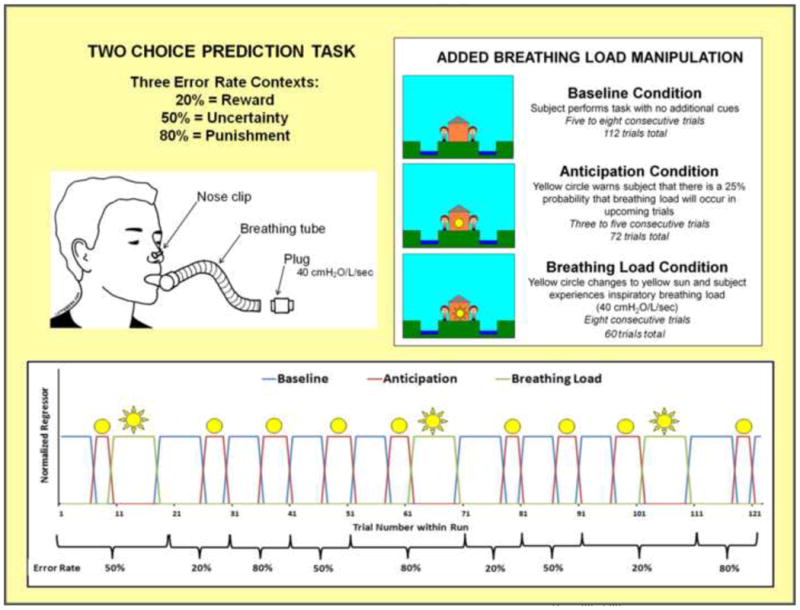
Illustration of two choice prediction task with added breathing load manipulation. Unbeknownst to subjects, the task was divided into three blocks of trials with differing reinforcement schedules: 20%, 50% and 80% error rates. Within the context of each error rate, subjects also experienced three interoception conditions: baseline, anticipation of breathing load, and experience of breathing load.
Figure 3
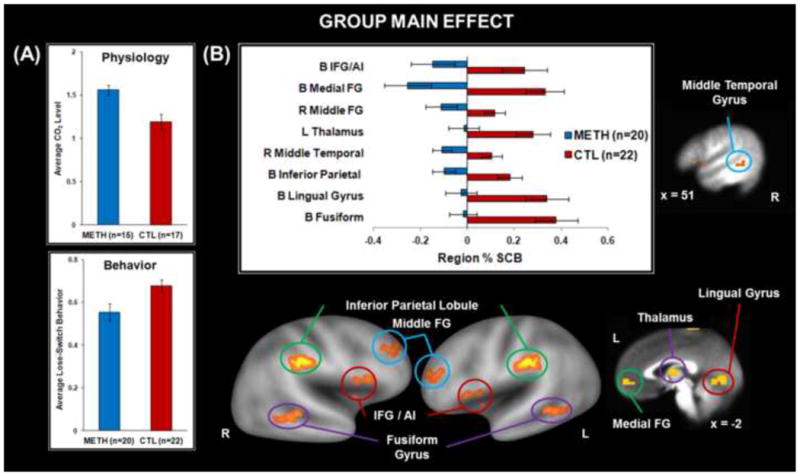
Figure 3. Group Main Effect (A) Physiology and Behavior Results
Methamphetamine use disorder (METH) subjects exhibited lower carbon dioxide (CO2) levels across interoception conditions/error rates and lower lose-switch behavior across error rates than healthy comparison subjects (CTL); (B) Neuroimaging Results. METH exhibited lower percent signal change from baseline (% SCB) than CTL in inferior frontal gyrus (IFG), anterior insula (AI), medial frontal gyrus (FG), middle frontal gyrus, thalamus, middle temporal gyrus, inferior parietal lobule, lingual gyrus, and fusiform gyrus. B = bilateral, L = left, R = right. Error bars indicate ±1 standard error of the mean.
Figure 4
Figure 4. Insula-Anxiety Interaction
Methamphetamine use disorder (METH) subjects endorsed higher State-Trait Anxiety Inventory (STAI) trait anxiety scores than healthy comparison subjects (CTL). Higher trait anxiety scores in METH were linked with higher left (L) inferior frontal gyrus (IFG) and anterior insula (AI) percent signal change from baseline (% SCB), comparable to % SCB of CTL. No relationship between trait anxiety and AI/IFG activation was evident within CTL. Error bars indicate ±1 standard error of the mean.
Figure 5
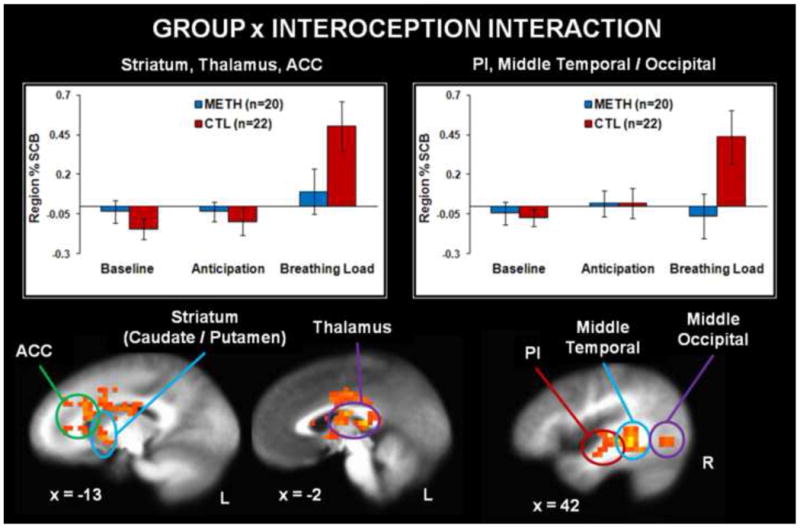
Figure 5. Neuroimaging Results, Group x Interoception Interaction
Methamphetamine use disorder (METH) subjects exhibited lower percent signal change from baseline (% SCB) than healthy comparison subjects (CTL) in posterior insula (PI), middle temporal gyrus, middle occipital gyrus, striatum, thalamus, and anterior cingulate cortex (ACC) in response to the aversive interoceptive stimulus (breathing load). Groups did not differ in % SCB during the baseline condition (consisting of the task alone with no additional cues) or the anticipation condition (cue warning of 25% chance of upcoming breathing load). L = left, R = right. Error bars indicate ±1 standard error of the mean.
Figure 6
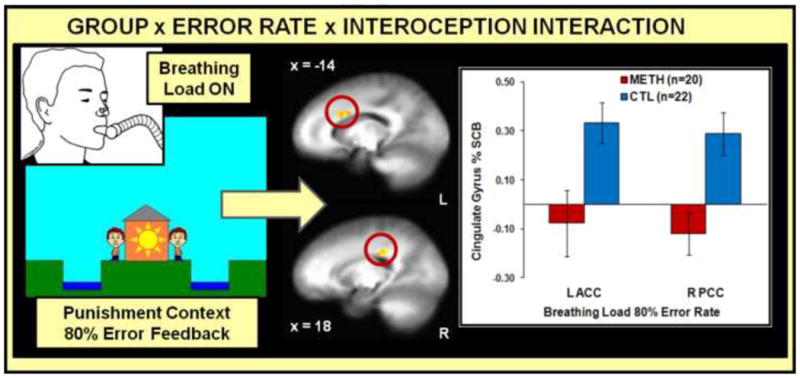
Figure 6. Neuroimaging Results, Group x Error Rate x Interoception Interaction
During the breathing load manipulation, methamphetamine use disorder (METH) subjects exhibited lower left (L) anterior cingulate (ACC) and right (R) posterior cingulate (PCC) percent signal change from baseline (% SCB) while making decisions within the context of punishment (80% error rate) than healthy comparison subjects (CTL). Error bars indicate ±1 standard error of the mean.

References

    1. Bechara A. Decision-making, impulse control and loss of willpower to resist drugs: a neurocognitive perspective. Nat Neurosci. 2005;8:1458–1463. - PubMed
    1. Beck AT, Steer RA, Brown GK. Manual for Beck Depression Inventory-II. Psychological Corporation; San Antonio, TX: 1996.
    1. Blomqvist A, Zhang ET, Craig AD. Cytoarchitectonic and immunohistochemical characterization of a specific pain and temperature relay, the posterior portion of the ventral medial nucleus, in the human thalamus. Brain. 2000;123:601–619. - PubMed
    1. Carver CS, Scheier MF. Assessing coping strategies: a theoretically based approach. J Pers Soc Psychol. 1989;56:267–283. - PubMed
    1. Chan PY, Davenport PW. Respiratory-related evoked potential measures of respiratory sensory gating. J Appl Physiol. 2008;105:1106–1113. - PMC - PubMed

Publication types

MeSH terms

Substances