


Effect of mycophenolate mofetil on progression of interstitial fibrosis and tubular atrophy after kidney transplantation: a retrospective study
- PMID: 24993756
- PMCID: PMC4091392
- DOI: 10.1136/bmjopen-2014-005005
Effect of mycophenolate mofetil on progression of interstitial fibrosis and tubular atrophy after kidney transplantation: a retrospective study
Abstract
Objectives: Chronic transplant dysfunction after kidney transplantation is a major reason of kidney graft loss and is caused by immunological and non-immunological factors. There is evidence that mycophenolate mofetil (MMF) may exert a positive effect on renal damage in addition to immunosuppression, by its direct antifibrotic properties. The aim of our study was to retrospectively investigate the role of MMF doses on progression of chronic allograft dysfunction and fibrosis and tubular atrophy (IF/TA).
Setting: Retrospective, cohort study.
Participants: Patients with kidney transplant in a tertiary care institution. This is a retrospective cohort study that included 79 patients with kidney and kidney-pancreas transplantation. Immunosuppression consisted of anti-interleukin 2 antibody induction, MMF, a calcineurin inhibitor±steroids.
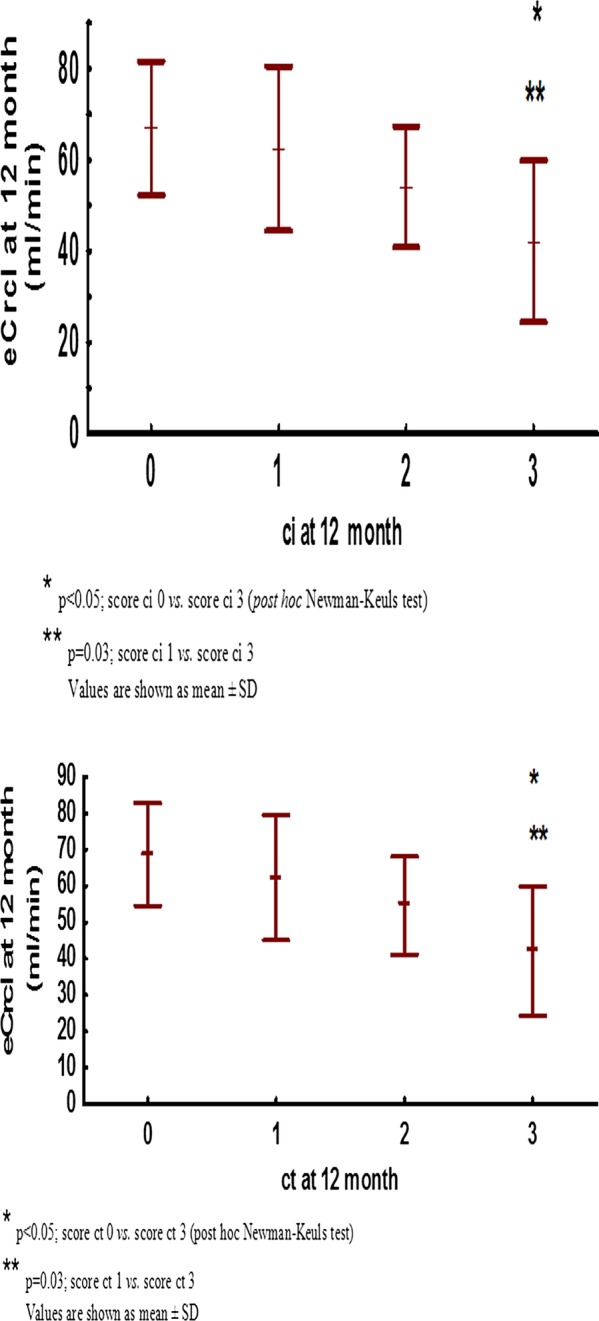
Primary outcome measures: An association of average MMF doses over 1 year post-transplant with progression of interstitial fibrosis (Δci), tubular atrophy (Δct) and estimated-creatinine clearance (eCrcl) at 1 year post-transplant was evaluated using univariate and multivariate analyses.
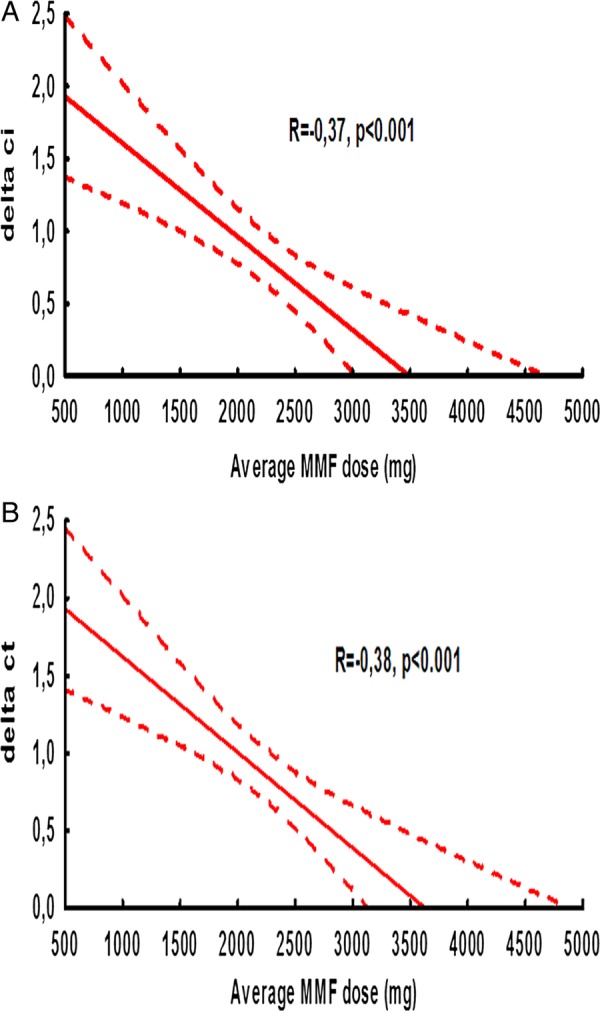
Results: A higher average MMF dose was significantly independently associated with better eCrcl at 1 year post-transplant (b=0.21±0.1, p=0.04). In multiple regression analysis lower Δci (b=-0.2±0.09, p=0.05) and Δct (b=-0.29±0.1, p=0.02) were independently associated with a greater average MMF dose. There was no correlation between average MMF doses and incidence of acute rejection (p=0.68).
Conclusions: A higher average MMF dose over 1 year is associated with better renal function and slower progression of IF/TA, at least partly independent of its immunosuppressive effects.
Keywords: Transplant Medicine.
Published by the BMJ Publishing Group Limited. For permission to use (where not already granted under a licence) please go to http://group.bmj.com/group/rights-licensing/permissions.
Figures
References
-
- Pascual M, Theruvath T, Kawai T, et al. Strategies to improve long-term outcomes after renal transplantation. N Engl J Med 2002;346:580–90 - PubMed
-
- Kuypers DR, Chapman JR, O'Connell PJ, et al. Predictors of renal transplant histology at three months. Transplantation 1999;67:1222–30 - PubMed
-
- Matas AJ, Gillingham KJ, Payne WD, et al. The impact of an acute rejection episode on long-term renal allograft survival (t1/2). Transplantation 1994;57:857–9 - PubMed
-
- Nankivell BJ, Borrows RJ, Fung CL, et al. The natural history of chronic allograft nephropathy. N Engl J Med 2003;349:2326–33 - PubMed
-
- Birnbaum LM, Lipman M, Paraskevas S, et al. Management of chronic allograft nephropathy: a systematic review. Clin J Am Soc Nephrol 2009;4:860–5 - PubMed
Publication types
MeSH terms
Substances
LinkOut - more resources
Full Text Sources
Other Literature Sources
Medical
Miscellaneous
